This article is published in Aerospace Daily & Defense Report part of Aviation Week Intelligence Network (AWIN), and is complimentary through May 22, 2026. For information on becoming an AWIN Member to access more content like this, click here.
NATIONAL HARBOR, Maryland—A multitude of options exist to hit a slow-moving ship: mines, torpedoes, short-range missiles, midrange cruise missiles, etc.
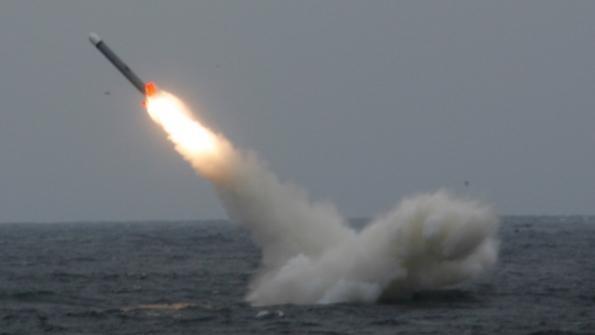
But the options narrow for the U.S. military to only one if the ship needs to be attacked from beyond 1,000 nm away: the Raytheon BGM-109 Block V Maritime Strike Tomahawk (MST), a subsonic, non-stealthy cruise missile launched by destroyers, submarines and the U.S. Army’s new Typhon system.
Except for the Netherlands, which was authorized to import the MST cruise missile last year, foreign militaries don’t have any options.
But that could be changing soon. The U.S. Air Force launched market research for the Family of Affordable Mass Missiles-Beyond Adversary’s Reach (FAMM-BAR) on April 17.
“The potential procurement objective is to produce an inventory for the [U.S.] Government and Foreign Military Sales. The expectation is that the annual production orders will range from 1,000-2,000 units per year for five years (procurement numbers will vary by year),” the Air Force Life Cycle Management Center’s Weapons Capacity Task Force says in the request for information.
The FAMM-BAR program lists five desired attributes for the potential weapon: a range of 1,000 nm or more, a speed of at least 0.7 Mach, palletized delivery from a cargo aircraft, the ability to receive midcourse navigation updates and the manufacturing capacity to produce more than 1,000 missiles a year. The main target set for the weapon is “slow moving maritime” vessels.
The FAMM-BAR nomenclature makes the program a new international and longer-range variant of the FAMM initiative, which is already developing FAMM-Palletized and FAMM-Lugged cruise missiles for the U.S. Air Force for large-scale production. By contrast, FAMM-P and FAMM-L require ranges of 250-500 nm.
The extended range of the FAMM-BAR also distinguishes the weapon from a similar effort by the U.S. Navy. The Coalition Heterogeneous Affordable Offensive Strike (CHAOS) program, launched in February, is seeking a medium-range, low-cost cruise missile to provide to international partners.
The demand from the Air Force and Navy has spawned a new industry. Anduril, CoAspire and Zone 5 Technologies are involved in the FAMM-P and FAMM-L programs. The latter two companies also are producing similar Extended Range Attack Missiles for Ukraine.
CoAspire unveiled a new version of its FAMM contender—the Rapidly Adaptable Affordable Cruise Missile (RAACM)—at the Navy League’s Sea Air Space conference here on April 20. The RAACM-ER is advertised with range greater than 1,000 nm.
Other options are also in development. Last year, Global Technical Systems, a Virginia-based company, unveiled a project to build a 1,200-nm cruise missile with an “anti-maritime warhead."