This article is published in Aerospace Daily & Defense Report part of Aviation Week Intelligence Network (AWIN), and is complimentary through Jul 18, 2026. For information on becoming an AWIN Member to access more content like this, click here.

Debrief: How Ukraine’s Battlefield Shifts Destinus’ Business Plan

plane flying over water and ice
Credit: Destinus

That the war in Ukraine upended the European defense industry’s long-term ambitions is now unquestioned, as countries in the region flood money into military modernization. 

Few illustrate how constant that change is better than a once little-known startup that had hypersonic passenger plane ambitions and now wants to become a European missile powerhouse.

Destinus, which has already supplied basic drones and missile systems to Kyiv, is not just introducing more sophisticated versions. It says it is preparing the next step in its push to become a full-fledged rival to the likes of MBDA by designing rockets not just for the battle in Ukraine today, but for conflict tomorrow.

The shift is echoed by others in Europe, where companies such as startup Donaustahl in Germany have adapted their business strategies because of the war, while established firms like armor-maker Rheinmetall are now pursuing opportunities in space and missiles—including with Destinus—and MTU is going after the uncrewed aircraft engine market through an acquisition.

The company aims to have the first of a new rocket artillery line of products in flight trials next year, said Destinus CEO and founder Mikhail Kokorich. “We're defining the characteristics of the first product,” he said, adding that the company has turned to Ukraine and its battlefield experience.

The planned system’s rocket range exemplifies how Ukraine is shaping the pursuit. Rather than start with a relatively short-range system and expand from there, Kokorich said Ukraine is driving a need for greater range from the get-go. The front lines between Ukrainian and Russian forces have evolved into a 50-60-km (31-37-mi.) no-go zone, so having rockets with that kind of range would be somewhat pointless, he said.

“What we see is that the minimum range of rocket artillery that makes sense now is 150 km,” he said, noting that anything less would effectively be designing a system for the last war, not the next one. One of the mistakes people in the West are making is embracing lessons too late. The current fascination with quadcopter drones, for instance, is coming just as the reality of the battlefield means their use is past its peak, Kokorich argued.

The partnership with Rheinmetall will give a much higher production scale. Eventually, the company plans to evolve into also fielding tactical ballistic missiles.

The rocket systems would augment the cruise missiles Destinus is working on that now are at the heart of its strike systems portfolio.

Kokorich, a one-time physics student and recreational pilot, left Russia in 2012 after founding a space company there and moved to the U.S. where he continued his space-related activities, including co-founding Helios Wire, later sold to EchoStar. Kokorich left the U.S., he said, after running into regulatory issues that he settled over allegations he did not properly disclose Russian ties and headed for Europe with an eye on working on hypersonic planes.

At the time, defense in Europe was still somewhat of a taboo topic, so his hypersonic work was billed as targeting the commercial market. Work on that project meant that when Russia launched its full-scale invasion of Ukraine, Destinus had built up some experience in the fields of guidance, navigation and propulsion as well. Once the war broke out, Kyiv approached the company for help in building long-range strike drones that now can reach more than 1,000 km.

Three years ago, Kyiv asked Destinus to work on cruise missiles. Given the challenges of buying components—such as turbojets, solid rocket motors and warheads—the company decided to make those itself. That started the shift to missiles with a goal now of producing about 200 per month.

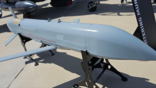
The Rula Blk. 1 was relatively simple, with fixed wings. Kokorich said that they have been a key part of Ukraine’s deep-strike campaign in recent months to target Russian logistics and energy facilities. It is now developing the longer-range Rula Blk. 2, which is longer and features foldable wings for launch out of a 40-ft. container. It has a more than 700-km range and a greater than 200-lb. payload.

It is also working on the smaller, 800-km-range Kryla with a 50-kg (110-lb.) payload for saturation attacks, designed for container launch or from the back of cargo planes using a palletized launcher system. The system is due to fly before year-end, Kokorich said.

As part of its air defense efforts, the company is now working on the Hornet Blk. 2 drone interceptor to follow the Blk. 1—which, as with the initial Rula version, again has no folding wings. The Blk. 2 will be rocket launched until an electrical engine takes over. It will also have a higher cruise speed and a Ku-band radar to enable head-on intercept. The Hornet could also be used for strike missions, for instance to take on ships, Kokorich said.

Missile interceptors are also on the agenda, he said, noting that it is premature to discuss details.

Robert Wall

Robert Wall is Executive Editor for Defense and Space. Based in London, he directs a team of military and space journalists across the U.S., Europe and Asia-Pacific.