This article is published in Aerospace Daily & Defense Report part of Aviation Week Intelligence Network (AWIN), and is complimentary through Sep 13, 2026. For information on becoming an AWIN Member to access more content like this, click here.
HUNTSVILLE, Alabama—A competition is underway to develop the U.S. Army’s next long-range, surface-to-surface missile for the Lockheed Martin High Mobility Artillery Rocket System (HIMARS).
U.S. Army officials are evaluating competing industry bids to develop an Affordable High Speed Strike (AHSS) missile.
The Army quietly released a request for white papers to industry in May to submit proposals for AHSS.
“AHSS is an entirely new missile,” a spokesperson for the Army’s Combat Capabilities Development Command (DEVCOM) tells Aviation Week.
The Army wants the AHSS missile to offer more range than the 1,000-km-plus (621.3-mi.) reach of the Precision Strike Missile Increment 4, of which the contract was stripped from Lockheed and reopened to competitive bidding earlier this year.
Army officials in late 2024 revealed plans to develop a PRSM Increment 5 with greater range and the ability to launch from an autonomous vehicle. But the DEVCOM spokesperson clarified that AHSS represents a different concept, including a requirement to be launched from a crewed HIMARS.
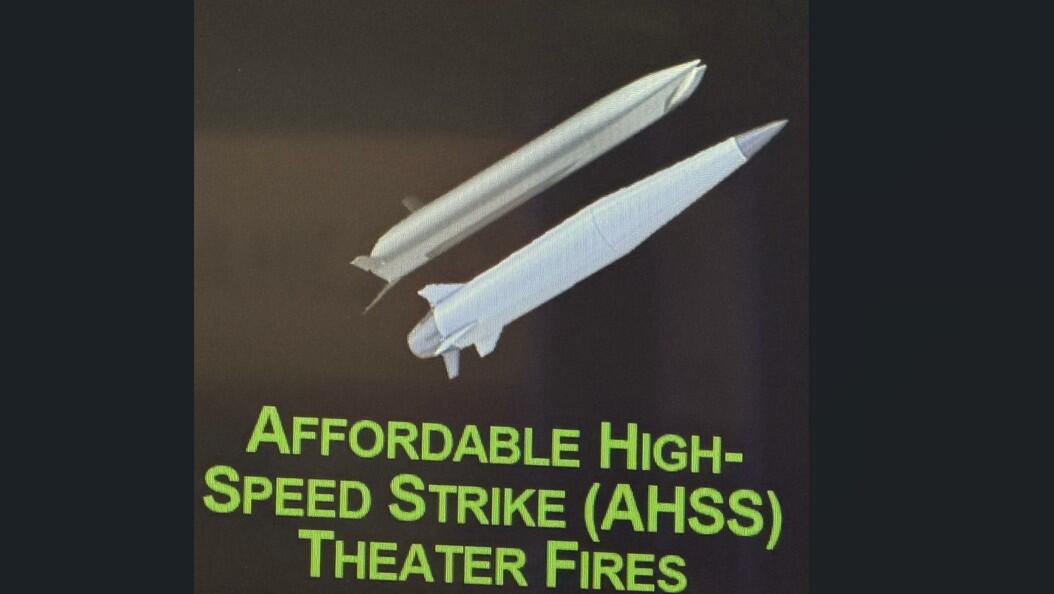
DEVCOM’s booth at the Space and Missile Defense Symposium here includes a graphic of two potential AHSS concepts. One shows a conventional rocket-propelled, ballistic missile. The other shows a missile with an air-breathing propulsion system.
The latter concept was referenced in written questions by the Senate Armed Services Committee in June 2025 to Brent Ingraham, who was then the nominee to be assistant secretary of the Army for acquisition, technology and logistics. The question from the committee asked, referencing the RTX/Northrop Grumman Hypersonic Attack Cruise Missile (HACM): “Do you believe the Army should assess possible alternative, cheaper capabilities, such as the air-breathing scramjet missile being developed by the Air Force?”
Ingraham replied that the Army’s AHSS program is working on delivering such capabilities, with participation by the Australian military. Australia is a development partner with the Air Force on the HACM program.
But that does not mean a ground-launched HACM or scramjet-powered cruise missile is the requirement for AHSS. Instead, the Army is not specifying a propulsion solution for AHSS, and allowing companies to submit their own ideas.
The Army has budgeted $246 million for AHSS in the Future Years Defense Program from fiscal 2027-2031. The budget description includes several roles for the AHSS missile, including a counter-air capability.
“The Army needs affordable, responsive high-speed strike capability to attack theater-level targets, provide offensive counter-air capability, and be launched from Army mobile, deployable, and survivable platforms,” the April 2026 budget document says.