This article is published in Aerospace Daily & Defense Report part of Aviation Week Intelligence Network (AWIN), and is complimentary through Oct 20, 2026. For information on becoming an AWIN Member to access more content like this, click here.
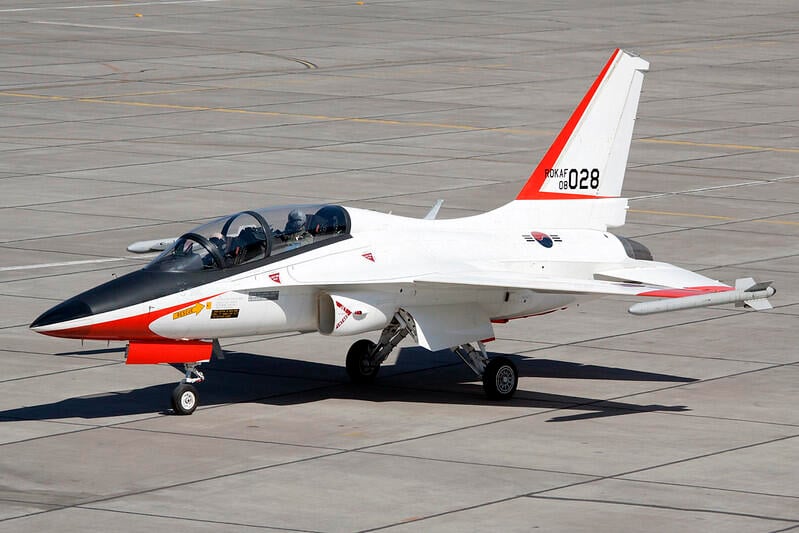
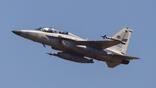
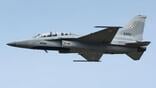
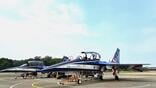
Korea Aerospace Industries (KAI) and Moroccan MRO providers, Maintenance Aero Maroc and Sabca Maroc, have teamed on a potential offer to provide KAI’s FA/T-50 family of advanced jet trainers and light combat aircraft to the North African country.
In an agreement signed at the Marrakech Airshow—held Oct. 7-10—the three companies signed a memorandum of understanding to jointly explore opportunities for business and industrial cooperation in Morocco.
The agreement focuses on a T-50 market opportunity with the Royal Moroccan Air Force (RMAF), the companies said, “paving the way for further discussions and potential collaboration in support of Morocco’s aerospace and defense ambitions.”
The RMAF is understood to be seeking a replacement for its Northrop F-5 Tigers light combat aircraft and its Dassault/Dornier Alpha Jet advanced jet trainers. It is possible that the RMAF would want a mixed fleet of F/A-50s and T-50 trainers to replace both types.
Ahead of the show, KAI said it would focus its presence on the FA-50 “promoting its high operational efficiency, which enables it to simultaneously perform advanced training and light combat missions.”
The deal emerges amid a defense spending spree by Rabat, which has seen the country’s air force receive new Boeing AH-64 Apache attack helicopters and Airbus C295 tactical airlifters, the latter from an order that was never formally announced by the airframer.
Morocco is in an arms race against neighboring Algeria. The two countries have long disputed Morocco’s control of Western Sahara, a strip of land along West Africa’s Atlantic coast, which is largely annexed by Morocco, but Algeria supports the territory’s pro-independence Polisario Front.
The C295 acquisition means Morocco is the first country to operate Europe’s two small tactical airlifters, the C295 and Leonardo C-27J together.
During the show, Lockheed Martin also announced it had completed the maiden flight of the first of Morocco’s new Block 70 model F-16s from its Greenville, South Carolina, production line.
Morocco is buying 25 Block 70 F-16s to join its existing fleet of 23 Block 52-model aircraft, Aviation Week’s Fleet Discovery Database states.
Rabat has also been linked with a potential acquisition of Embraer’s C-390 airlifter and a possible buy of second-hand McDonnell Douglas KC-10 Extenders.
This year’s edition of the show also included the first-ever official participation of Israeli companies at the show, with a presence from Elbit, Israel Aerospace Industries and Rafael following the normalization of diplomatic relations between Israel and Morocco through the Abraham Accords in 2020.
Meanwhile, Emirati defense group Edge also signed agreements with Morocco’s National Defense Administration—the country’s defense materiel agency—to explore the production of aeronautical engines in Morocco.
Edge says it is proposing bringing production of its Powertech engines to the North African country to power uncrewed air systems to “build an industrial backbone that meets the Kingdom’s defense requirements.”
Also developing a presence in-country is French defense technology company Harmattan AI that announced during the event it was developing a deep-strike one-way attack drone called Irifi capable of reaching targets some 2,000 km away.
The company announced in June it was establishing a presence in Morocco with the setting up of a research and development center focused on the development of air defense capability. It says the propeller-driven Irifi does not rely on satellite navigation and uses a visual terminal guidance system to perform its mission autonomously. It claims that swarms of Irifi drones can be commanded to perform strikes by a single human commander, who is informed by an artificial intelligence algorithm that can process significant amounts of satellite imagery to find targets.

Related Content