
This article is published in Aerospace Daily & Defense Report part of Aviation Week Intelligence Network (AWIN), and is complimentary through Oct 08, 2026. For information on becoming an AWIN Member to access more content like this, click here.
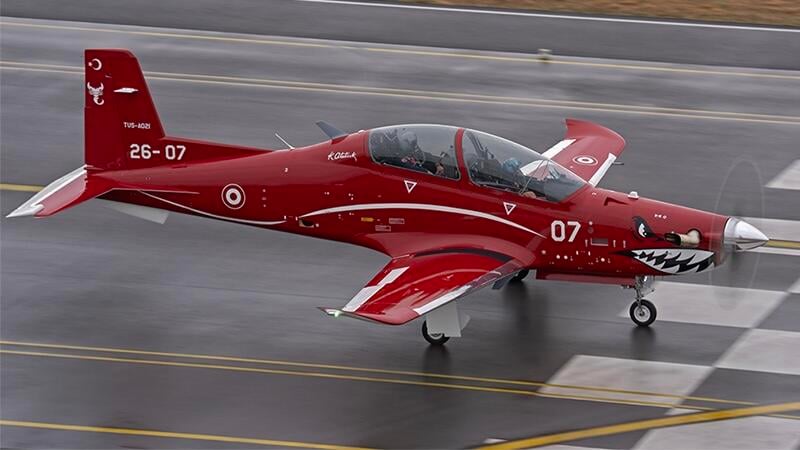
The Turkish Aerospace Industries (TAI) Hurkus-II turboprop trainer has been inducted into Turkish Air Force operations, becoming the first indigenously designed aircraft to join the service.
The first of a planned fleet of 55 aircraft was formally inducted into service in a ceremony at TAI’s facilities in Ankara on Sept. 28. Twelve aircraft will be delivered this year and will continue at a rate of two per month until completion in 2028.
The Turkish Air Force plans to use the Pratt & Whitney Canada PT6-powered aircraft at its flight training school in Izmir, replacing the Korea Aerospace Industries KT-1. The deliveries are part of a broader effort to make use of domestically developed aircraft for the Turkish Air Force training system, with pilots progressing from the Hurkus-II to the new Hurjet advanced jet trainer in the coming years, when the latter finally replaces the Northrop T-38 Talon.
The Turkish Air Force had ordered 15 examples of the first Hurkus model but did not take delivery, so TAI adapted the aircraft and later exported them, including to Chad and Niger.
TAI was contracted in May 2021 to adapt and modify the Hurkus design to meet Turkish Air Force demands for better performance.
In response, TAI reduced the aircraft’s empty weight by around 500 kg (1,100 lb.) and enhanced its aerodynamics, making notable changes to the vertical stabilizer and rear fuselage. The first flight of the Hurkus-II in its new configuration was performed in December 2024.
Delivery comes just weeks after the Hurkus-II received its military type certificate.
The aircraft has been designed to support both basic and initial advanced pilot training on a single platform.
TAI said the Hurkus will allow pilots to familiarize themselves with modern avionics and mission systems early in their training, “helping to reduce the training burden and transition costs associated with the jet training phase.”
Haluk Görgün, president of Turkey’s defense industry agency SSB, said the Hurkus-II featured a localization rate of 80% and claimed the aircraft was a “best-in-class” turboprop trainer.
Görgün said he was confident that it would also secure export orders from “friendly and allied countries.”
Azerbaijan is expected to announce an order for an unknown number of the aircraft at the upcoming Azerbaijan International Defense Exhibition in Baku later this week.

Related Content


