This article is published in Aerospace Daily & Defense Report part of Aviation Week Intelligence Network (AWIN), and is complimentary through Mar 18, 2026. For information on becoming an AWIN Member to access more content like this, click here.
OA-1K
FORT WALTON BEACH, Florida—Despite concerns about the survivability of the low-flying slow aircraft throughout the U.S. Air Force’s special operations fleet, and the increasing use of space-based surveillance systems, there will remain a long-term need to keep the aircraft flying, a top official argues.
Air Force Special Operations Command (AFSOC) is in the middle of an overhaul of its fleet, looking to bring on the L3Harris OA-1K for light attack and surveillance, while also looking at the phasing out of its U-28 Draco surveillance aircraft and full retirement of the MC-12 Liberty and Javaman aircraft. Brig. Gen. Craig Prather, the director of strategic plans, programs and requirements, argues that although the threat against this type of aircraft is increasing, their use will always be required.
“A physical world continues to demonstrate the need for the full spectrum of airborne ISR [intelligence, surveillance and reconnaissance] capabilities, particularly when necessary to inform, then enable, actions on the objectives,” Prather said Feb. 11 at the Special Air Warfare Symposium here. “Whether manned or remotely piloted, [beyond line of sight] or directly overhead objectives, the joint force relies on what is difficult to replace: real-time, full-motion video electro-optical feeds paired with other various intelligence capabilities to ensure awareness, certainty and enable action.”
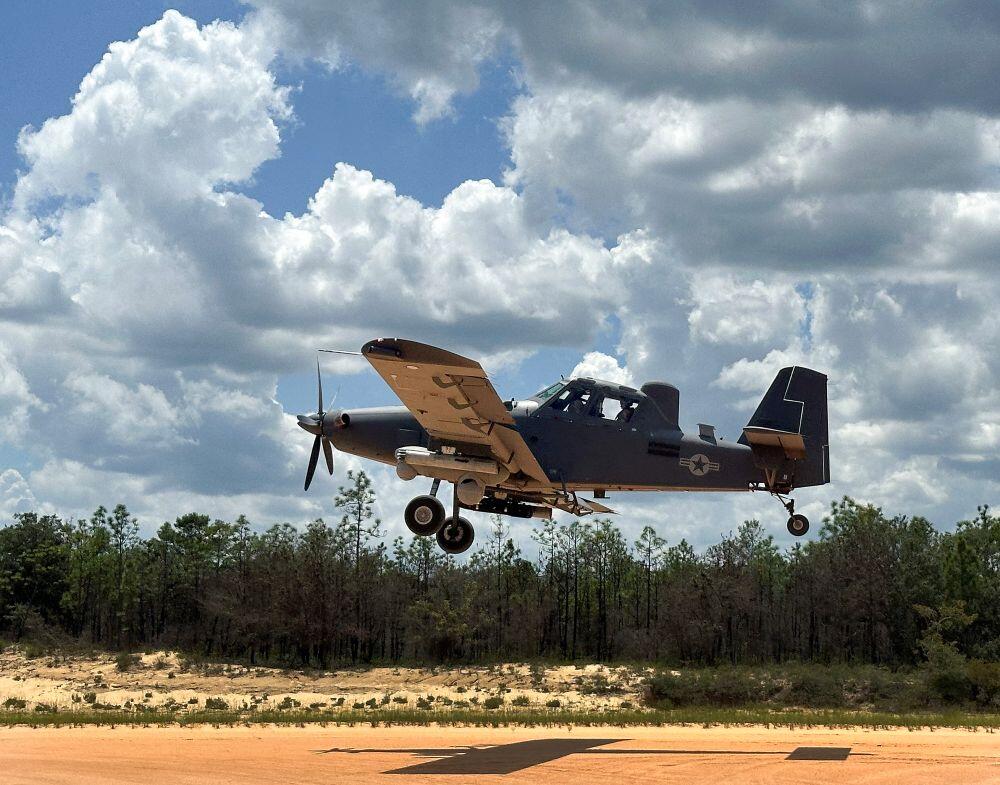
The OA-1K Skyraider II, a heavily modified Air Tractor crop duster outfitted with sensors and hardpoints for multiple munitions, is AFSOC’s primary modernization effort. The aircraft, which does not have a bailout option for the pilots, has been the focus of survivability concerns, prompting a reduction in the overall targeted fleet size. AFSOC currently plans to field 62 of the aircraft, down from the expected 75, and critics including the Government Accountability Office (GAO) have questioned the need for the aircraft altogether.
AFSOC also flies uncrewed MQ-9 Reapers for surveillance and light attack, and is looking at broadening the use of the UAV by integrating launched effects under a program called the Airborne Adaptive Enterprise (A2E).
“To infill a force or execute a strike, SOF [special operations forces] airborne ISR, the mix of remotely piloted and manned assets will continue to play a pivotal role in supporting our nation’s priority theaters, providing awareness and enabling action,” he says.
For strike, AFSOC is looking at broadening the use of its current fleet in small ways as opposed to a large acquisition effort. This includes changing the tactics of its AC-130J Ghostrider II gunship away from fixating on a single target, usually through its guns, to focusing on multiple targets through different weapons. With A2E, AFSOC is bringing on launched effects, though the use of those systems is not limited to MQ-9s and can be brought on to other existing aircraft. These air-launched uncrewed systems will increase the survivability of carrier aircraft, provide more situational awareness or strikes, he says.
“The integration of SOF aviation strike platforms or even SOF maneuver platforms with standoff capabilities from air-launched effects to cost-effective, long-range fires provides another area where we are modernizing our SOF air fleet to mitigate distance, threats and time,” he says.