This article is published in Aerospace Daily & Defense Report part of Aviation Week Intelligence Network (AWIN), and is complimentary through Mar 14, 2026. For information on becoming an AWIN Member to access more content like this, click here.
SECAF Unveils ‘Ringleader’ Effort To Track Targets At Speed And Scale
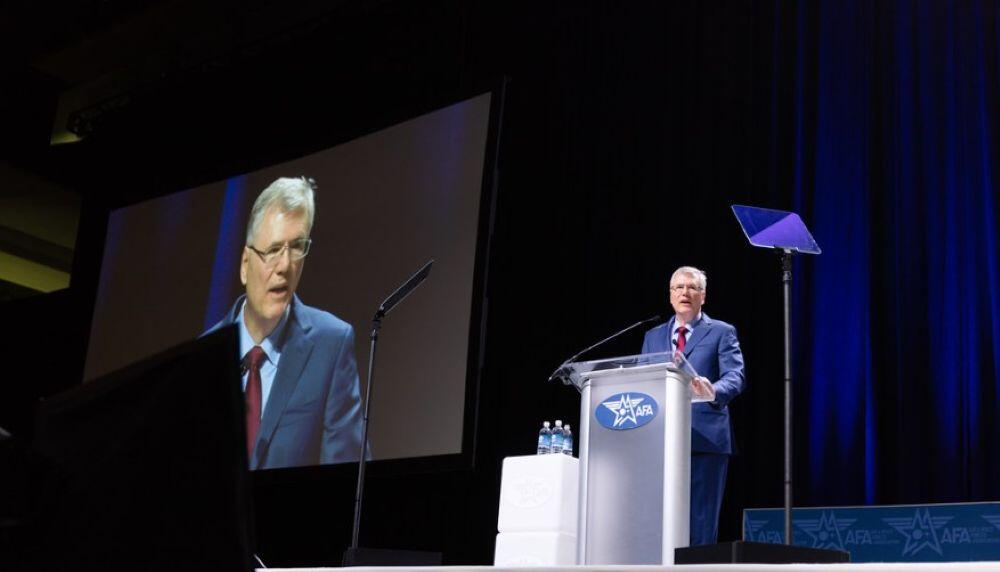
Air Force Secretary Troy Meink delivers a keynote address Feb. 23 at the Air and Space Forces Association’s Air Warfare Symposium in Aurora, Colorado.
AURORA, Colorado—The Department of the Air Force wants to test its ability to fuse sensor data from across the Defense Department via a series of exercises it is calling “Ringleader,” Air Force Secretary Troy Meink announced Feb. 23.
In recent years, the department has built out the necessary software, hardware and network infrastructure for battle management. “Now, it’s time to test it,” Meink said in his keynote speech at the Air and Space Forces Association’s Air Warfare Symposium here. The Ringleader exercises will harness live data pulled from U.S. military proliferated satellite constellations along with other sensors “to track targets at speed and scale,” and the department is inviting its sister services and industry partners to participate, he said.
The experiments will help the U.S. Air Force and Space Force hone its battle management processes as it collects a much broader range of targeting data than ever before, including from proliferated constellations in development by the U.S. Space Force and the intelligence community.
The department is fielding multiple sensors to provide ground moving target indication (GMTI) and air moving target indication (AMTI), and now must figure out how to disseminate the data and get it to the warfighter for timely decision-making, Meink said in a Feb. 24 media roundtable at the symposium. While that activity was already underway, the department is now looking at a “larger framework” through these new exercises, he said.
Ringleader is envisioned as a collaborative effort between the two services that sit under the Department of the Air Force to work through “reps and sets” in a modeling and simulation environment that can then inform acquisition and operational concepts, Chief of Space Operations Gen. Chance Saltzman told reporters at the symposium.
“We haven’t collected this kind of data from a global perspective, with this level of volume of data, and turned it into rapid battle management decisions,” he said Feb. 24. “The Secretary’s concept is basically, ‘Hey, let’s practice.’”
Meink wants the department to embrace automated satellite operations to take full advantage of large on-orbit constellations, he said in his keynote speech. ”The old manual ways are not going to cut it,” he said. “We need to automate virtually all aspects of operating and orchestrating satellite constellations.”
Congress provided $2 billion to the Space Force to field AMTI satellites under its 2025 budget reconciliation bill, with some demonstrations and prototypes of data collection payloads underway. The feedback from those efforts has been “highly encouraging,” Saltzman said, praising the fidelity of the on-orbit sensors. The service is also looking to leverage the work it has already completed for space-based GMTI to inform a future AMTI constellation.
“I’m very hopeful, because the money’s coming through, that we’ll be able to progress quickly through, because of what we learned with the GMTI piece of it,” he said.