This article is published in Aerospace Daily & Defense Report part of Aviation Week Intelligence Network (AWIN), and is complimentary through Mar 20, 2026. For information on becoming an AWIN Member to access more content like this, click here.
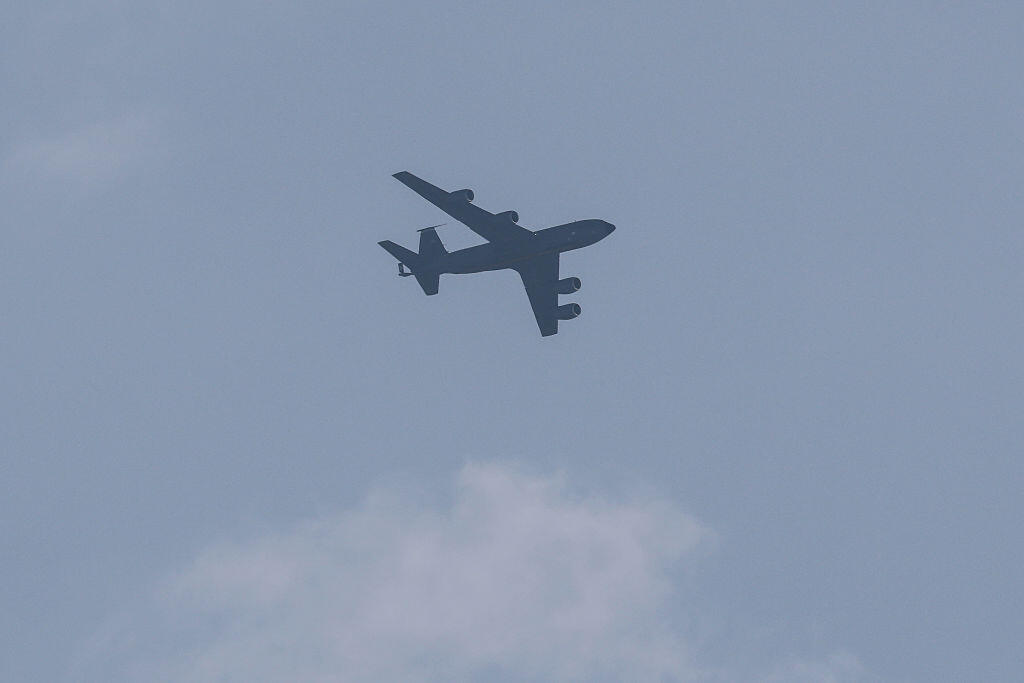
All six crewmembers onboard a U.S. Air Force KC-135 died when their aircraft crashed in western Iraq on March 12 after an incident involving another Stratotanker, U.S. Central Command (Centcom) said in a statement.
The tanker was on a combat mission as part of Operation Epic Fury, supporting the ongoing campaign of American and Israeli airstrikes in Iran, said Gen. Dan Caine, chairman of the Joint Chiefs of Staff, in a briefing on March 13.
It is not yet clear what caused the accident, but another KC-135 landed at Tel Aviv’s Ben Gurion Airport and images are circulating on social media showing a large part of its tail sheered off.
The accident marks the first U.S. loss of life in an aircraft during flight operations since the war began. It also represents the fourth American aircraft lost as part of the ongoing operation, after a Kuwaiti Air Force F/A-18 shot down three U.S. Air Force F-15Es in the early stages of the conflict.
The two aircraft were part of a fleet of dozens deployed to Israel for the ongoing war. Tankers have maintained an extremely high pace of operations in day and night supporting a campaign of airstrikes that has totaled more than 6,000 targets struck inside Iran.
Despite the mishap, tankers have continued to operate in the region to support what Caine and Defense Secretary Pete Hegseth said would be a continued increase in the pace of operations. Aircraft strike packages were launching every hour, Caine said.
“Today will be our heaviest day of kinetic fires across the operating area,” Caine said during the briefing. “Centcom continues to attack ballistic missile and drone capabilities so that they are no longer a threat to U.S. forces, our bases or our partners.”
March 13’s operations would represent a 20% rise in strikes compared to the previous day’s peak, Hegseth said. For the day’s operations, 1% of munitions used would be expensive standoff munitions, with the rest being far less expensive over-the-top bombs such as Joint Direct Attack Munitions (JDAM), Hegseth said.
The American campaign continues to target Iranian ships, particularly those that enable the Islamic Revolutionary Guard Corps to lay mines in the Strait of Hormuz. The strikes targeting ships have utilized U.S. Army MGM-140 Army Tactical Missile System (ATACMS) and Precision Strike Missiles (PrSM), Caine said.
Despite ongoing strikes, Iran has continued to block shipping in the strait as reports of mine laying continue.
“They are the belligerents here, holding the straits closed,” Caine said. “Although there is some traffic moving through there. We’ve made it a priority to target Iran’s mine-laying enterprise—their mine layers, the naval bases and depots, in addition to the missiles that could influence the straits.”
The Israel Defense Forces (IDF) said that in total, since the start of what it has called Operation Roaring Lion, it has conducted around 7,600 strikes against Iran, with roughly 4,700 aimed at the country’s missile program and 2,000 regime targets. The Israeli Air Force has flown 4,700 operational sorties, with more than 380 in Iranian airspace. On March 13 alone, Israeli Air Force fighters attacked more than 150 military sites in Iran, the IDF said, including missile and drone launch capabilities.
In addition, the IDF says it has struck 1,100 targets it links to Hezbollah in Lebanon, among them more than 200 associated with missiles and their launchers.
Iran was still able to fire missiles and drones against neighbors, though. NATO again downed a missile bound for Turkey, the Turkish Defense Ministry said March 13. The United Arab Emirates, the same day, said it engaged seven ballistic missiles and 287 drones fired in its direction. Bahrain and Saudi Arabia also reported attacks aimed at them.