This article is published in Aviation Week & Space Technology and is free to read until May 02, 2026. If you want to read more articles from this publication, please click the link to subscribe.
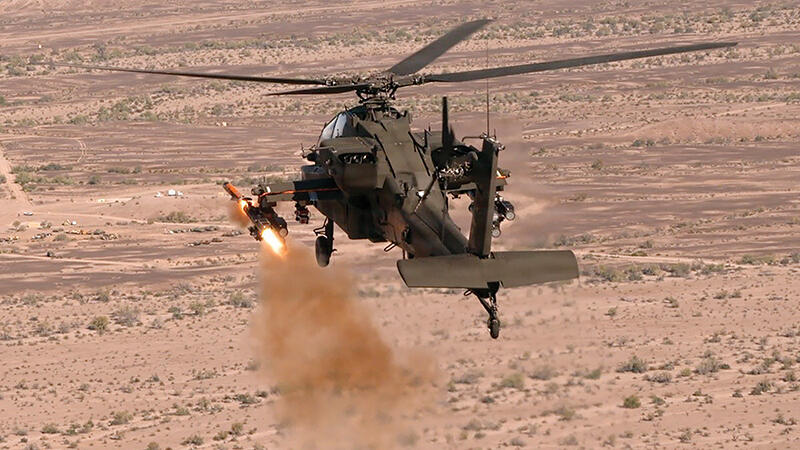
U.S. Army helicopters are planned to field initial launched effects by the end of the summer.
The Pentagon is using a series of competitions, acquisition programs and drone-on-drone scrimmages to support an American industry it wants to see expand, and it is focused on the U.S. Army’s ability to field large numbers of small uncrewed systems for reconnaissance quickly.
The effort comes as the Defense Department and other U.S. government agencies have increased the requirement to eliminate from American government stocks drones and their components made in other countries.
- The Defense Department seeks an “American DJI”
- Launched effects are slated to be fielded in months
“We’re not just creating the market or establishing a market for defense suppliers; we’re creating the market for all commercial vendors,” said James Mismash, deputy assistant secretary of defense for industrial base growth and director of Pentagon small business programs, at Aviation Week’s Defense Conference in Washington on March 18. “We want to establish the next-generation American DJI.”
The Pentagon hosted the first Drone Dominance Gauntlet at Fort Benning, Georgia, in February as part of the broader effort to spend $1.1 billion to field more than 300,000 drones over 18 months. Twenty-five companies competed in a series of scenarios—long-distance strike, urban strike and kinetic strike—flown by military personnel. In the end, 11 companies were named as leaders, setting them up for orders for 30,000 drones as part of the first phase’s $150 million in prototype funding. These companies were, in order of best performance: Skycutter, Neros Technologies, Napatree Technology, ModalAI, Auterion, Ukrainian Defense Drones, Griffon Aerospace, Nokturnal AI, Halo Aeronautics, Ascent AeroSystems and Farage Precision. A second gauntlet is set for August intended to make hundreds of thousands of one-way attack drones ready by 2027.
Mismash says the gauntlets will be ongoing competitions—the 14 companies cut in the first round can incorporate feedback and compete for the next round. Restrictions on foreign-made components will tighten in each round.
For end-user soldiers, ordering the drones should be as easy as using an e-commerce site. The service on March 24 formally unveiled its Unmanned Aircraft Systems Marketplace—built in collaboration with Amazon Web Services—that replaces the Defense Innovation Unit’s Blue List of approved uncrewed aircraft systems (UAS).
The portal featured more than 90 UAS systems by early March, as well as soldiers’ reviews of the drones, says Brent Ingraham, the Army’s assistant secretary for acquisition, logistics and technology. The site was announced by the Army-led Joint Interagency Task Force 401 in February and was used first internally by specific Army units. The Pentagon announced multiple major orders using the site in late March.
The Army placed a $52 million order from Skydio on March 22 for more than 2,500 small quadcopter X10Ds. The order went from bid to award in less than 72 hr. and marked the service’s largest small UAS procurement from a single manufacturer.
The Army announced two contracts with AeroVironment on March 20 for UAS that are slated to be fielded within months. One is a $117 million order for the larger Group 2 P550 Long-Range Reconnaissance system to perform reconnaissance and target acquisition for battalion commanders. The other is a $17 million order for a new one-way attack drone called the Red Dragon.
As part of the increased use of UAS for scout roles, the Army is accelerating fielding of one-way attack drones and loitering reconnaissance systems, also known as launched effects, on its crewed aircraft. The service announced on March 26 that an Army Boeing AH-64E Apache had launched an Anduril Altius A700 UAS in an experiment to further integrate launched effects on aviation platforms. A Sikorsky UH-60 Black Hawk launched the Altius in December 2023 test.
Days before the Apache trial announcement, the Army said it had selected three companies to provide initial long-range launched effects systems this year. AEVEX, Griffon and Dragoon Technology are contracted to deliver the Launched Effect—Long Range part of the overall launched effect family. AEVEX’s Atlas Precision Strike System is a candidate for Launched Effects—Short Range. The Army released a solicitation in January for the Launched Effects—Medium Range capability, also known as the Long-Range Precision Munition, to target integrated air defense systems within more than 100 km (62 mi.).
The Army plans to field its first launched effects in July and to equip every division with ground- and air-launched systems by year-end, four years ahead of a previous plan. The initial role will be scouting and serving as decoys, but the service intends to add reconnaissance and electronic warfare roles, a March Government Accountability Office report states.

Related Content