This article is published in Aviation Week & Space Technology and is free to read until Nov 08, 2026. If you want to read more articles from this publication, please click the link to subscribe.
Chile Charts Broad Airpower Modernization
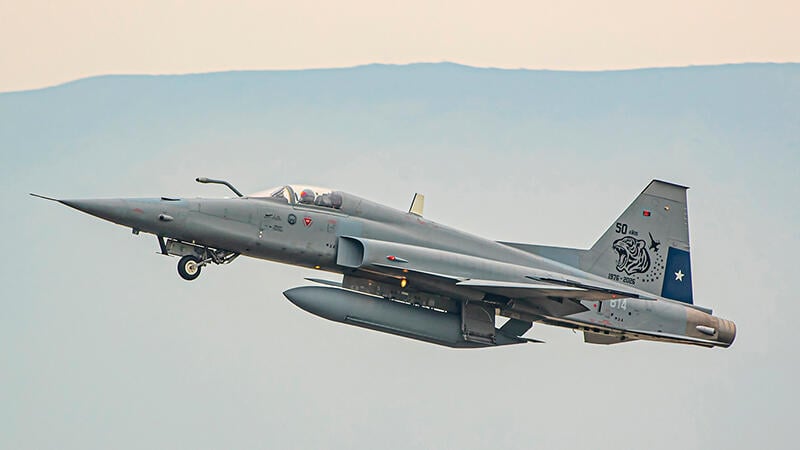
Since Chile’s F-5 Tigers marked 50 years of operational use this year, a replacement is arguably overdue.
Chile’s government is moving to renew crucial air capabilities as it seeks to strengthen its military presence in the country’s far south amid renewed tensions with neighboring Argentina.
Defense Minister Fernando Barros used an air base near the Strait of Magellan at the southernmost tip of South America in late September to announce that the country was preparing to replace its long-serving Northrop F-5 Tigers, renew its strategic airlift fleet and acquire new utility helicopters to replace its aging Bell UH-1 Iroquois rotorcraft.
- Chile is renewing rotorcraft and transport aircraft fleet
- Ex-Canadian CP-140 could bolster Chilean maritime patrol
The location of Barros’ announcement was as much a part of the political message as his words. The region has become politically sensitive since Argentina began questioning Chilean sovereignty in the Strait of Magellan, an increasingly important global trade corridor. Chile has been stepping up its military operations in the region, deploying Lockheed Martin F-16s, its Boeing E-3D Sentry airborne early warning aircraft—acquired from the UK—and KC-135 tankers to reinforce its presence and sovereignty there.
Chile has long had one of the most capable air forces in the region, but its military edge has eroded due to underinvestment.
Argentina, meanwhile, is rebuilding its combat aircraft fleet with secondhand F-16s acquired from Denmark, and to Chile’s north, Peru is moving toward an acquisition of F-16 Block 70s.
Barros said it is necessary to begin making decisions about military capabilities Chile might need in 10, 15 or 20 years. The acquisitions would focus on increasing Chile’s presence in the southern region and enhancing the country’s ability to project toward Antarctica, he said.
A priority for Barros’ renewal plans is finding a replacement for the Chilean Air Force’s F-5 Tigers, which marked 50 years of service this year. As Chile’s second fighter type alongside the F-16, the F-5 has generally been committed to the defense of southern Chile, operating from Punta Arenas. The platform is now aging, however, and is increasingly outclassed.
Recent Chilean media attention has focused on a potential acquisition of the Lockheed Martin F-35, particularly following the type’s presence and demonstration at the FIDAE Airshow in Santiago last April. The F-35’s high operating costs make it one of the less likely candidates, although it has not been ruled out, said Milton Zablah, the Chilean Air Force’s director of planning and institutional doctrine, in a televised interview.
Santiago is considering the F-16 Block 70, too, which would offer the advantage of familiarity, as the Chilean Air Force already operates a mix of Block 50 and Block 15 Mid-Life Update aircraft acquired from Europe.
Other candidates are Saab’s Gripen E/F, which could benefit from Brazil’s status as both an operator and manufacturer of the aircraft. The Korea Aerospace Industries (KAI) FA-50 is in the running, too. Although KAI would be a new supplier to the Chilean Air Force, the fighter’s similarities to the F-16 could increase its attractiveness. Boeing’s F-15EX, the Eurofighter Typhoon and KAI’s KF-21 could also be examined but would be expensive to operate and require significant changes to the service’s existing supply chain.
To reinforce its southern bases and support operations in Antarctica, Chile is also advancing a long-delayed search for a new airlifter to replace its Lockheed KC/C-130H Hercules fleet. The C-130J might be the most plausible option because of Chile’s experience with the Hercules and local aerospace company Enaer’s background in supporting it. Airbus, however, has also heavily marketed the A400M as a “strategic solution for Chile,” Embraer officials say.
Embraer’s C-390 also closely fits the requirement, officials at the OEM say. Chile and Enaer were participants in the aircraft’s development in the early 2010s and have since signed industrial and services cooperation agreements related to the C-390.
The most advanced of the three procurement goals is the renewal of the helicopter fleet. The Pantera program to replace the UH-1H is underway, and funding for the acquisition has been approved. Although the UH-1H is a medium-class rotorcraft, Santiago wants to replace it with new light, single-engine models, such as the Airbus H125, Bell 407 and Leonardo AW119. Chile also wants to bolster its long-range maritime patrol capability.
The country’s navy is looking to acquire up to four ex-Canadian CP-140 Auroras—derivatives of the Lockheed P-3 Orion—in 2027 to augment its existing fleet of P-3s and Airbus C295s. The service also plans to replace its Airbus Dauphin helicopters.
For Chile, the buildup is increasingly about ensuring that its reach southward keeps pace with the strategic importance of the region.
Related Content