
This article is published in Aviation Week & Space Technology and is free to read until Jul 03, 2026. If you want to read more articles from this publication, please click the link to subscribe.
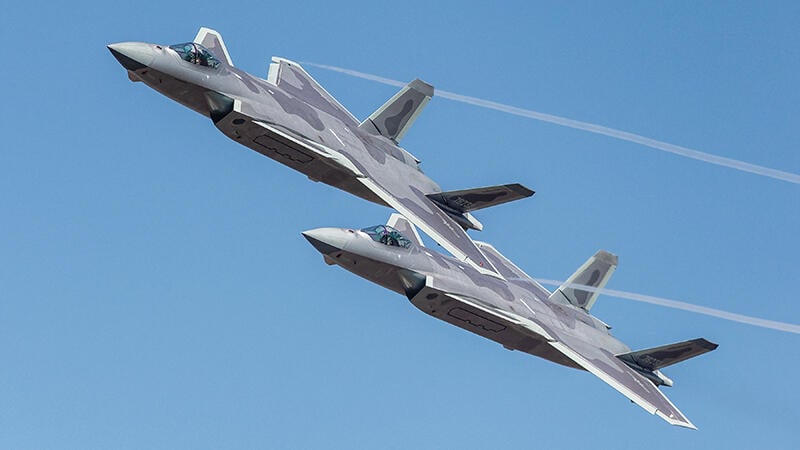
China unveiled the J-20 15 years ago as the country’s first stealth fighter.
When analyzing the technology prowess of the Chinese People’s Liberation Army, U.S. Air Force Maj. Derek Ecklebe talks about a problem with his golf swing.
Ecklebe, a military fellow at the China Aerospace Studies Institute (CASI), invested in an expensive driver to solve a problem with his swing, but his annoying tendency to slice the ball off the fairway remained. “I still have a slice,” he said at the CASI annual conference at the National Defense University here May 21. “If I don’t figure out how to use that new technology, it’s kind of worthless.”
- J-36, J-50 and H-20 stealth prowess questioned
- Chinese counter-stealth claims dismissed
Ecklebe, who previously managed stealth signatures for the Air Force’s Northrop Grumman B-2 bombers, detects a similar problem with the People’s Liberation Army’s (PLA) approach to acquiring technology to make their own aircraft stealthy and to countering adversaries’ stealth technology.
“Looking at what the Chinese own today, and looking at how they approach it and how they think about it, I would argue that they have some really good technology in some respects,” Ecklebe said. “They just have a really nice, brand-new driver, [but] they still don’t know how to throw their hands through and stop the slice.”
No one doubts that China’s military power has improved dramatically in two decades. In 2011, the country fielded its first stealth fighter, the AVIC Chengdu J-20 Mighty Dragon. Prototypes for two more radar-evading combat aircraft—the Chengdu J-36 and AVIC Shenyang J-50—entered flight testing at the end of 2024. The AVIC Xian H-20 crewed stealth bomber remains in development, its shape shrouded in official secrecy. Several more stealthy uncrewed aircraft—designated the GJ-11, CS5000T, CH-7, GJ-X and WZ-X—have broken cover.
China’s National Defense Ministry often refers to the canard-delta, twin-engine J-20 as a “stealth fighter.” In a Jan. 11 news release hailing the 15th anniversary of the fighter’s unofficial unveiling, the ministry said the event marked “the end of an era in which China lacked [a] domestically developed stealth fighter.” But the J-20’s stealthy features do not impress Ecklebe.
“The J-20 is really bad from a signature perspective,” he said. “Calling it ‘stealth’ is very generous to the Chinese engineers that made it.”
Fourteen years after the J-20 arrived, China showed off two apparent candidates for the PLA’s first sixth-generation combat aircraft. Featuring no vertical tails—a necessity for minimizing detection by low-frequency, early warning radars—the J-36 and J-50 represent the next evolution in Chinese stealth technology. Still, Ecklebe is skeptical. Although both represent an improvement over the J-20, some features raise red flags, he said.
“Having run [the B-2 squadron’s] signature [management] shop for three years, knowing every single nook and cranny of the airplane, of the materials, of the shape of the signature down to every angle, frequency and polarization, I have some huge questions about why they decided to do what they did,” Ecklebe said. “I think they are going to run into some massive signature regrets here in a couple years as they try to modernize these airplanes.”
China’s next stealth aircraft to emerge will be the H-20 bomber. A Chinese general revealed the existence of the development program in 2016. The U.S. intelligence community assesses that Beijing’s first crewed, long-range stealth bomber will enter service in the 2030s. Sarcasm dripped into Ecklebe’s voice when he mentioned this aircraft.
“Frankly, my favorite is the H-20,” he said. “I can’t wait to see this thing. Based off of what I’ve read, [and] what I’ve been able to see—at this level [of classification]—I’ll say: I can’t wait.”
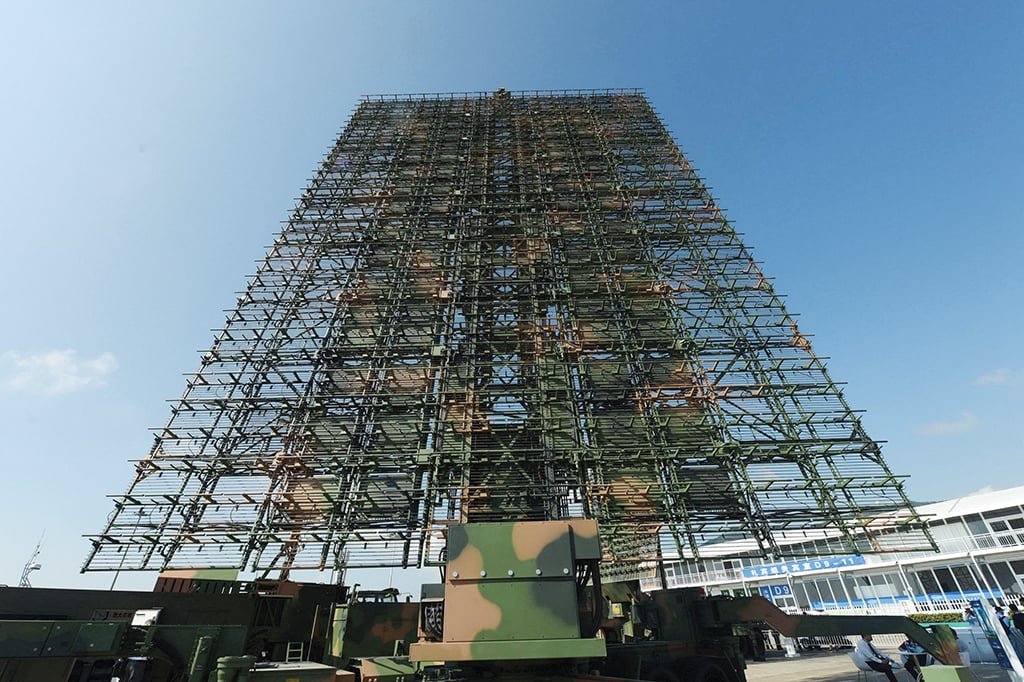
Ecklebe challenged statements that the PLA possesses a “counter-stealth” capability that negates decades of U.S. investment in stealthy bombers, fighters and munitions. During the 2025 World Radar Expo in China, Chinese defense electronics company CETC reportedly called the low-frequency JY-27V a “master artist” in detecting stealth aircraft, according to the state-run Global Times. The company also displayed the ultra-high-frequency-band YLC-8B radar as an “anti-stealth” sensor at the event.
These Chinese announcements spooked observers even within the U.S. military, Ecklebe said, but he said they should not be alarmed.
“As a community, we have to get a better understanding that low frequency is not counter-stealth,” he said.
Low-frequency radars have the ability to detect stealth aircraft, he conceded. But detection is not the same as targeting. The accuracy of a low-frequency radar is limited by the physics of the wavelength, which ranges from 1 m to 10 cm (39.4 in. to 3.9 in.). To guide a missile to a target accurately, the low-frequency radar must pass those coordinates to a high-frequency radar, which stealthy designs are optimized to defeat.
“There are times where I don’t really care [about being detected],” Ecklebe said. “Because if they can find me with a low-frequency radar but then they have to switch over to another radar to be able to close that kill chain . . . the higher in frequency they go, they’re going to have harder and harder problems trying to find me.”
Fundamentally, the Chinese military and defense industry’s approach to stealth and counter-stealth technology rests on a misperception, Ecklebe argued. In his view, technology is only part of what drives a U.S. advantage in stealth. With 35 years of stealth aircraft in combat operations, the U.S. has learned to package the technology with procedures, tactics and planning.
“They are putting less of an emphasis on doctrine, on training and on integration, and that is really going to bite them here in a couple of years,” Ecklebe said.
The PLA’s interest in stealth intensified after the 1999 shootdown of a U.S. Air Force Lockheed Martin F-117 Nighthawk during the Kosovo War. A Yugoslav Army SA-3 surface-to-air missile battery is credited with intercepting the stealthy combat aircraft in what proved to be a watershed moment for stealth technology for both Washington and Beijing.
In the U.S., the loss of the F-117 was blamed on poor mission planning, leading to a procedural adjustment, Ecklebe explained. “We are very, very, very good [at] being highly adaptive in our mission planning and our execution, particularly post-F-117 shootdown,” he said. “Never fly the same route twice, right? Well, that was a lesson learned out of Serbia because of this event.”
China, meanwhile, assessed Yugoslavia’s victory over the Nighthawk as a technology failure, he said. That drove the PLA’s interest in developing a counter-stealth ability, as they believed that a technology “silver bullet” could negate the U.S. advantage over targeting radars.
“This was the precipitating event for the Chinese,” Ecklebe said. The PLA believed they could defeat stealth aircraft because “they viewed the shootdown as a failure of the technology, which is why, I have argued, they have been hyperfocused on the technological solution to counter-stealth.”

Related Content
Comments