This article is published in Aerospace Daily & Defense Report part of Aviation Week Intelligence Network (AWIN), and is complimentary through Aug 24, 2026. For information on becoming an AWIN Member to access more content like this, click here.
FARNBOROUGH, England—Turkish Aerospace Industries (TAI) and Lockheed Martin look set to restart assembly of Black Hawk helicopters in Turkey after a hiatus.
Lockheed Martin will now provide another 39 Black Hawk production kits to support the Turkish Utility Helicopter Program (TUHP) after production was halted last summer after just 38 aircraft out of an expected 109 were produced. Turkish Aerospace CEO Mehmet Demiroglu told journalists at the Farnborough Airshow that his company had received export licenses for the next batch of 39 aircraft and said he expects to be able to restart producing the T-70 version of the Black Hawk in the next 12-18 months.
Under the TUHP program, contracted in 2014, TAI was set to build 109 S-70 Black Hawks to T-70 standard equipped with Turkish-made avionics as well as locally produced landing gear and dynamic systems, however since sanctions were placed on Turkey following its purchase of a Russian air defense system, the U.S. State Department had not provided licenses for the transfer of the kits for the remaining 71 helicopters.
Lockheed Martin stopped work on the program in October 2024.
“That program has now started again,” Demiroglu said, adding: “Of course, there will be some delays from when you look at the original schedule…but within a year and a half or so, we’ll be starting to manufacture the platforms again.”
Lockheed Martin confirmed that the program had been renegotiated.
Demiroglu was also confident that deliveries of kits for the remaining 32 could also be secured to reach the desired total of 109.
The issues with the TUHP program had prompted TAI to accelerate work on an indigenous helicopter program called T-925, a 12-metric ton, twin-engine utility helicopter. But even with the TUHP program back on course, Demiroglu says the T-925 is “in full burner, rather than on the back burner.”
He expects the T-925 to partly address an emerging replacement cycle for up to 200 rotorcraft in the Turkish military between 2030 and 2040 as well as address export market opportunities. He expects to build as many as 400-500 T-925s in the 10-15 years starting from 2030.
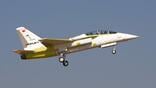
Meanwhile, the company continues to develop its Hurjet advanced jet trainer, which has already been selected by Spain to replace its Northrop F-5 trainers and Turkey to replace its T-38 Talons. Two prototypes are currently flying, and Demiroglu says four more prototypes are to follow, including a naval variant and a fighter version. The naval variant is being targeted at the Turkish Navy, which has embarked on an indigenous aircraft carrier building project. Demiroglu hinted that a single-seat version was also among the concepts for the aircraft being studied.
Demiroglu also is hoping to be able to offer the General Electric F-404-engine jet trainer to meet the UK’s emerging Jet Trainer Service program and is currently seeking partners for the project. TAI is already partnered with Airbus to deliver a modified version of the aircraft for the Spanish Air Force.
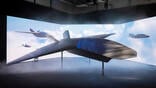
TAI also is working to refine the design of its Anka III uncrewed combat air vehicle as it aims to push that aircraft into production for the Turkish Air Force. Demirolgu said Anka III’s design had been “upgraded” based on the company’s experience with the development of the Kaan fighter to try to further reduce its radar cross section by modifying its intake and exhaust.
“We also upgraded designs for communication, distributed antennas, so that it does not affect the stealthiness of the of the platform,” Demiroglu said.
Two new prototypes reflecting the various design changes are now in build, he said and a first flight would follow early in 2027.
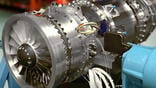
He said he was happy with the platform’s existing Ukrainian engine, the Ivchenko-Progress AI-322 and that the powerplants were on order as part of the serial production plan, but he said if there was a supply chain challenge, then TUSAS [Turkish for TAI] Engine Industries’ development of a 6,000lb thrust-class engine called TF6000 could also be adopted for the platform.
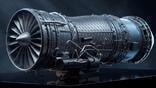
Demiroglu would not divulge when he expects to make the long-awaited first flight of the next prototype of the indigenous Kaan combat aircraft, which had originally expected to take place by year end 2025, but confirmed that aircraft had begun taxi trials. He said that development of the TEI TF35000 engines was more challenging than expected, but the program was still on track to be used in the Block 30 version of the aircraft. He confirmed that Ankara had been given approval to acquire 80 GE F110 engines from the U.S. to power the Block 10 and Block 20 tranches of aircraft. “Because those engines are for serial production, which is at least two years away, we will have no issue receiving those engines in time to support our serial production for the Turkish Air Force,” Demiroglu said.