This article is published in Aerospace Daily & Defense Report part of Aviation Week Intelligence Network (AWIN), and is complimentary through Aug 16, 2026. For information on becoming an AWIN Member to access more content like this, click here.
StormShroud
LONDON–The UK’s new Storm Fire one-way attack drone has been designed to be mass produced through distributed manufacturing, the Royal Air Force (RAF) has confirmed.
The Storm Fire was one of two new previously undisclosed in-service autonomous systems revealed by RAF Chief of the Air Staff Air Chief Marshal Harv Smyth during the Global Air and Space Chiefs Conference here on July 16.
They form part of an emerging family of platforms—prefixed Storm—that will be a “powerful compendium of control of the air capabilities,” Smyth told delegates.
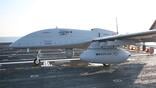
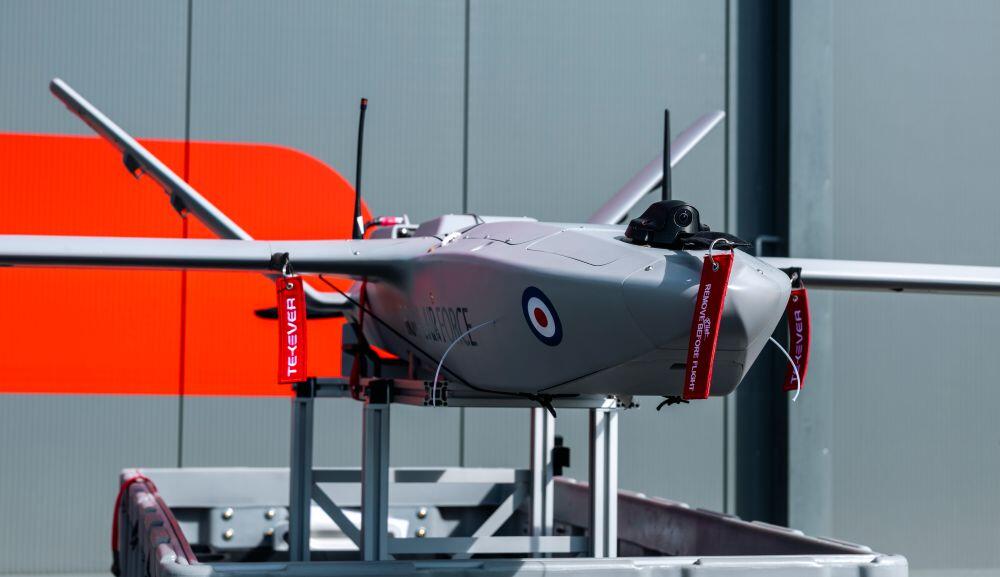
Others in the Storm-family include the StormShroud, the Tekever AR5-based collaborative platform designed to carry an electronic warfare payload, and Storm Fighter, of the UK’s new £300 million ($403.6 million) Collaborative Combat Aircraft (CCA) program.
Smyth described Storm Fire as a 1,000-km (621.3-mi.) one-way attack drone that would be operated by the RAF Regiment, a ground-based force protection element of the service charged with the seizing and defense of airfields. The service has since confirmed that Storm Fire is an “ultralow cost, long-range,” one-way attack drone that is designed to be “synchronized with other air effects.” Production of the system would be done through “federated manufacturing,” with production designed to be scaled up in the event of a conflict.
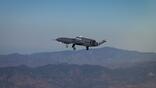
Storm Fire is likely to be a new name for Lanner, a foam-molded lifting body uncrewed aircraft system (UAS) that is designed to be produced at a cost of less than £20,000 a copy. The service has been experimenting with the system for around 18 months in conjunction with QinetiQ.
Smyth also announced Storm Chrome, which he described as an electronic warfare platform. The RAF says the development of this low-cost platform has been funded by the service in concert with a UK industry partner, but has not named the company.
“The platform offers the ability to survive in contested environments with further variants planned to increase range and payload capacity,” RAF officials told Aviation Week.
Smyth said the Storm family of capabilities will be spiral developed and further expanded “to remain ahead of the adversary and stay lockstep with today’s and tomorrow’s rapid technology development.”