This article is published in Aerospace Daily & Defense Report part of Aviation Week Intelligence Network (AWIN), and is complimentary through Jan 14, 2026. For information on becoming an AWIN Member to access more content like this, click here.
The European Union (EU) is to support research and technology efforts on the development of small turbofan engines for collaborative combat aircraft (CCAs), autonomous aerial refueling and a multirole light attack aircraft.
The projects are among 31 topics in the 2026 call for proposals for the European Defense Fund (EDF), for which Brussels has earmarked €1 billion for the European Commission-led initiative to support European defense research, development and cooperation.
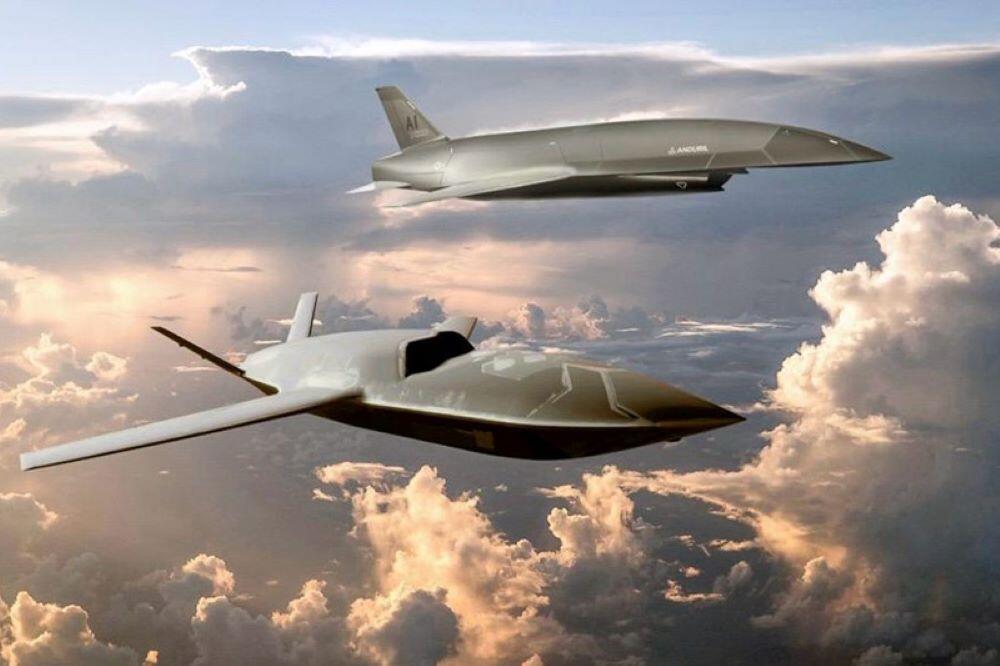
Among the aerospace-related projects is a push for the development of small turbofan engines to equip CCAs as more European air forces take an interest in CCA or remote carrier capabilities and other jet-powered uncrewed combat air systems.
The EDF-funded research, worth €20 million ($23 million), will focus on studies into a turbofan in the 25-35 kN range, equivalent to 5,600-7,900 lb. of thrust that would be capable of operating at speeds of up to Mach 0.95. The engine must also be able to operate with different fuels.
Program requirements call for the cost per unit to be significantly less than comparable certified civil and military engines of the same thrust family and be easily maintainable.
Rolls-Royce in Germany already is exploring the CCA market and Safran revealed at the Paris Air Show that it was looking at a range of small engines that cover the 3,300 lb., 6,600 lb. and 11,000 lb. thrust ranges.
EDF funding will also support research into autonomous and automatic aerial refueling, an area of study already being explored by Airbus Defense and Space for its A330 Multi-Role Tanker Transport. However, the €20 million research funding calls on potential bidders focus on probe-and-drogue refueling rather than with the refueling boom system, which the EDF documents say are not in the scope of the research. Part of the work should look at the development of an autopilot function for autonomous air-to-air refueling of both crewed and uncrewed combat aircraft, the documents say, as well as what sensors and systems could enhance or support refueling autonomy. There should also be a demonstration of the technology in a flight test, including dry contact, to ensure data is gathered.
The aim of the autonomy is to further reduce the workload of the crew while maintaining and even increasing the safety of the hazardous operation.
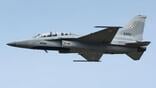
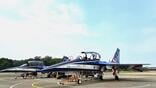
The EU will also support the development of a single-engine, low-cost Future Multirole Light Aircraft (FMLA) that could perform light attack; intelligence, surveillance and reconnaissance; and aerial security duties. EDF documents say there is a need for a “multirole light aircraft that can bridge the gap between today’s battlefield and modern technology.” The documents note that most aircraft in this segment operating in Europe are aging but do not identify the types to which they are referring. The EDF will fund studies and initial design work on FMLA with a budget of €15 million.
Funding will also be awarded to developments that will enable European weapons to be equipped with Galileo navigation satellite receivers, providing an alternative or supplement to guidance by U.S. Global Positioning System satellites.
There will also be new studies on enhanced self-protection suites that will be able to deal with the increasingly broad array of aerial threats to fixed-wing and rotary-wing aircraft and suggest that a combination of both active and passive defenses could be adopted.
Studies will also explore the potential use of high frequency (HF) over-the-horizon radar systems to improve the early warning capabilities of European countries. Europe appears to be seeking a similar system to Australia’s Jindalee Operational Radar Network that could eventually provide coverage of the Atlantic Ocean, Mediterranean Sea and Arctic Circle. The €29 million project will look at new technologies that integrate different HF infrastructures (transmitters and receivers) in a collaborative active and passive mode that would “increase the air and sea detection range for monitoring, early warning and detection of low-flying stealth aircraft.”
The European Commission is also making the first steps toward the High-End Endo-Atmospheric Interception (EATMI) project—a follow-on to the EDF-funded European Hypersonic Defense Interceptor (HYDEF) and Hypersonic Defense Interceptor System (HYDIS2) research and technology projects on hypersonic interceptors. EATMI will lead to the development of dedicated demonstrators for such an effector, but only one of the two project teams, HYDEF or HYDIS2, will be selected to progress to the €100 million EATMI program. EATMI aims to get the technologies associated with the interceptor to TRL 6 by 2030 to support future preliminary design review of the full interceptor system, so that it could be developed and industrialized after 2035.