This article is published in Aerospace Daily & Defense Report part of Aviation Week Intelligence Network (AWIN), and is complimentary through Mar 18, 2026. For information on becoming an AWIN Member to access more content like this, click here.
Dzyne Targets Greater Range, More Flights For Long-Endurance Drones
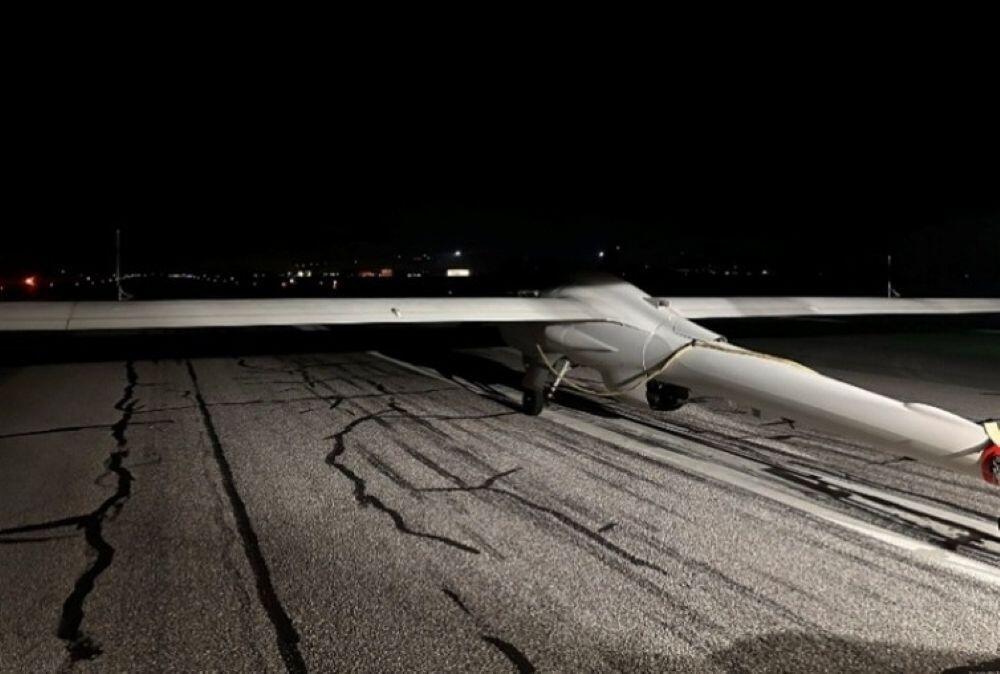
ULTRA Turbo.
FORT WALTON BEACH, Florida—Dzyne Technologies, a small but key player in the ultralong-endurance military aircraft market, is looking to showcase even longer flights for its new aircraft following a demonstration for the U.S. Air Force.
It is also seeking new opportunities to keep an older model flying.
Dzyne on Feb. 4 announced that it completed a 60-hr. flight with its ULTRA Turbo aircraft, a Stemme S12 glider heavily modified for the U.S. Air Force Research Laboratory’s Center for Rapid Innovation. The test under AFRL’s direction called for 60 hr. of flight at 25,000 ft. and 100 kt. (115 mph), though the company says it is looking to do more.
Frederick Walker, an aviation safety officer, instructor pilot and business development representative for Dzyne, operated the flight and said the aircraft landed with plenty of gas in the tank to go farther.
“That was the threshold we were able to achieve … so that was the goal for that, but we can fly a lot longer than that. That was just that particular customer’s request,” Walker said Feb. 11 on the sidelines of the Special Air Warfare Symposium (SAWS) here. “We’re looking forward to that. … We can definitely fly for 70, 80 hours.”
The aircraft in the test flew with an L3Harris WESCAM MX-15 gimballed imaging system. Walker says the aircraft has a payload capacity of about 400 lb., and Dzyne is “looking forward to seeing what we can do.”
While AFRL is the primary customer, Dzyne has said it is looking for more, with its presence at SAWS indicating special operations use. The company has also shown potential interest in the Middle East and Southeast Asia.
Before ULTRA, Dzyne had deployed the similar uncrewed aircraft system (UAS) called Leap—a Pipistrel Sinus light aircraft outfitted with an autonomy system and sensors. The aircraft had been deployed by U.S. Special Operations Command, though its continued use in the Middle East is murky.
Paul Kubek, Dzyne’s senior director in its long-endurance program office, says Dzyne is looking to fly the assets “in different areas.” The company has built aircraft both for military customers and for its own use, so it is looking at contractor-owned, contractor-operated options for Leap.
Dzyne in May also announced it had delivered autonomous air-launched expendable cargo gliders to the U.S. Air Force. The system, known as Grasshopper, can carry a 500-lb. payload for a one-time delivery of equipment and aid, using a parachute to land nose-first in a drop zone.
At SAWS, Dzyne showcased both the unpowered base Grasshopper and the Long-Range Grasshopper, which uses a turbine engine to deliver a payload at a range of about 500 mi. The latter design is focused on resupplying forces in contested areas, enabling the launching aircraft to stay out of the threat radius, Kubek says. The Air Force has purchased both of the models, he says.