This article is published in Aerospace Daily & Defense Report part of Aviation Week Intelligence Network (AWIN), and is complimentary through Jun 20, 2026. For information on becoming an AWIN Member to access more content like this, click here.

Debrief: SOF Week Stages Debut Of Stealthy Paraglider Design

SOF Week

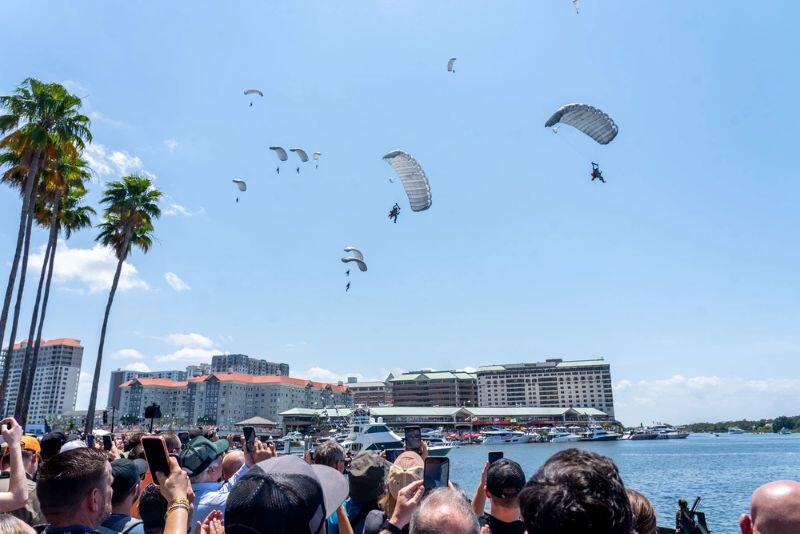
Multinational forces demonstrate powered paraglider operations in Tampa.

Credit: U.S. Army Sgt. Taylor Zacherl

Powered paragliding, or paramotoring, began in the early 1980s. Mike Byrne, a British pilot, attached a Konig 3-cylinder engine with a propeller to a paraglider wing. A recreational market and sport quickly followed.

Militaries were slower to grasp the potential of powered paragliders than other new forms of flying, but there were still examples. Hamas raiders crossed Israeli border obstacles by flying over them in powered paragliding trikes on Oct. 7, 2023. Amid a five-year-long civil war, the Myanmar military bombed a suspected rebel village from a paraglider on Oct. 8, 2025, killing at least 24 people, the Associated Press reported. 


The U.S. military also has shown interest. A parachutist reconnaissance Marine flew a motorized Augmented Parachute System (APS) during an exercise on Ie Shima near Okinawa on April 24, 2025. A year before, U.S. Special Operations Command (SOCOM) demonstrated a mock commando raid during the “Battle in the Bay,” kicking off the 2024 edition of the Special Operations Forces Week in Tampa, Florida.

Now comes the true test of the staying power of powered paragliders in the U.S. military’s arsenal: a customized powered paraglider designed for military purposes.

Tisbury, UK-based Blakcro will unveil the foot-launched P1 powered paraglider for special forces. A trike-mounted version is also in development. Company officials say the P1 is the first such vehicle designed for the military from the beginning, rather than adapted from an off-the-shelf powered paraglider designed for recreational or sport fliers.

“We are engaged with the SOCOM foreign competitive test team,” Simon Walker, Blakcro’s director of programs, told Aviation Week during a recent interview.

Starting with a clean-sheet design allowed BlakCro to focus on making the P1 vehicle harder to detect. The propellers are shaped to be less detectable to enemy sensors, Walker said. The chassis also is designed to reduce noise at a system level. BlakCro has delivered powered paragliders to the UK and several European militaries, particularly in the Scandinavian region.

“On consumer units, they have the fuel tank below the pilot and that creates turbulence that hits the propeller. That makes most of the noise,” Walker said. “We've integrated the fuel tank between the pilot and the engine, allowing a free space underneath the pilot. That makes an over 20% reduction in detectable distance.”

The arrival of powered paraglider designs for the military market comes as demand is rising. In 2024, the Marine Corps revealed plans to reach initial operational capability of the APS in fiscal 2027. The Army also solicited for the Personnel Air Mobility System, with plans to equip Airborne forces with powered paragliders.

“Traditional air assets, including fixed wing and rotary-wing transport aircraft, will likely be unavailable for the movement of small teams due to supporting other missions and the difficulty of operating these vehicles in anti-access/area denial threat areas. To overcome the challenges of conducting operations in this space, a concept of expanded maneuver in all domains calls for new platforms that can provide low-cost mobility solutions over extended ranges which are available at the individual unit/warfighter level,” the Army said in the 2024 solicitation document.

“People are seeing it as an advanced alternative to parachuting, except you don't need the drop aircraft. You're not putting the drop aircraft at risk. You can offset more than 200 miles over multiple flights, over multiple days. And also, if need be, the operator can self-extract to a safe area completely independently,” Walker added.

Steve Trimble

Steve covers military aviation, missiles and space for the Aviation Week Network, based in Washington, DC.