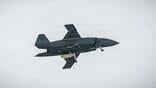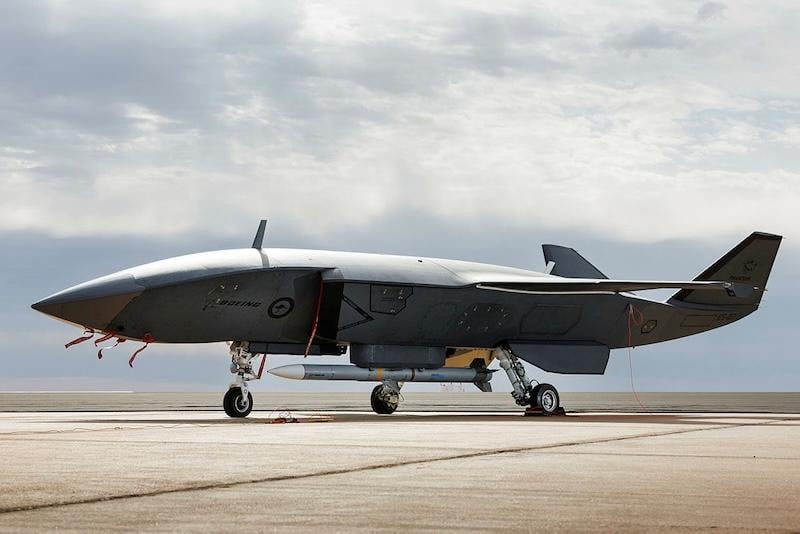
SINGAPORE—Boeing Australia expects to have the operational version of its MQ-28 Ghost Bat flying for that nation’s air force by 2028 as it uses momentum there to garner international interest for a later block of the collaborative combat aircraft.
The MQ-28 program closed out 2025 with an AIM-120 shot from a Ghost Bat flying with Boeing’s F/A-18s and E-7—a significant milestone that the company says showcases how mature the trailblazing CCA has become.
“We want to make sure that everyone out there realizes the maturity,” says Glen Ferguson, the director of Boeing’s MQ-28 Global Program, on the eve of the Singapore Airshow.
“When we sit down with foreign customers and take them through where we’re actually at, most of them are blown away at how mature we are because we show them things that we can’t show publicly, where they realize the depth of the capability and how well integrated and well advanced that capability is,” Ferguson says.
Following the December missile test, the Royal Australian Air Force (RAAF) awarded Boeing Defense Australia a $500 million contract for its third tranche of MQ-28s to be built and delivered through 2028. The RAAF will receive seven Block 2 and Block 3 aircraft, on top of the eight Block 1s and three Block 2 that were in production and test.
Ferguson says Boeing and the RAAF will also start discussions on what the next phase of production will be following the award. All told, Australia has invested about $1.4 billion in MQ-28 development.
The Block 2 aircraft is an “operational version“ of the test Block 1, and the focus for 2026 is to get the system operational with the RAAF by 2028. At the same time, Boeing Australia wants to get the Block 3 design set, which will be the core system to be taken to the international market. The company plans to build the aircraft at an increased pace in 2028 with Block 3.
The Block 3 design will extend the wings by 3 m (10 ft.) on each side, providing a 30% increase in fuel—a “quite significant range increase”—along with an increase in stores capacity, Ferguson says.
Block 3 will also include the internal weapons bay, sized for AIM-120 Amraam or small-diameter bombs. Block 1 and 2 aircraft have the space, and Ferguson says the latter can be retrofitted for an internal bay if the RAAF decides to.
All three blocks are powered by a Williams International FJ44-A engine, which has become the most popular powerplant for CCAs.
Because the airframe was initially designed in Australia without U.S. input, it was at the outset independent of International Traffic in Arms Regulations (ITAR) restrictions. However, following a 2023 agreement with the U.S. Air Force and U.S. Navy to collaborate on the system, ITAR-restricted technology has been introduced. This has largely been communications and weapons-related equipment. Ferguson says this has been compartmentalized, meaning it can be removed for other international sales to be free of ITAR restrictions.
The U.S. Navy has deployed a test and evaluation squadron to Australia to work on the aircraft, and as part of the agreement an MQ-28 has been operating at Naval Air Station Point Mugu, California. The agreement allows the two nations to share skills with the aircraft as it develops.
“I think it’s in everyone’s interest to be interoperable, and the core of that agreement is about making sure that we’re all doing things along with each other,” Ferguson says.
Boeing is one of several companies that are on contract with the Navy for early CCA designs, though Ferguson declined to comment on progress there as it is an American program. Boeing is also competing for future increments of the U.S. Air Force’s program, with both Anduril and General Atomics Aeronautical Systems Inc. flying their designs for the first increment. Though those two are flying, Boeing believes its system is currently the most developed.
“MQ-28 is not only the most mature CCA in the world by a very long way, it’s also the most capable,” Ferguson says. “You never quite know that sometimes, because you’re not really privy to other people’s capabilities, but what we just proved in the last 12 months makes us pretty comfortable to say that.”

Related Content