This article is published in Aviation Week & Space Technology and is free to read until Dec 25, 2025. If you want to read more articles from this publication, please click the link to subscribe.

Boeing F/A-18 Automatic Ground Collision Avoidance Makes Strides

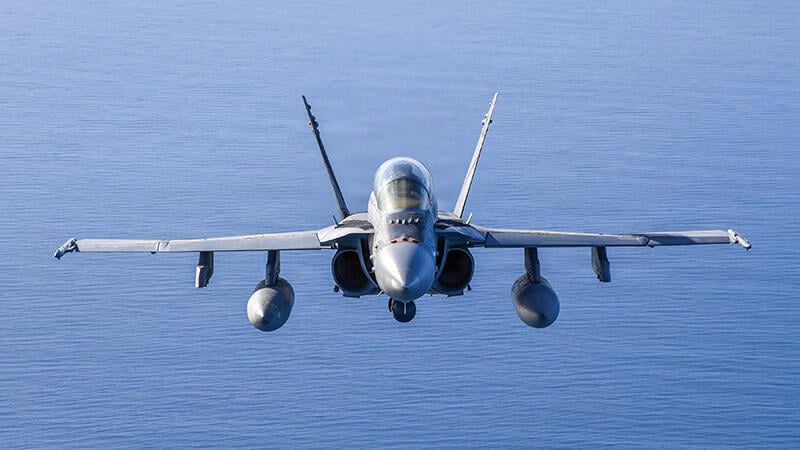
F/A-18 flying over sea

U.S. Navy F/A-18s evaluated the Automatic Terrain Awareness and Warning System at sea and over desert terrain in California.

Credit: Katie Archibald/U.S. Navy

The U.S. Navy and Marine Corps, along with two partner operators, are set to install automatic ground collision avoidance systems in Boeing F/A-18 fleets—admitting that the technology could have prevented several fatal crashes.

Both the legacy F/A-18 Hornet fleet in the U.S. Marine Corps and Royal Canadian Air Force and the F/A-18E/Fs and EA-18G Growlers in the U.S. Navy and Royal Australian Air Force passed major milestones in the process in November.

  • Upgrades are also coming for Canada and Australia
  • U.S. Navy’s approach differs from that of the Air Force

The Marine Corps first identified the need for such systems on its F/A-18A-D fleet after the Air Force fielded an Automatic Ground Collision Avoidance System (Auto GCAS) on F-16s starting in 2014, and in response to a series of fatal F/A-18 crashes in the Marine Corps and Navy in 2010-16.

The Naval Air Warfare Center’s Weapons Division announced on Nov. 19 that it had completed evaluation of the Automatic Terrain Awareness and Warning System (ATAWS) and expects to roll it out in 2026. Unlike Auto GCAS, which relies on the fly-by-wire system in F-16s or Lockheed Martin F-22s and F-35s, the F/A-18’s manual controls require using flight control inputs, according to the Naval Air Warfare Center.

The ATAWS uses the aircraft’s current Terrain Awareness and Warning System, which tracks the Hornet’s position using terrain data, altitude, speed and attitude. While that system provides visual and auditory warnings, the ATAWS levels wings automatically and then instructs the aircraft to pull up rapidly. The system returns controls to the pilot when it is at a safe altitude.

“The Marine Corps F/A-18A-D legacy Hornet community was the driving force behind ATAWS,” Lt. Col. Timothy Burchett, commander of Air Test and Evaluation Squadron (VX) 31, said in an announcement. “Every Hornet saved means one more aircraft and aviator available for combat.”

Over the past two years, VX-31 at NAS China Lake, California, and VX-23 at NAS Patuxent River, Maryland, have evaluated the ATAWS. VX-23 conducted 32 flights to evaluate the system’s response to various dives and recoveries, while VX-31 completed 16 flights over flat desert and mountains to ensure the ATAWS did not falsely activate. Both units conducted an additional 16 flights over seven weeks. All told, the squadrons conducted 177 test points.

The ATAWS’ success paves the way for a new and long-awaited system for the Navy’s Super Hornets and Growlers. Pilots and safety advocates have long pushed for the development, and calls increased after the Navy posted its highest mishap rate in 11 years in fiscal 2025. This included the Oct. 15, 2024, crash of an EA-18G into terrain near Mount Rainier in Washington, which killed two aircrew. The investigation into that mishap has not been released.

“The F/A-18 and EA-18G communities have experienced several aircrew fatalities and loss of aircraft due to controlled flight into terrain (CFIT),” the Navy said in budget documents. “To mitigate this risk, [Auto GCAS] has been identified as a critical safety enhancement. . . . This is a significant aircraft safety improvement that could have prevented multiple fatal F/A-18 mishaps over the past two decades.”

The fiscal 2019 National Defense Authorization Act called on the Navy to develop ways to improve the safety of the aircraft, but that was largely unanswered until now. Congress further prodded the service in a draft version of the 2026 law released in July, ordering the Navy to outline an acquisition approach to field the system.

“In summary, Auto GCAS provides a crucial automated safety feature that complements aircrew skills and training, safeguarding against human error, aircrew incapacitation and the inherent risks of tactical fighter operations,” the House Armed Services Committee’s bill report states.

The Navy is requesting $18 million in its fiscal 2026 budget for the effort, and it released a solicitation for a software update on Nov. 10 to begin the work. Specifically, Naval Air Systems Command (Navair) is looking for a software update to the aircraft’s digital map and flight control computers on its Tactical Aircraft Moving Map Capability program to support Auto GCAS. This shows the Navy is not simply porting over the system developed for Air Force aircraft—including newly disclosed work on Boeing F-15s and T-7s.

Super Hornets and Growlers already have a terrain awareness and warning system that alerts pilots of potential CFIT incidents and provides guidance to avoid crashing. This upgrade would permit the aircraft to recover automatically from potential CFIT if the pilot is incapacitated, according to Navair.

“Avionics upgrades to Naval Aviation platforms are required to ensure compliance with current safety and airworthiness requirements,” the solicitation states.

Brian Everstine

Brian Everstine is the Pentagon Editor for Aviation Week, based in Washington, D.C.