This article is published in Aerospace Daily & Defense Report part of Aviation Week Intelligence Network (AWIN), and is complimentary through Jul 03, 2026. For information on becoming an AWIN Member to access more content like this, click here.

BAE Combat Air Demonstrator Progresses Critical GCAP De-Risk Efforts

new image of the fcad demonstrator

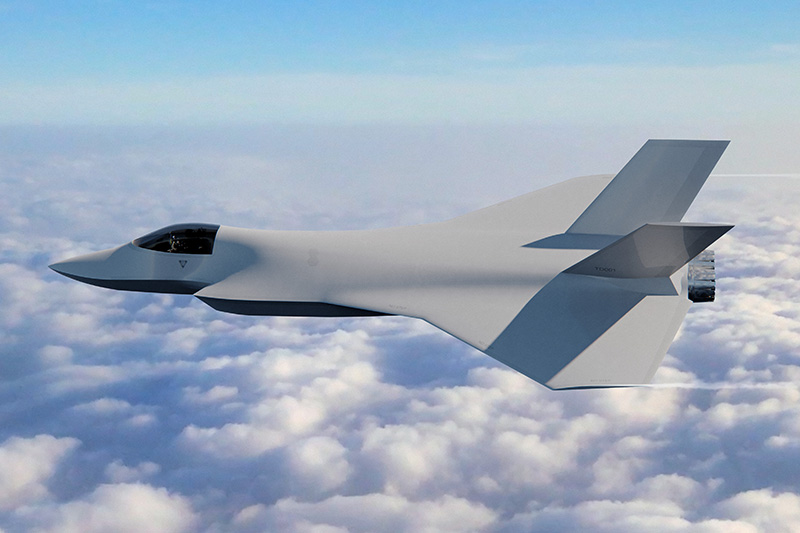
BAE has released a new artist's impression offering a more complete side profile of the FCAD.

Credit: BAE Systems

WARTON, England—BAE Systems has reached the "business end" of developing its Future Combat Air Demonstrator (FCAD), the aircraft that will pave the way for the fighter emerging from the tri-national Global Combat Air Program (GCAP).

Around 75% of the demonstrator by volume has now been manufactured, with major structural sections having spent the past 12-18 months in production as the airframer targets a rollout by the end of 2027.

old FCAD image
Development of the demonstrator is considered a major de-risking effort for the GCAP. Credit: BAE Systems.

“We are pushing boundaries, testing new things and trying new engineering and manufacturing approaches to be ready and match-fit for the main program that is to come,” Tony Godbold, BAE Systems’ FCAS delivery director, told journalists during briefings at the company’s facilities here earlier this month.

Aviation Week was one of a small number of trade publications allowed to see the front, center and rear fuselage sections of the demonstrator taking shape at BAE's site in Samlesbury, England, while the huge double-delta wings are being built at the Warton facility.

The company has also released a new artist's impression offering a more complete side profile of the aircraft.

Frames for each fuselage section have been aligned on jigs with the center fuselage section arguably the most revealing, showing two deep internal weapons bays positioned ahead of the main landing gear. Their size suggests the demonstrator could potentially carry around twice the internal weapons volume of the F-35's relatively shallow bays, and potentially could be capable of accommodating larger-diameter stores.

Where the landing gear will be fitted, faceted edges have been added to the frames to reduce the radar cross-section of where the gear doors will be fitted.

Individual ducts for the two Eurojet EJ200 engines wrap over the weapons bays and run almost the full length of the center fuselage, explaining the unusually shaped intake ducting displayed previously. It remains unclear whether the ducts stay parallel all the way to the rear of the aircraft or whether the engines are widely spaced, as journalists were not shown the aft section of the rear fuselage. The demonstrator will also feature modified engine nozzles rather than the standard Eurofighter Typhoon installation, Aviation Week has been told.

The intake-fuselage junction is manufactured as a single component using additive manufacturing. The component could not have been produced using conventional manufacturing techniques. Meanwhile hot isostatic pressing (HIP), has been used to produce titanium actuator cradles for the aircraft's large trailing-edge control surfaces.

Based on what was shown, the demonstrator appears to be at least one-third longer than the Eurofighter, as Aviation Week has previously reported, making it the largest aircraft assembled in the UK since the Nimrod MRA4. The production GCAP fighter is expected to be larger still.

For final assembly, BAE plans to transport the fuselage—referred to as the cigar—to Warton next year to be mated with the wings and vertical stabilizers. Three wings and three vertical stabilizers have been produced, two each for installation on the aircraft, and the third of each for structural testing.

Godbold said the demonstrator would continue BAE's tradition of building "large-finned aircraft," hinting that the vertical stabilizers could approach the size of those fitted to the Panavia Tornado—an aircraft often nicknamed “The Fin.”

Meanwhile, the composite skins are among the largest carbon-fiber structures ever produced by the UK aerospace industry.

“The demonstrator is allowing us to shift risk,” Godbold said. “It is better we trip up on things now that we don’t want to trip up on when we get into the main program.”

Godbold said work is already underway to secure military airworthiness certification—the first time BAE has undertaken the process from scratch. The company is also exploring how the demonstrator can support additional research objectives. Among the trials planned is endeavoring to prove low-observability techniques as well as missile launch from a weapons bay. To prepare for first flight, BAE said its test pilots have already accumulated more than 300 hr. in the simulator, while automated coding tools are generating much of the flight control software for the fly-by-wire system. The aircraft will be flown using a sidestick controller and a large-area cockpit display.

“It is a critical de-risk program for GCAP,” Godbold said. “It gets us early testing and generating real-world data that we are leveraging in the design process.”

“It also gets us ready in terms of our people and exercises new process tools and techniques that we've got to employ in the main program,” he added.

The pace of FCAD reflects the wider ambitions of GCAP, whose partners aim to deliver a next-generation fighter in roughly half the time it took to bring the Eurofighter Typhoon into service. Italy, Japan and the UK face a particularly demanding timetable, driven by Tokyo's requirement to field an initial operational capability in 2035.

The aircraft will eventually replace the Eurofighter fleets of Italy and the UK, as well as Japan's Mitsubishi F-2.

FCAD will be the first wholly UK-built demonstrator since the Experimental Aircraft Program (EAP), the aircraft that supported the development of the Eurofighter Typhoon. BAE will mark 40 years since EAP’s first flight in August.

Tony Osborne

Based in London, Tony covers European defense programs. Prior to joining Aviation Week in November 2012, Tony was at Shephard Media Group where he was deputy editor for Rotorhub and Defence Helicopter magazines.