This article is published in Aerospace Daily & Defense Report part of Aviation Week Intelligence Network (AWIN), and is complimentary through Jul 12, 2026. For information on becoming an AWIN Member to access more content like this, click here.

Airbus Tests Aerodynamic Modifications For Helicopters

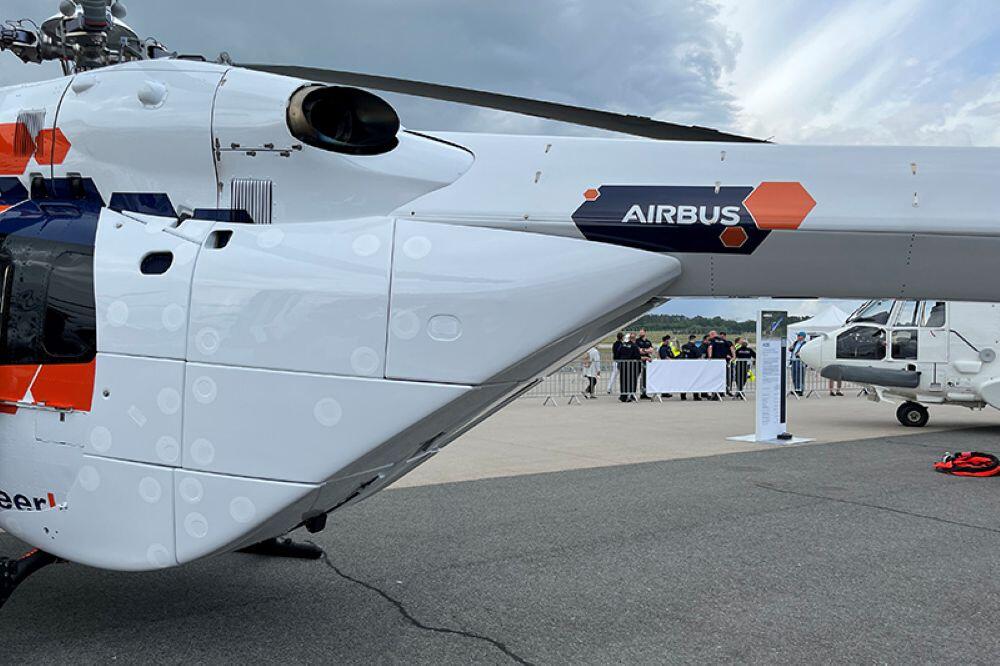
Credit: Tony Osborne – Aviation Week Caption: The temporary aft fuselage fairings fitted to the Airbus PioneerLab on display at the Berlin ILA Air Show.

The temporary aft fuselage fairings fitted to the Airbus PioneerLab on display at the Berlin ILA Air Show.

Credit: Tony Osborne/Aviation Week

BERLIN–Airbus is experimenting with aerodynamic adaptations that could transform the performance of its conventional helicopters.

Using the company’s Germany-based H145 light twin-engine helicopter-based PioneerLab–one of four flying rotorcraft laboratories operated by the airframer–Airbus is testing an aerodynamic improvement kit that changes the cross section of the tailboom and resculptures the rear fuselage. Combined, the modifications are expected to increase lift performance and reduce drag, potentially leading to reductions in fuel burn as well as increases in payload and performance.

To test the modifications, the company has produced composite fairings that can be scabbed onto the tail boom and rear fuselage. A modified horizontal stabilizer has also been added, fitted with downturned tips.

The modified tail boom with a diamond, rather than oval-shape cross section, takes downward airflow from the main rotor and sends it in the same direction as airflow produced by the anti-torque system

“We produce, for nothing, part of the anti-torque and therefore reduce the power required by the fenestron [ducted anti-torque system],” Johannes Plaum, Airbus Helicopters head of Research and Technology in Germany, said June 10 on the opening day of the Berlin ILA Air Show here.

A similar tail boom is fitted to the Racer high-speed compound rotorcraft demonstrator, but it is the first time such a system has been incorporated onto an Airbus conventional rotorcraft. Early flight demonstrations have shown the modifications have reduced drag in low-speed flight and improved stability in forward flight. The company will also experiment with a new aft body shape later in flight testing, although it has been fitted on the aircraft while present in the static display.

The current H145 rear fuselage configuration creates low-pressure air and leads to drag in forward flight. But the new design smooths the airflow toward the tail boom, Plaum notes. Trials are being conducted step by step. The initial focus is on the impact of the modified tailboom, then the horizontal stabilizer, followed by the aft fuselage modifications, before testing what Plaum describes as “the whole full-blown package.” So far, flights have only been performed with the horizontal stabilizer and tail boom. Testing is being conducted at the company’s Donauworth facility.

Meanwhile, the company is also moving ahead with the development of a hybrid propulsion system that will remove the two Safran Arriel engines from the PioneerLab and replace them with a single 1000-shp Pratt & Whitney Canada PW210S and two Collins-developed, 250-kW electric motors powered by lithium-ion batteries. Plaum says engineers completed the preliminary design review of the hybrid propulsion system last year and are moving into detailed design of the system. Bench system testing will then follow, and flight testing will be performed later. The aim of the initiative is to deliver a 30% reduction in fuel burn, which could be reduced further if combined with the aerodynamic modifications.

Both initiatives are what Plaum refers to as “technobricks” that could influence the design of the company’s future light rotorcraft. An earlier experimental helicopter, the EC135 Bluecopter that flew in 2015, had a significant influence on the development of the company’s new H140 twin-engine rotorcraft currently in flight test. It is destined to reach commercial service in 2028.

Tony Osborne

Based in London, Tony covers European defense programs. Prior to joining Aviation Week in November 2012, Tony was at Shephard Media Group where he was deputy editor for Rotorhub and Defence Helicopter magazines.