This article is published in The Weekly of Business Aviation part of Aviation Week Intelligence Network (AWIN), and is complimentary through Jan 09, 2026. For information on becoming an AWIN Member to access more content like this, click here.

NTSB Recovers Cessna 550 Cockpit Voice Recorder

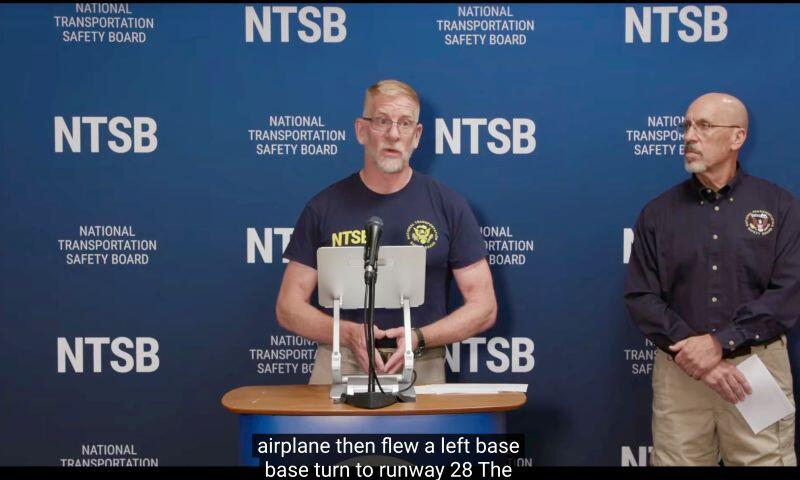
NTSB Investigator in Charge Dan Baker, at podium, and Board Member Michael Graham brief reporters in North Carolina.

NTSB Investigator in Charge Dan Baker, at podium, and Board Member Michael Graham brief reporters in North Carolina. 

Credit: NTSB

In an investigative update Dec. 20, NTSB Board Member Michael Graham said the safety board was provided with a brief text message to a family member from a passenger on the accident aircraft stating: “emergency landing.” It has compiled several witness statements, which indicate “the airplane was stable on approach, configured for landing with the landing lights on, but coming in low.” Accident investigators have recovered the Cessna 550’s cockpit voice recorder, ground proximity warning system, Garmin GTN 750 multifunction display, and caution and warning panel. —Ed.

Accident investigators have not determined who was piloting the Cessna 550 Citation II that crashed Dec. 18 while attempting to land at Statesville Regional Airport (KSVH) in North Carolina, resulting in the deaths of all seven people on board.

The twinjet had departed from Runway 10 at 10:05 a.m. EST and was airborne for about 10 min. before turning back toward the airport, where it crashed near the runway threshold, NTSB accident investigators said Dec. 19. Former Nascar driver Greg Biffle and three members of his family were among the seven people killed.

NTSB Board Member Michael Graham said three of the Citation’s occupants possessed pilot’s licenses, but safety investigators have not yet determined who was controlling the aircraft. A cockpit voice recorder has been recovered from the wreckage and sent to the NTSB’s recorders laboratory in Washington, D.C., for analysis.

Preliminary ADS-B data showed the twinjet made an initial left turn to the west, followed by another left turn toward the airport approximately five min. after takeoff, said Senior Air Safety Investigator Dan Baker, the NTSB investigator-in-charge. It flew a left base turn to Runway 28 and initially struck an approach lighting stanchion about 1,800 ft. from the runway threshold.

The Cessna subsequently struck trees, two other light stanchions, and the airport perimeter fence short of the runway threshold before coming to rest near the threshold, oriented on an easterly heading.

Visual meteorological conditions prevailed at the time of the accident, with drizzle and open ceilings at 1,200 ft. and 2,200 ft., as well as a 5,000-ft. ceiling, Baker said. Wind was calm with five statute mile visibility.

“Post-impact fire consumed the majority of the fuselage and the inboard wing sections,” Baker said. “All four corners of the airplane and flight-control surfaces have been identified in the wreckage and the debris field. Both engines were present with the main wreckage.”

Sixteen NTSB investigators responded to the accident scene. The safety board expects to release a preliminary accident report within 30 days; a final probable cause finding will take 12-to-18 months. Graham asked that anyone who may have photos, video, or debris from the accident contact the NTSB by email at [email protected].

The FAA, aircraft manufacturer Textron Aviation, and engine manufacturer Pratt & Whitney Canada are parties to the investigation.
 

Bill Carey

Bill covers business aviation and advanced air mobility for Aviation Week Network. A former newspaper reporter, he has also covered the airline industry, military aviation, commercial space and uncrewed aircraft systems. He is the author of 'Enter The Drones, The FAA and UAVs in America,' published in 2016.