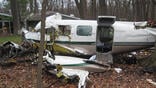
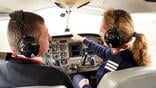
NTSB censored images of the unresponsive pilot and pilot-rated passenger of a TBM 700 intercepted over the Caribbean Sea in 2014.
On the afternoon of June 4, 2023, air traffic controllers received an all-too familiar report from U.S. Air Force F-16s sent to intercept an incommunicado Cessna Citation V in cruise flight at 34,000 ft. over the nation’s capital: The airplane itself looks fine, but the pilot is slumped over in the seat. The twin-engine business jet with pilot and three passengers flying on autopilot later ran out of fuel and crashed in a near-vertical descent in rural Virginia. There were no survivors. Altitude-related hypoxia was the likely culprit given the aircraft’s pressurization system failed for undetermined reasons and the operator had not provided supplemental oxygen as a backup.
Nine months earlier, on Sept. 4, 2022, an eerily similar scene unfolded at 36,000 ft. over the Baltic Sea when French fighter pilots intercepted an incommunicado Citation II. German investigators said their photos taken by the pilots showed “an undamaged airplane and an incapacitated pilot in the left-hand seat.” The business jet later ran out of fuel and crashed, with none of the pilot or three passengers surviving. The German accident investigation authority (BFU) has not yet issued a final report, but altitude-related hypoxia due to pressurization issues will likely be key elements. The investigation's intercept photos showed the pilot’s oxygen mask “hanging unused in its place.”
While manufacturers are increasingly addressing the ever-present high-altitude hypoxia threat with technology solutions in new avionics—namely, automatic emergency descent modes and automatic landing systems—the vast majority of the legacy fleet still relies on pilots as the last line of defense against hypoxia if all other safety nets fail. This once again raises the age-old question of whether civilian pilots are adequately trained to deal with the threat. By all indications, there is growing interest in the topic as general aviation (GA) pilots graduate into increasingly capable aircraft that fly above 18,000 ft., and pilots in general are becoming more aware of the detrimental effects of even mild hypoxia at altitudes below which the FAA requires supplemental oxygen.
The Citation V crash brought about renewed interest in the issue, in part because the aircraft flew on its own directly over the most secure airspace in the U.S.—Washington, D.C.—and the fighter jets that scrambled from nearby Joint Base Andrews accelerated to supersonic speeds in the chase, rattling windows and nerves.
In its final report, issued in May, the NTSB surmised that the pilot lost consciousness due to altitude hypoxia during the climb phase of the flight from Elizabethtown, Tennessee, to Long Island, New York. What was not clear was whether the aircraft experienced rapid or slow decompression, the latter requiring heightened hypoxia awareness due to its gradual onset. The agency did not issue any recommendations in this crash, nor has it done so for any fatal hypoxia-related GA accidents in the U.S. since the loss of the Learjet 35 carrying golfer Payne Stewart in 1999.
The familiar scene—fighter pilots or air traffic controllers unable to reach unresponsive pilots—plays out for all types of aircraft, jet and piston, pressurized and unpressurized, that cruise above 10,000 ft. The FAA requires supplemental oxygen for pilots when flying above 12,500 ft. for more than 30 min. and all the time above 14,000 ft. Figure 1 (Page 50) shows BCA’s count of fatal accidents over the past two-plus decades where hypoxia was specifically called out or suspected as a contributor.
BCA counted 21 fatal GA accidents related to hypoxia at altitude since October 1999 (Payne Stewart crash), including the 2014 loss of the pilot and pilot-rated passenger in the TBM 700 pictured at the top of the article. Additionally, nearly 90% of the fatal accidents occurred at or below 25,000 ft., the altitude above which the FAA requires specific ground training in high-altitude physiology and hypoxia.
Hypoxia Training Options
Unlike the U.S. military, the FAA does not require pilots to physically experience their response to altitude-related hypoxia in an altitude chamber (hypobaric) or an oxygen-reduced environment (normobaric) on a routine basis. As an example, Navy E-2 pilots renew their hypoxia awareness training every four years in a flight simulator using masks that reduce their oxygen intake to simulate hypoxia. The FAA in 2010 determined that normobaric, or “ground level” hypoxia training was a “sufficiently faithful surrogate” for altitude chamber training.
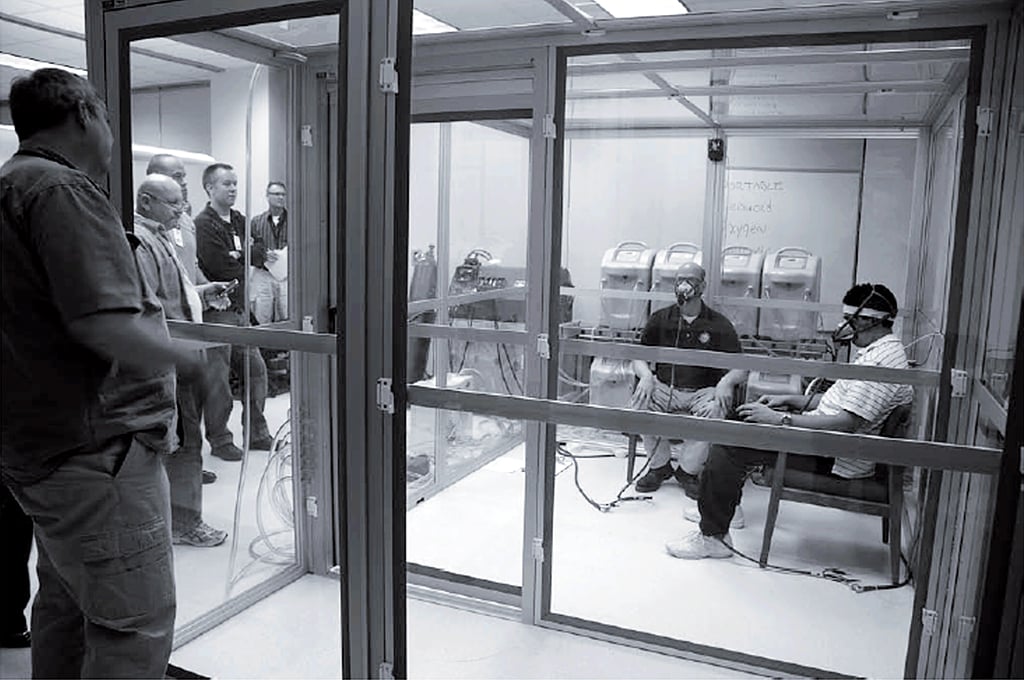
Civilians can get access to hypobaric and normobaric training at a limited number of locations through the U.S., including at the FAA’s Mike Monroney Aeronautical Center in Oklahoma City, at certain universities and at third-party vendors. Embry-Riddle Aeronautical University requires normobaric training for one of its flight physiology courses. The FAA also has very popular Portable Reduced Oxygen Training Enclosures (PROTE) that it takes on the road monthly to various aviation shows and other events around the country. Participants take the free training in groups of five and are able to learn the correlation between oxygen saturation levels on their pulse oximeters and their hypoxia symptoms.
Aircraft type clubs often offer their members the training at third-party providers like the Southern AeroMedical Institute.
After the 1999 Payne Stewart crash, one of the NTSB’s 11 recommendations called on the FAA to gather the aeromedical and operational community to determine whether to mandate experiential hypoxia training for civilian pilots.
At the heart of the recommendation was the analysis of whether civilian pilots, like military pilots, would sufficiently benefit from experiencing their unique individual responses to hypoxia in a test environment to justify a modification to the FAA regulations.
There is proof that the training works for military pilots around the world. In a study of 341 Taiwanese military pilots queried during their recurrent (every four years) altitude chamber testing in 2018, 46 reported having experienced an inflight hypoxia problem at some point in their flight career.
“Most of the events were detected by the participants because of their experience with personal hypoxia symptoms or those that they experienced during previous chamber flights,” the authors write. The study was published in International Journal of Environmental Research and Public Health in 2021.
The aeromedical committee the FAA brought together published its final report in July 2001, finding no need to revise the rules.
“The lack of compelling accident data over a 20-year period coupled with the availability of specialized training supplemented by videos, online courses, presentations by pilot and aviation industry organizations and programs promoted by the FAA led the committee to conclude that regulatory change is not warranted or recommended,” the committee concluded.
Interestingly, the study included the results of two surveys of business aviation pilots, one by Bombardier and one by NBAA, both of which showed strong preference for experiential hypoxia training for pilots.
The NTSB ultimately agreed with the aeromedical committee’s position, closing the recommendation as acceptable.
Looking Forward
However, more than 20 years later, the threat of hypoxia-related fatal accidents does not appear to be subsiding, as evidenced in part by airframers and avionics companies continuing to invest heavily in technology solutions.
Most business aviation OEMs are now offering some combination of automatic descent mode or auto-land mode, triggered by inactivity on the flight deck. Garmin’s Emergency Descent Mode (EDM), available on unpressurized aircraft including the Cirrus SR series of piston-powered aircraft, begins monitoring for activity when above 14,900 ft. and on autopilot.
If the pilot makes no key press inputs to the flight displays for a certain amount of time, the aircraft will attempt to get the pilot to respond with a key press, and failing that, will begin to automatically descend in steps to as low as 12,500 ft.
Garmin offers the next logical step—EDM plus Autoland—in the higher-end Cirrus aircraft, the Vision Jet, the Piper M600 and M700, the King Air 200 and 300 (retrofit) and the Daher TBM 940 and 960 single-engine turboprops. Collins Aerospace, Honeywell and Thales offer similar emergency descent modes for various business aircraft.
Given the size of the fleet and cost of upgrades, it will take many years before these technologies are widely available in the high-flying GA fleet, meaning pilots themselves will continue to be the last line of defense against hypoxia.
While it is not likely that regulations will change given the relatively small threat of hypoxia crashes as compared to larger fatality risks in general aviation—loss of control, engine failures and controlled-flight into terrain—there is much room for improvement.
The financial equation for hypoxia training has changed with the ubiquitousness of pulse oximeters and the maturation of the lower-cost ground-level techniques potentially making it possible for a broader swath of the GA pilot population to experience hypoxia on the ground. However, it is not clear how many such facilities exist, their location or the cost or availability of training as there is no centralized database with the information.
What is possible in the near term is to get pilots to more regularly report occurrences of hypoxia to databases like the NASA Aviation Safety Reporting System (ASRS) so the industry can gain an accurate picture of the threat. Currently there is little reporting, says Dr. Timothy Holt, chair of the Eastern Kentucky University School of Aviation and executive director of the school’s Center for Aviation. Holt previously worked at Embry-Riddle Aeronautical University, where he led a study of GA pilots and their experiences with hypoxia. Questionnaires were sent out through AOPA and other organizations, to which 344 pilots responded, the majority of whom experienced hypoxia in some form. Of those 200 pilots, only 12 told someone about the incident—air traffic control, flight instructors, flight surgeons or medical examiners. “They didn’t know who to report to,” Holt says. A cursory look at ASRS for hypoxia-related incidents shows on average about two reports per year, with the trend line decreasing.
Holt, a former Navy P-3 and MH-60S aircrewman and instructor, as well as a private pilot, tells BCA his research shows that the threat continues and more can be done in experiential education about hypoxia. Holt plans to continue the research in his new role.

Related Content