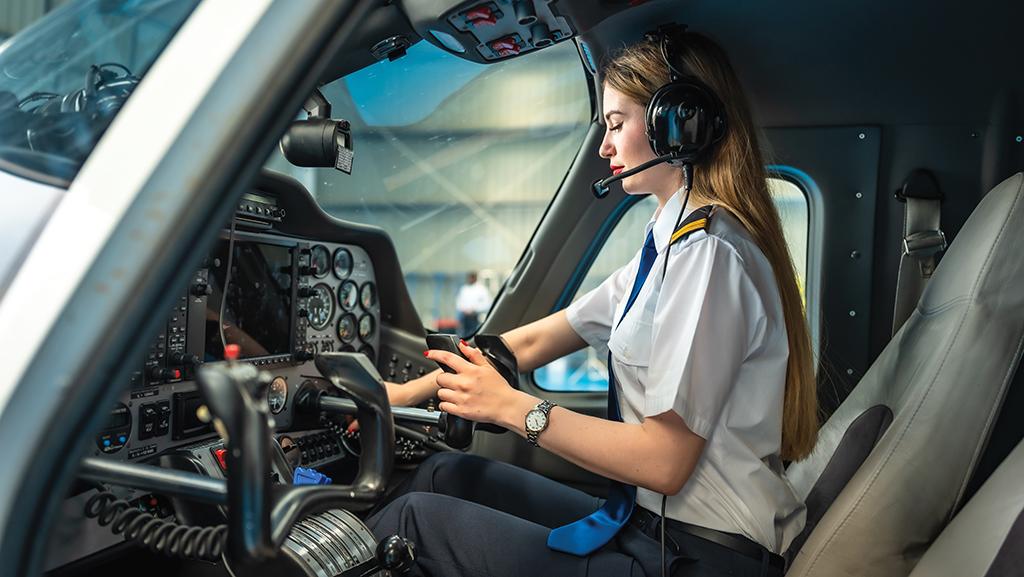
When choosing a career, young pilots have a “multitude of possibilities,” says one airline training academy executive.
The number of job openings for pilots, mechanics and others involved in business aviation often depends upon how much the airlines are hiring, according to the Aviation Search Group, a staffing firm that helps companies find candidates for job openings.
Since airlines often recruit from those operations, “it’s kind of based on them,” said Randy Rowser, Aviation Search Group managing director.
Directly following the pandemic, hiring was “crazy busy,” Rowser said during EAA AirVenture in Oshkosh, Wisconsin, where the firm was exhibiting. The company serves mainly Part 135 and Part 91 operators in their flight operations and maintenance employment needs.
“We even worked more with [Part] 121s [air carriers] in that time because everybody was so time sensitive to stack back up.” Now, hiring is more back to normal. “It’s always cyclical,” Rowser said of the job market. The most challenging position to fill today is that of a mechanic with an Inspection Authorization certificate.
What’s the easiest position to fill?
“Every time I say, ‘This is going to be easy,’ it never is. For pilots? We’ve been around 25 years, so we have a really robust internal network,” Rowser said. “A lot of times, we’re really involved in pilot hiring.”
Besides a pilot having the proper ratings, “when you’re a Part 91, you really need that guy to fit in with your staff,” he said. “That’s what we do. Is that easiest? That’s probably just one of the ones we’ve done the most.”
At Endeavor Air, a subsidiary of Delta Air Lines, the rate of hiring at the legacy airlines also impacts its onboarding.
“With the major airlines slowing down with their hiring—that affects us,” Eric Wagner, said Endeavor Air program manager of outreach and recruitment. “Our pilots usually flow to Delta, and if they’re not flowing, we don’t need to backfill them. Until the majors start hiring at a little more of a higher pace, we won’t have to hire as many. Right now, it’s a little slower, but that can open up at any time.”
For one, Boeing has not been able to produce as many aircraft as some of the airlines need, so there are not as many new aircraft being delivered, Wagner said. Second, “It’s been kind of a ‘wait and see’ year with the economy,” with companies being more cautious in how they are moving forward this year.
Today Endeavor is hiring about 30 pilots a month, compared to about 100 a month following the pandemic. “Whether that stays that way for long, I’m not sure, but that’s about where we’re at,” Wagner said.
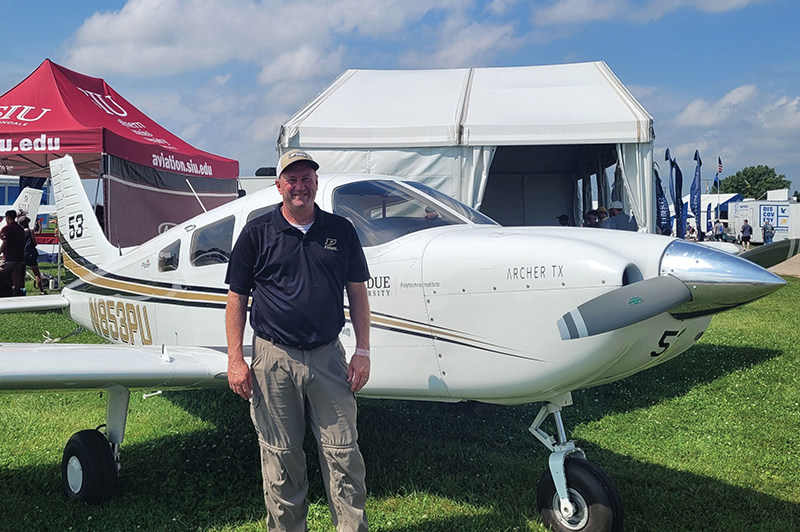
At Purdue University, its Polytechnic Institute offers four bachelor’s degrees and two master’s degree programs within its School of Aviation Technology. But it is the professional flight program that receives the highest number of applications.
The West Lafayette, Indiana-based school received a record 2,000 applications for 100 spots in the program this year, compared to 1,800 applications a year ago, said Brian Dillman, associate professor of aviation and transportation technology.
The industry is starting to “normalize,” Dillman told Aviation Week, “which means that the [fast] hiring pace that we’ve had over the last three to five years has started to move back to what it was to say, 10 to 12 years ago.”
While a pilot shortage is beginning to dwindle in the short term, a shortage of technicians is starting to rise, he said. Purdue offers a degree in aeronautical engineering technology, which focuses on engineering principles and airframe and powerplant (A&P) competencies. Students in the program qualify for the A&P mechanic certification.
“This is the first year where the projections for the number of technicians has equaled—and I suspect next year it will exceed—the number of pilots,” Dillman said. “The number of technicians that are going to be necessary are going to get more and more significant.”
The challenge is making students aware of the opportunities for those careers, he said.
“They think wrench turning is the only thing that is available, and there’s certainly a subset of that,” Dillman said. “But there’s a lot of opportunity in other areas. You can specialize in composites, nondestructive testing, avionics is a burgeoning area ...Airplanes are becoming the Internet of Things. You have Wi-Fi being fed in with Starlink. You have all these different platforms available. [Aircraft] become mobile offices in many cases. All of that has to be supported by technicians.”
At St. Louis University, its aviation program accepts 35 to 40 students per year and has a total of 120 or 130 students across the four-year program. The program has a graduation rate of 80%, said Gregory Triplett, dean of the school of science and engineering.
Some students come into the program with past flight experience, while others have had zero experience.
To help promote careers, St. Louis University offers a summer camp for high school juniors and seniors interested in the career path. It also holds a special event for Women in Aviation.
The market is returning to normal, said David Chilenski, assistant chief flight instructor at St. Louis University. However, “we still find an interest in aviation to be overwhelming, and with the upcoming pilot retirements at the majors, there is still extraordinary opportunities for those who are pursuing aviation today. We’re not going to see the explosive growth after COVID. But what we’re seeing is still above-average hiring.”
Today, it is taking slightly longer for pilots to get to the legacy airlines than it did about two years ago, Chilenski said. “What we’re trying to do is make sure we have quality instruction and quality rigorous instruction in the beginning.” That way, pilots have the basic building blocks in place to make the transition.
After graduation, students often stay on to work as certified flight instructors (CFI) to gain flight hours.
“We build most of our own instructors,” Chilenski said. After the pandemic, certified flight instructors were getting hired away quickly, and schools had a difficult time keeping them.
“That is stabilized now,” Chilenski said. “The CFIs now really have time to build their experience and provide much higher quality instruction. It’s actually better for the industry as a whole.”
About three years ago, there was an acute shortage of FAA examiners, but that has improved, too, Chilenski said. “The FAA changed how they are managing examiners and we’ve seen a real improvement.”
Today, the wait is about two weeks, he said.
In her position as U.S. commercial director for Skyborne Airline Academy based in Vero Beach, Florida, Jessica Hutchinson speaks with recruiters on a regular basis.
“What we’re realizing is over the next 20 years, there’s definitely going to be a need for pilots, without a shadow of a doubt,” Hutchinson told Aviation Week. “Right now, that's who they are hiring. The market is starting to stabilize after COVID, and we’re in our actual natural element of where the hiring cycle starts, stops, slows down. Some of it has slowed down probably a little earlier than expected, due to resources. We’ve got aircraft orders that aren’t being fulfilled at this current time.”
Most recently, the airlines have jobs available, but in today’s environment, but they have now the opportunity to select from the most qualified pilots compared to when there was a rushed need to hire.
“I do know that the airlines are still hiring and there’s still a need, but they can be more selective now,” Hutchinson said.
Aviation is cyclical, and it is a common cycle.
“What are airlines waiting for? They’re waiting for Boeing and Airbus to deliver,” she said. “If they can’t deliver, they don’t want to put someone in a seat waiting. They have to be strategic about that. But if you look at the trend, this is temporary. The need continues to grow.”
Over the next 20 years, there will be a need for 600,000 pilots globally, she said, referring to the latest Boeing forecast. “That’s a lot of pilots.”
Hutchinson's message to students is: “Now is the time” to train.
“Because when the airlines are ready, so are you.”
Skyborne mentors students to opportunities for pilots in areas including airlines, corporate and cargo.
“There’s a multitude of possibilities,” she said. “What type of lifestyle do you want when you are a pilot? Are you a person that wants to go home the next day? Do you love jet setting? What does that look like? What is it like to fly new types of aircraft that are in the eVTOL sector, things that are hybrid? They’re out there now. Is that something you want to do? Is sustainability a big deal for you? So, then we educate them.”
Editor's Note: This story has been updated on the areas in which Skyborne mentors their students.