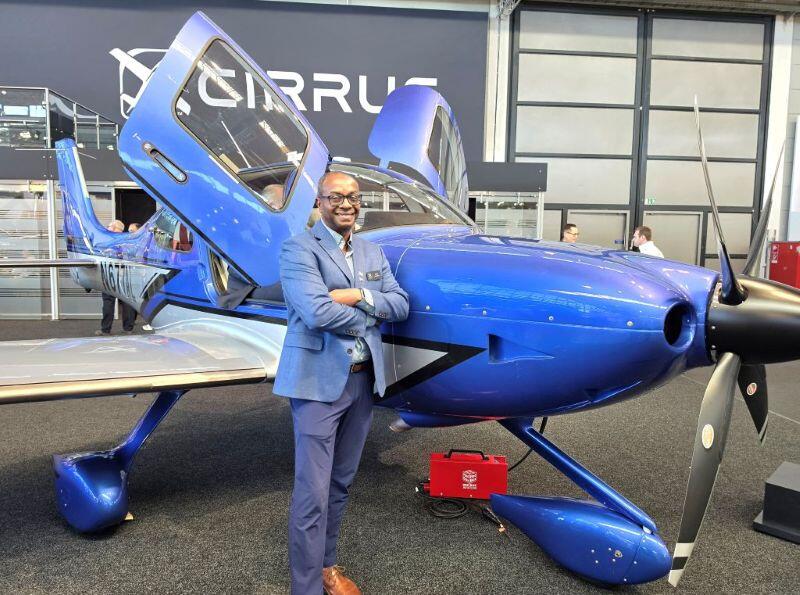
Boni Caldeira, Cirrus Aircraft vice president of international sales.
FRIEDRICHSHAFEN, Germany—Boni Caldeira, Cirrus Aircraft vice president of international sales, joined Cirrus in 2007. While he fell in love with aviation at an early age, he didn’t begin flying until after college. The initial idea that flying would be a great hobby turned into an aviation career. Since then, Caldeira has logged more than 11,000 flight hours around the world. He is based in Maryland, but frequently travels between his home, Cirrus’s jet delivery center in Knoxville, Tennessee, Amsterdam and other international locations. Caldeira’s focus is on customer retail sales.
Q. Your first job in aviation was in an avionics shop, which installed GPS equipment. That led you to Cirrus. What did you do there?
A. I would go up with pilots and show them how to use their GPS. Then the Cirrus pilots started coming, and I would show them how to use the avionics in the airplane, and that’s how I fell into Cirrus, because it was the most technologically advanced airplane. I became an instructor, and I started teaching people in a Cirrus. Later, I bought a Cirrus and did some commercial flying. It was very much through that first avionics job that I got into this world of ... technically advanced airplanes.
Q. Cirrus has increased the number of service centers, training centers and instructor pilots in Europe. How big is the European market for Cirrus? How do you describe it?
A. The European market is growing. We deliver more airplanes year after year to European customers and expect to deliver more this year than we did last year. A big part of that is, of course, we’re investing fairly heavily in terms of people, in terms of the network that we’re building out—everything to be able to create and ensure a certain level of customer experience that we’re after.
International [sales] is about 20 to 25% of the total production that we have; it varies a little bit from year to year. Within that, Europe is 10% of that 25%. It’s a meaningful number.
Q. What is your biggest challenge internationally?
A. The quick, easy answer is, oh, its regulation, or it’s this or it’s that. That’s probably the easiest answer that comes to mind. But if we’re a little bit honest and we say, ‘Are we actually doing everything we can do or are we just seeing the problem that is right in front of us and using it a little bit as an excuse?’ I’m not going to say it’s regulation. I’m going to say it’s our focus—like our ability to say, ‘Let’s bring our collective efforts to bear on a focused goal.’ That is probably the biggest thing. Until you have actual representation in market, until you have Europeans’ voice being heard, whether it comes to, what does it take to design the next airplane? How is the next airplane we’re designing going to fit in the European market? How is the next service program we’re designing going to fit in the European market? How’s the next training program we’re designing worldwide going to fit into the European market? Until you start approaching it that way, you’re not doing your best. That’s the decision that we made two years ago. Like, you know what, we’re going to change that. And it’s paid off. It’s working. So, what’s our biggest challenge? That focus. Cirrus has been an American company for quite a while. Making it a worldwide company, that’s really the challenge—think worldwide.
Q. You mentioned that customers everywhere want the same things—reliable and convenient service and high-quality training, among them. Are there any differences in Europe, however?
A. It’s not that what they want is different. It’s just that our ability to execute on it might require somebody with specialized skills or a specialized background. That’s really where your differences come in. To get a representative that’s capable and competent in the Czech Republic, that’s probably not going to be an American. That’s probably going to be somebody from the Czech Republic. In France, that’s going to be someone born and raised in France. That’s where you start seeing some differences.
Q. Has the war in Iran had an impact on business?
A. Obviously, gas prices are going up. But I think everybody’s noticed that. But no. It’s been minimal. Our customers are typically taking a slightly longer view. So, I would say minimal change. Most of our customers are business owners of some sort, and if their business starts to suffer, then I think we will see some effects. But you don’t get those quick effects.
Q. A personal question—what do you love most about flying?
A. That’s a tough question. My son is now a pilot. When I think of super memorable moments—it’s teaching my son how to fly ... and watching him get his pilot’s license and his instrument rating—and taking some of the coast-to-coast flights he and I have done—those are the pinnacle for me. I’ve been very fortunate.

Related Content