
Aircraft Overview: Airbus Helicopters' H135
Aircraft Overview: Airbus Helicopters H135
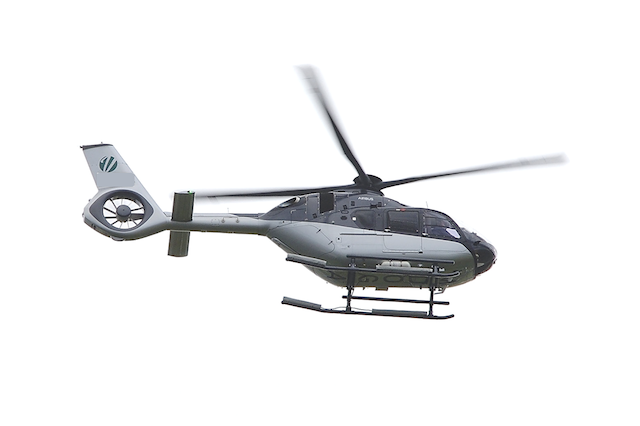

The H135 is a light, twin-engine helicopter produced by European manufacturer Airbus Helicopters.
According to the European Union Aviation Safety Agency (EASA) type certificate data sheet (TCDS) for the EC135 type, H135 is the marketing designation for several EC135 variants: the EC135 P3, P3H, T3 and T3H.
At the 2025 Verticon industry event, Airbus Helicopters introduced a “growth variant” of the H135—the H140—which features several airframe, cabin and engine improvements.
When the H140 was announced, it was expected that the helicopter would enter service “in 2028 for the emergency medical services segment.”
The H140 is described as being “purpose-built for [HEMS]” and having a cabin that “optimized” for such operations, with the cabin itself being larger than the H135’s cabin and able to seat as many as six passengers.
Indeed, the H140’s cabin area is increased by 20% to over 215 ft.3 Another benefit for HEMS layouts is that the cabin floor is “completely flat [and] unobstructed from [the] cockpit to [the] clamshell doors.”
The size of the H140’s side and rear clamshell doors—as well as the “raised tail boom position”—are also beneficial for HEMS operators.
Cabin
EC135 variants marketed as the H135 have a maximum passenger seating capacity of seven, while the available cabin configurations for passenger transport include one that accommodates two pilots and five passengers, as well as a six- or seven-passenger high-density seating configuration.
For helicopter emergency medical services (HEMS) operations, one possible configuration allows for two medical attendants, a stretcher and two pilots.
Avionics
The H135 can be operated by one pilot, with the pilot(s) operating both the H135 and H140 by utilizing Airbus Helicopters’ Helionix avionics system that has a four-axis autopilot and synthetic vision system.
The airframe manufacturer also states that the H135’s Helionix installation features in-flight envelope protection.
Furthermore, the H135 can also be equipped with cabin layouts, a cockpit, and exterior lighting that are “night-vision goggle (NVG) friendly,” in addition to “accommodat[ing] a night vision imaging system (NVIS).”
Mission and Performance
Missions that the H135 can perform include corporate and VIP transport, where it is marketed as the ACH135, disaster relief and rescue, energy—harbor piloting, and “offshore energy and powerline maintenance”—HEMS, law enforcement, and military training.
Comparatively, while the H140 has been described as being designed for the HEMS market, it is also able to perform missions such as business and private aviation, law enforcement, offshore, and passenger transport.
The performance limitations of the EC135 P3, P3H, T3, and T3H include a 150-kt. indicated airspeed (KIAS), never-exceed speed (VNE), and a 20,000-ft. pressure altitude, maximum operating altitude.
Beyond that speed limitation, Airbus Helicopters states that the H135 has a 136-kt. fast cruise speed and an out-of-ground effect (OGE) hover ceiling of 7,200 ft.
The H135 is also capable of a 342-nm maximum range and maximum endurance of 3 hr. 36 min., both of which are based on an airframe equipped with a standard fuel tank.
Unlock the data behind the charts with Aviation Week Intelligence Network’s Fleet & Data Services. Learn more at aviationweek.com/bcaaircraftoverview.
Variants
Two turboshaft engine options are certified for the EC135 variants marketed as the H135—Pratt & Whitney Canada’s PW206B3 and Safran Helicopter Engine’s Arrius 2B2—both of which have a full-authority digital engine control (FADEC) system.
The H135’s four-blade main rotor is bearingless, high-set, and described by the manufacturer as “contributing to operational safety,” with operational safety further increased by the 10-blade Fenestron shrouded tail rotor.
Two maximum takeoff weights (MTOW) —6,570 lb. and 6,834 lb.—have also been certified for the previously noted EC135 variants, and the useful load of the H135 is 3,124 lb.
Changes and improvements made to the H140 include a T-shaped tail boom that is new and which has a Fenestron that is optimized and lowers sound levels, a different variant of the Arrius engine, and a bearingless main rotor that has five blades.
That latter feature of the H140 is “the same five-bladed rotor system that was introduced on the H145 in 2019.” The variant of the Arrius engine which powers the H140 is the 700-hp Arrius 2E—engines that have a dual-channel FADEC system—while the H140’s MTOW will be increased to nearly 7,000 lb.
The horizontal stabilizer on the H140’s T-shaped tail boom is located “on top of the Fenestron tail rotor,” a “design [that] provides up to 176 [lb.] of additional lift in hover conditions.”