
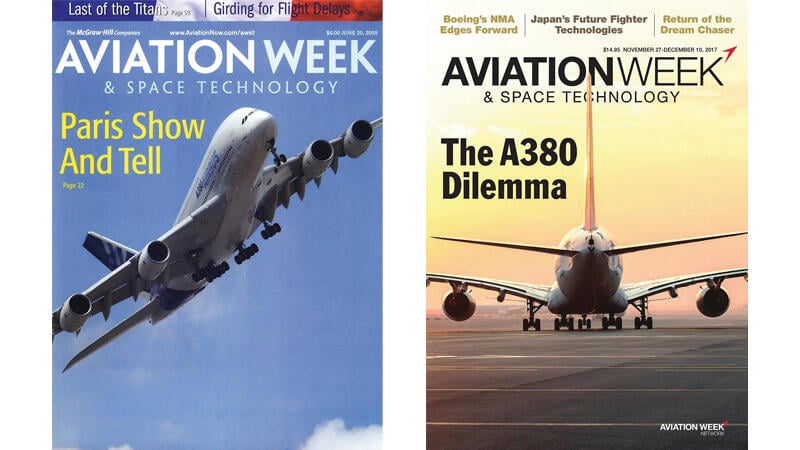
A380: End of the Line
“If you have a product that nobody wants anymore, or you can only sell only below production cost, you have to stop it, as painful as it is.” So said Airbus’ then-CEO Tom Enders in February 2019, announcing that A380 production would end in 2021, barely 16 years after the ultralarge airliner wowed the crowd with its debut display at the 2005 Paris Air Show. The end was presaged in editor Jens Flottau’s November 2017 article from a Dubai Airshow press conference and the “unprecedented public humiliation” when key customer Emirates Airline snubbed Airbus and signed a surprise order with Boeing for 787s. Emirates later ordered the expected additional A380s, only to cancel them, precipitating Airbus’ decision to end production. Despite the A380’s “outstanding engineering and industrial achievement . . . we have no substantial backlog and hence no basis to sustain production,” Enders said, ending Airbus’ great adventure.
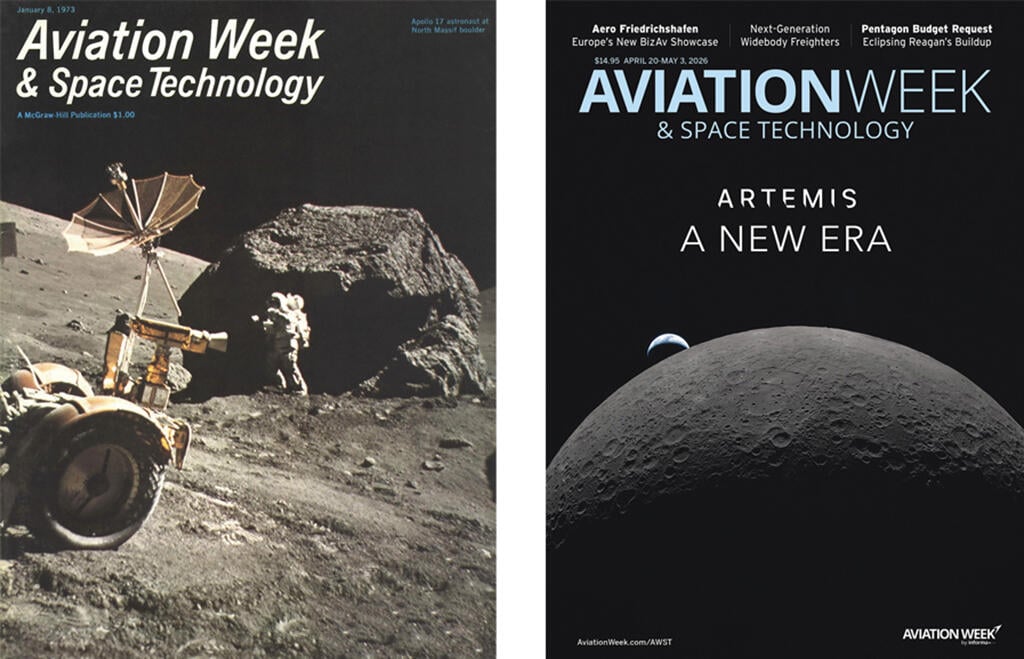
Back to the Moon
It would take 53 years from the time U.S. astronaut Harrison Schmitt was photographed next to Split Rock on the lunar surface during the Apollo 17 final mission in 1972 until humans to return to deep space. In 2019, during his first term in office, President Donald Trump called for “NASA boots on the Moon” by 2024—“a timeline that could be a blessing or a curse,” Space Editor Irene Klotz wrote. NASA did not get the budget increase needed to accelerate the Artemis program by four years. But on April 6, 2026, Artemis II rounded the Moon, giving the four astronauts on the debut crewed mission stunning views of Earth and the lunar far side. Time will tell if the flight marks the dawning of a new era of space exploration, Klotz wrote, quoting NASA Administrator Jared Isaacman: “The Artemis program picks up where Apollo 17 left off but will live on past any one rocket or crewed vehicle . . . to ensure that we never give up the Moon again.”
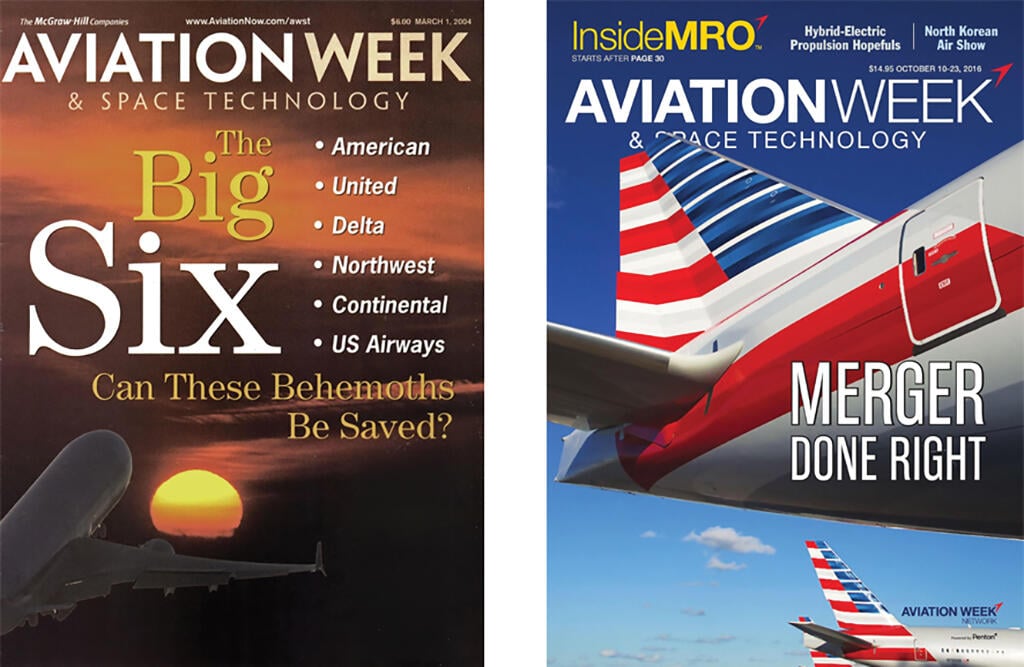
Airline Merger Mania
The maelstrom that engulfed U.S. airlines after Sept. 11, 2001, was over, but the day of reckoning had only been postponed, Editor-in-Chief Anthony L. Velocci, Jr. predicted in 2004. He was right. By 2013, the six legacy majors were three, capped by a merger of American Airlines and US Airways that by 2016 was “mostly living up to its promises,” AW&ST concluded. And the transformation did not stop there. When Velocci health-checked the industry in 2004, the low-cost carriers were grabbing market share from the major airlines. In 2026, they are experiencing their own crisis, with Spirit Airlines shutting down in May and Southwest Airlines parting ways with its no-frills business model to compete with the Big Three legacy majors, which have learned to beat them at their own game.
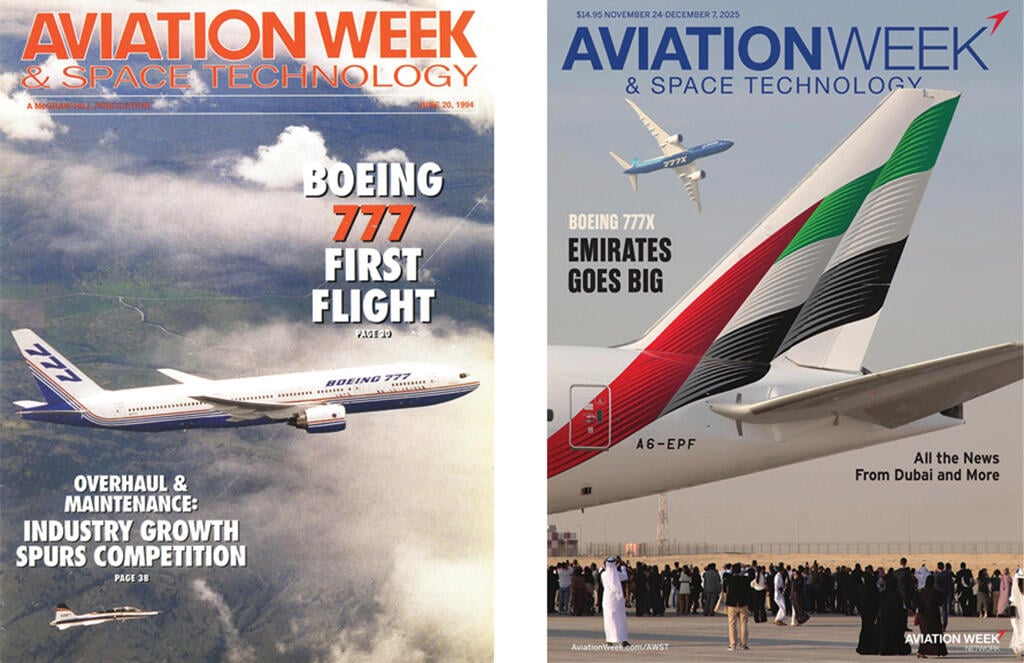
Boeing 777: Study in Contrasts
Boeing’s 777 was developed at what now seems like a breakneck pace. The widebody was launched in October 1990, first flown in June 1994, entered service barely a year later and—almost 1,800 aircraft later—is still being produced as a freighter. The test program got off to a quick start, editor Paul Proctor wrote after that first flight, noting, “the massive certification effort will involve nine 777s powered by three engine types flying an estimated 6,700 hr. and 4,800 cycles.” But the first 777 was delivered to United Airlines on schedule in May 1995 and went on to achieve “the smoothest entry into service of any new aircraft in history,” editor Carole Shifrin wrote in June 1997. While airlines have embraced its successor, the 777-9, they must wait until 2027 for deliveries, almost 14 years after launch and seven after first flight. The delays have not deterred customers. News emerged at the Dubai Airshow in November 2025 of airline interest in a bigger 777-10. “We want them to take a good, hard look at a stretch,” Emirates Airline President Tim Clark was quoted as saying in an article by editors Guy Norris and Jens Flottau.
Breaking the Duopoly
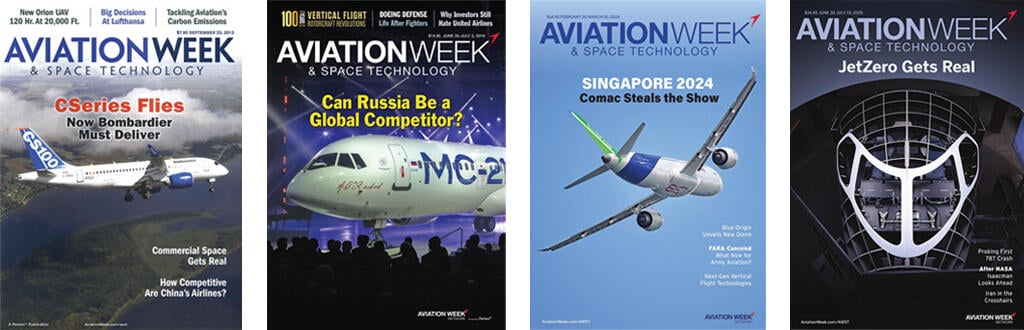
Who will challenge Airbus and Boeing in their dominance of the commercial aircraft market? Canada, Russia or China? The wait continues. Montreal-based Bombardier’s bid came to an end in 2018 with the transfer of the C Series airliner program to Airbus for $1 and the birth of the A220. Irkut (now Yakovlev) rolled out the MC-21 in June 2016, prompting AW&ST editors to ask: Is this finally a Russian commercial aircraft that can compete globally? It was almost the same question posed in November 2015, when China’s Comac rolled out the first completed C919. Both aircraft made their first flights in May 2017, but delays followed. China’s C919 finally entered service in 2023. Russia’s MC-21 is delayed to 2027 due to the need to replace Western components. The C919 starred in the February 2024 Singapore Airshow, and AW&ST’s team reported that Comac was sending a clear message that the C919 is now part of the international commercial aircraft scene. Neither Airbus nor Boeing seem worried, however. Will U.S. startup JetZero break the mold with its blended wing body? “Can JetZero really pull this off?” editor Guy Norris asked in a June 2025 article that revealed the startup’s plans to build a full-scale blended wing body demonstrator. The answer, quoting cofounder and CEO Tom O’Leary, was an unequivocal “yes.”
China’s Race to Space
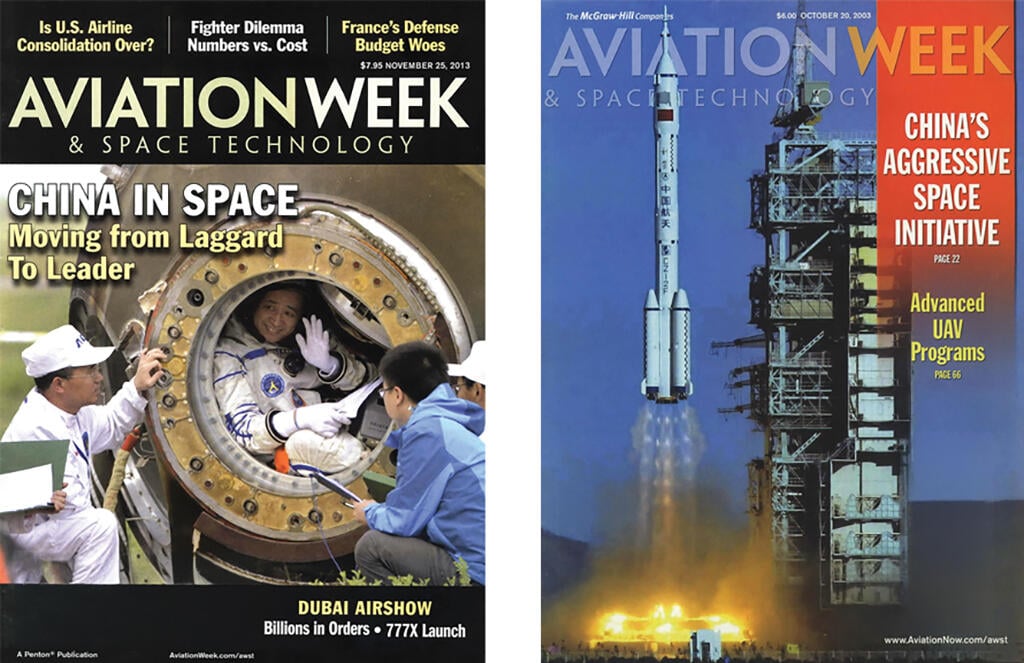
In 2003, with the launch of Shenzhou 5, China became only the third country after Russia and the U.S. to have its own human spaceflight capability. In less than a decade, Beijing had flown a dozen taikonauts and launched a mini-station. Within two decades, China had established a permanent crewed space station, Tiangong, and begun routine crew rotations and cargo resupply flights. Even that first 21-hr. 23-min flight on Oct. 15, 2003, by Lt. Col. Yang Liwei, a People’s Liberation Army Air Force fighter pilot, had U.S. defense analysts worried about China’s military ambitions in space, Space Editor Craig Covault reported. Those concerns have only grown as the pace of the country’s space program has accelerated. Even as China’s leaders touted progress in human spaceflight as evidence of its superpower status, editors Frank Morring, Bradley Perrett and Amy Svitak noted in November 2013 the U.S. military and political unease over a constellation of maneuvering Chinese satellites and the threat posed by orbital debris from a 2007 Chinese antisatellite test.
What Next for Embraer?
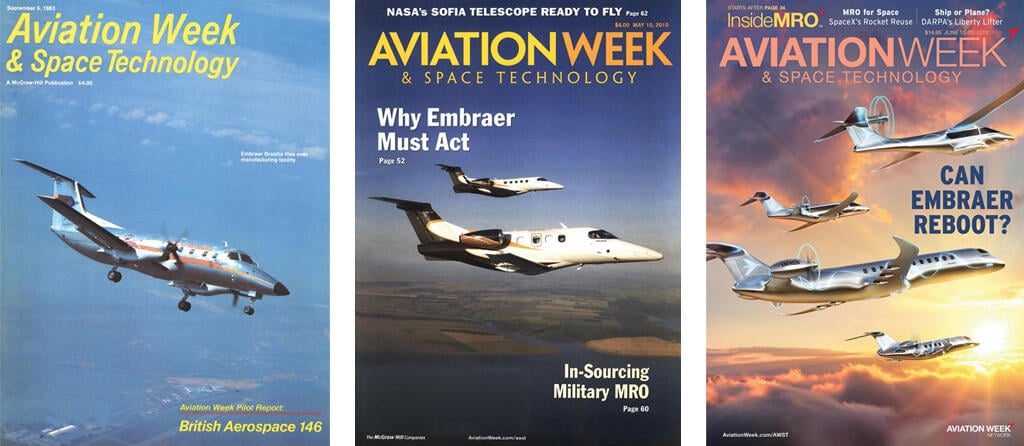
Emerging on the aerospace stage in 1969, Brazil’s Embraer carved out a lucrative niche in the regional market following the success of its EMB 120 Brasilia 30-seat turboprop, first flown in 1983, with the popular 40-50-seat ERJ and 70-146-seat E-Jet and E-Jet 2 families. Success in business and military aviation followed. Embraer entered the executive aircraft market in 2005, launching the Phenom family of light jets and challenging market leader Cessna head-on. The Phenom 300 has now been the bestselling light jet for 14 straight years. On the defense side, Embraer has built a growing export business around the Super Tucano trainer/attack aircraft and C-390 tanker/transport. The company has branched out into advanced air mobility through spinoff Eve. But where Embraer will go next has been a popular topic for AW&ST covers—and remains so almost 60 years later. Will the company take on Bombardier and Gulfstream with a large-cabin, long-range business jet? Or will it do the almost unthinkable and challenge Airbus and Boeing in the narrowbody market? Over the past 15 years, Embraer has consistently said it is studying the market, but a decision is not imminent. “We are always looking at future options in our business,” CEO Francisco Gomes Neto said on an earnings call in May 2024.
Nuclear Power for Space
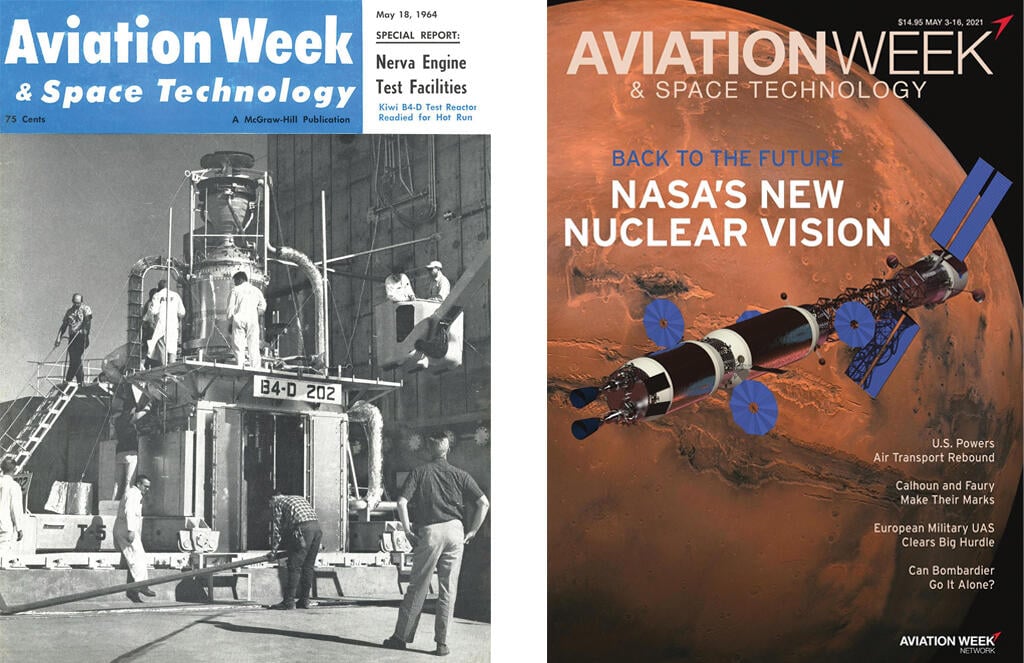
Nuclear propulsion for space travel has been a recurrent theme in AW&ST, from the Nerva nuclear rocket engine test stand featured on the cover in 1964 to the resurgence of interest in nuclear propulsion for Mars missions in the 2020s. Plans have shifted to nuclear electric propulsion, with a launch set for 2028, but hopes are high that the era of nuclear space is finally coming. The first Nerva nuclear thermal rocket was being prepared for testing when editor Erwin J. Bulban reported on the program in 1964. Six engines were tested but, despite being judged a success, Nerva was canceled by President Richard Nixon in 1973. It would be decades before the U.S. resumed research. Senior Editor Guy Norris reported in 2021 on DARPA and NASA plans for an in-space demonstration of a nuclear thermal propulsion system. Priorities would shift, however. In June 2026, Norris and Military Space Editor Vivienne Machi wrote about a NASA-led, whole-of-government charge to accelerate the deployment of reactors for power on the Moon and nuclear electric propulsion to power a spacecraft to Mars before continuing deeper into the Solar System. “Can U.S. space nuclear ambitions finally get off the launchpad?” they asked.
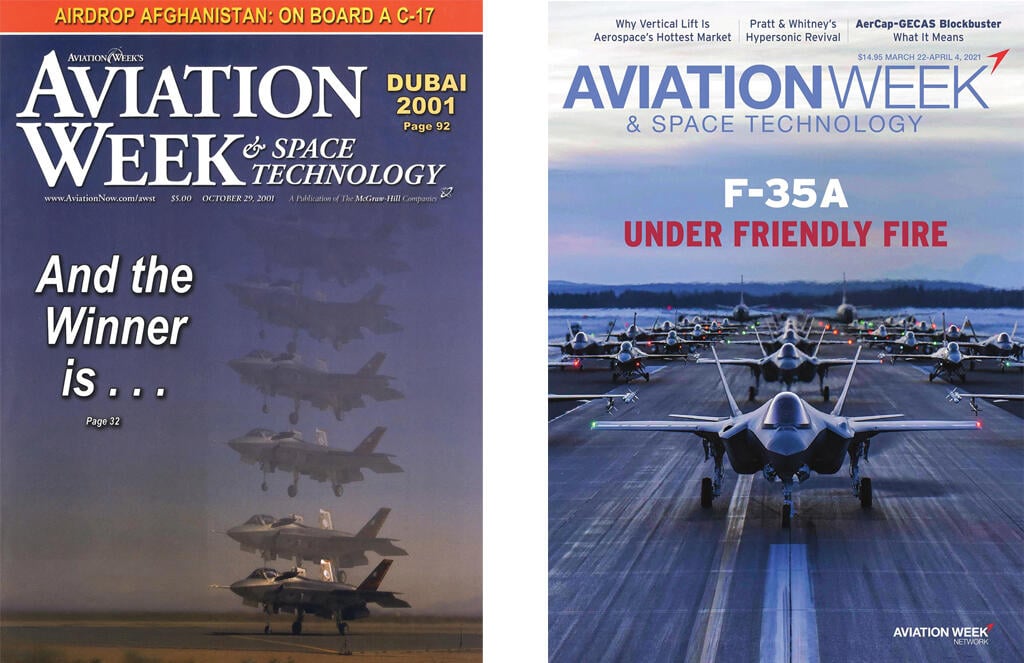
F-35: Headline-Maker
With a Pentagon decision on its biggest-ever contract due just after the magazine’s deadline, AW&ST delayed printing the Oct. 29, 2001, issue by a day and prepared alternative covers. Would it be Boeing’s X-32 or Lockheed Martin’s X-35? When Lockheed beat Boeing to win the Joint Strike Fighter (JSF) program, the X-35 won its way onto the cover—and not for the last time. With its complexity and challenges, the F-35 program would make several more cover appearances. “No ifs, ands or buts about it, Lockheed Martin’s victory . . . is a huge win for the company and its teammates Northrop Grumman and BAE Systems,” editors David Fulghum and Robert Wall wrote. They asked what would become of Boeing’s fighter business, a question that was not resolved until the company won the U.S. Air Force’s F-47 Next-Generation Air Dominance fighter program in 2025. For the Lockheed team, winning the multivariant, multiservice, multinational JSF program was just the beginning of years of highs and lows. “The Lockheed Martin F-35A is in trouble again,” editor Steve Trimble wrote in March 2021, with the U.S. Air Force “openly considering more affordable alternatives.” Costs, delays and operational readiness are continuing issues, but more than 1,340 F-35s have been delivered, and the aircraft has seen combat success with Israel, the U.S. and the UK.
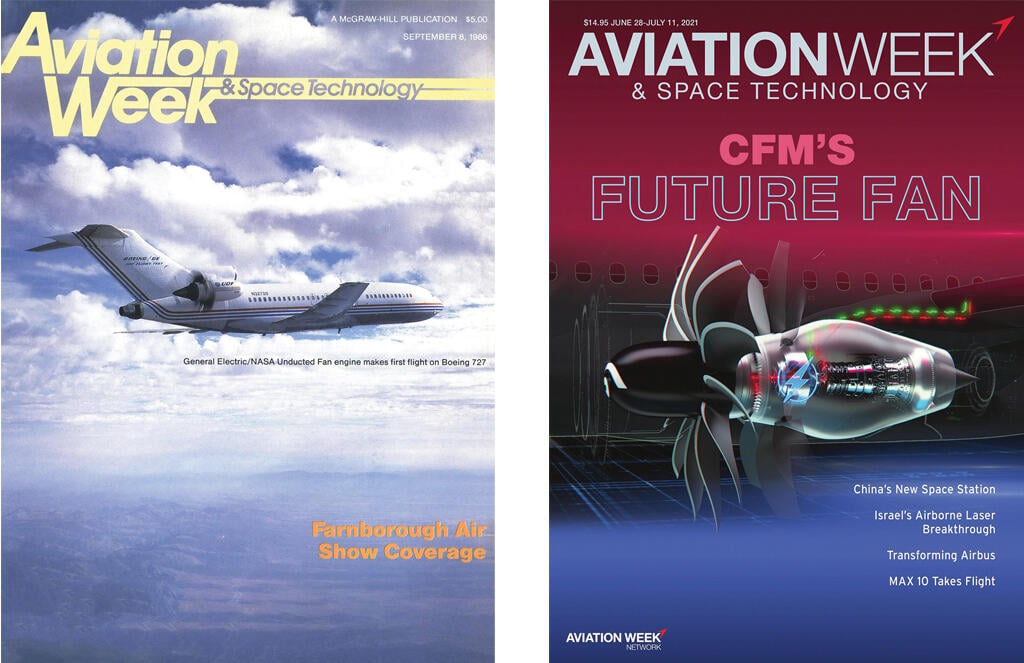
Open Rotor Revival
Markets evolve, technologies mature and ideas reemerge. In 1988, General Electric’s GE36 Unducted Fan (UDF) engine testbed made its international debut at the Farnborough Airshow. Almost 40 years later, GE and Safran’s joint venture company CFM International is progressing toward flight tests by decade’s end of its Open Fan engine candidate for Airbus’ next-generation single-aisle. The GE36 was one of two open-rotor engines flown in an MD-80 modified into a testbed by McDonnell Douglas. The other was Allison’s 578-DX propfan. GE’s open-rotor engine demonstrated a 30% reduction in fuel burn over the MD-80’s standard turbofans, but oil prices dropped, and the idea did not take off. Planned UDF-powered airliners from Boeing and McDonnell Douglas never materialized. But research continued at GE and NASA in the U.S. and at Safran in Europe, and in 2021 CFM launched the Revolutionary Innovation in Sustainable Engines (RISE) program to develop technology for its next single-aisle engine. But why now? “In its accelerating quest for sustainability, aviation needs a step change in fuel efficiency,” editors Guy Norris and Thierry Dubois wrote in June 2021. And why open rotor? “The answer, says CFM, is timing and technology,” they wrote. As Airbus heads toward a launch decision in 2030 on its eAction next-generation single-aisle, the Open Fan is set to be flown on an A380 testbed in 2029.
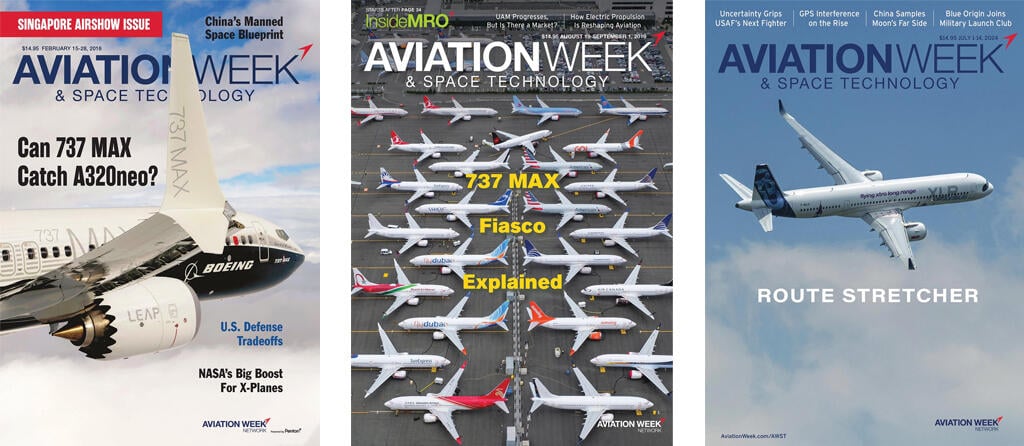
Single-Aisle Showdown
Forced into launching the 737 MAX to compete with Airbus’ A320neo, Boeing hoped to maintain its dominant narrowbody market share. “The case for the smooth development of the new 737 is urgent,” editor Guy Norris wrote in 2016. But by the time the 737-8 flew in January 2016, Boeing was more than a year and 1,300 orders behind Airbus—and it would only get tougher. The company was “quietly confident” it could accelerate deliveries and close the gap, Norris wrote. It was not to be. The MAX grounding in 2019-20 following two fatal crashes slowed production, and the A320 family overtook the iconic 737 in total deliveries in October 2025. How one of the industry’s most successful models ended up grounded less than two years after entering service was explored in detail by editor Sean Broderick in August 2019. Seven years and three CEOs later, Boeing is finally emerging from its lengthy interregnum: Once capped by the FAA, MAX production is ramping back up, and the final 737-7 and -10 family members are undergoing certification. Airbus is almost 4,900 orders ahead, however, led by demand for the larger A321neo.

SpaceX: Startup to Star Turn
In 2004, SpaceX was a scrappy startup attacking the high-cost culture of the U.S. launch industry and planning to undercut Boeing’s dominant Delta family with the Falcon V. “SpaceX plans to pursue Boeing by using existing technology in innovative ways,” Space Editor Craig Covault wrote in the March 29, 2004, issue of AW&ST, which featured the company’s first booster, the Falcon 1, on the cover. It would take SpaceX four launch attempts to reach orbit with the Falcon 1, but the rest is history. The larger Falcon V, in development when Covault wrote in 2004, became the workhorse Falcon 9, which has launched 682 times since 2010. Today, SpaceX dominates the space industry. The company’s rapid ascendance has been documented on several AW&ST covers. They include a jubilant Elon Musk celebrating the first crewed Dragon mission to the International Space Station for NASA in June 2020, making SpaceX the first private entity to fly people in orbit. “This is hopefully the first step on a journey toward a civilization on Mars,” Space Editor Irene Klotz quoted Musk as saying. Gracing the cover in October 2024, the dramatic first gantry capture of the reusable Starship underlined Musk’s relentless drive to reach Mars this decade. After its historic trillion-dollar public listing in June, SpaceX has left its upstart origins far behind.
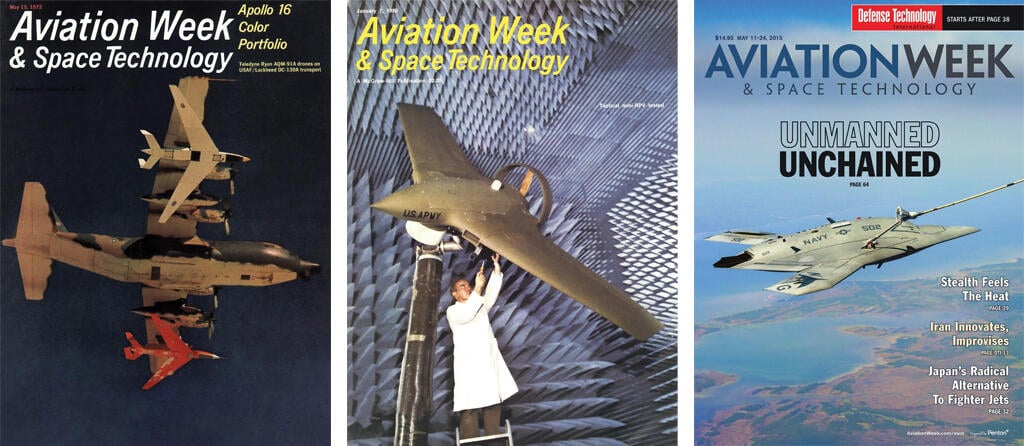
UAS: Expendable to Indispensable
The term might change—remotely piloted vehicles (RPV), uncrewed aerial vehicles (UAV), autonomous aircraft, drones—but AW&ST has tracked the development of uncrewed aviation back to the 1940s. The story traces through Ryan’s AQM-91 Firefly, developed but never used to overfly China, to the recent emergence of sophisticated uncrewed combat aircraft, such as Northrop Grumman’s carrier-based X-47B demonstrator. The Lockheed MQM-105 Aquila mini-RPV, the U.S. Army’s first effort to develop a battlefield drone, was a cover story in January 1980. It was a spectacular failure. Plagued by soaring costs, shifting requirements and poor management, the Aquila was canceled in 1987. By then, Israel had resoundingly demonstrated the military value of UAVs. The Aquila debacle would shape U.S. uncrewed aircraft development for decades to come. The milestone carrier capability and autonomous refueling demonstrated by the X-47B in 2013-15 have yet to be deployed operationally but presaged the current wave of global activity in collaborative combat aircraft and crewed-uncrewed teaming.
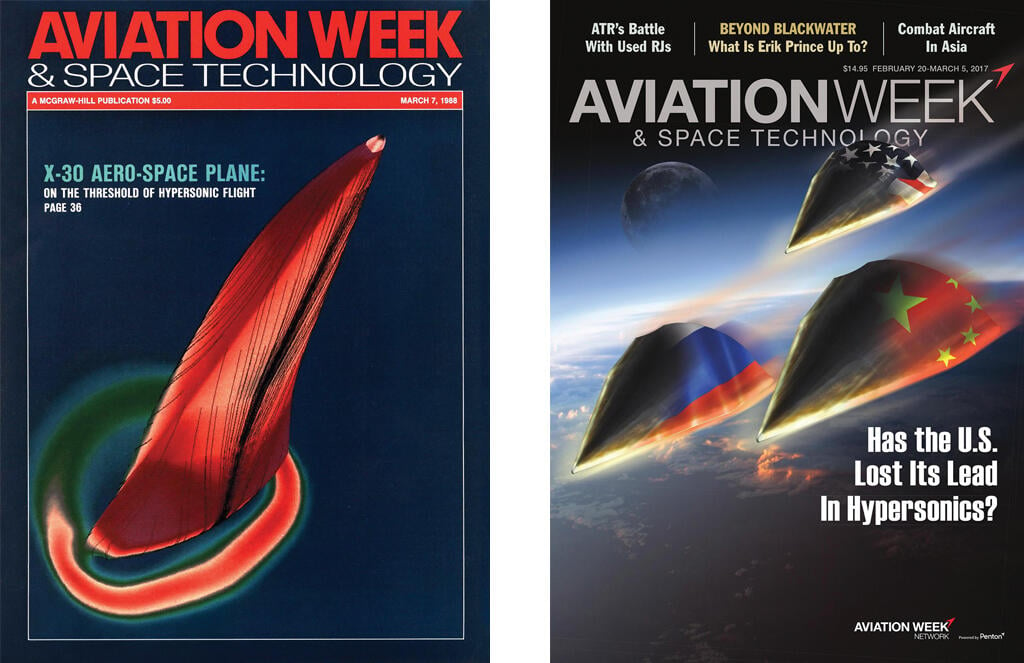
Hypersonic Highs, Hypersonic Lows
Success of the Rockwell X-30 National Aero-Space Plane “is no longer a technical issue as much as a management issue,” editor Craig Covault quoted a program manager as saying in 1988. The wave-riding X-30 was designed to fly up to Mach 25 on the power of slush hydrogen and scramjet engines. The $3.3 billion program was the largest experimental aircraft project ever undertaken by the U.S., Covault reported. Doomed by technological overambition, the X-30 was dead by 1993—and with it much of U.S. hypersonics research, a trend reversed only after editor Guy Norris revealed in 2017 that a classified report warned the U.S. risked losing its lead in hypersonics to China and Russia. In 2013, with the success of the scramjet-powered Boeing X-51A, the U.S. seemed to be on the brink of developing the first generation of air-breathing high-speed strike weapons, Norris wrote. Four years later, the U.S. was in danger of falling behind its rivals. What followed was a rush to develop and field a slew of hypersonic weapons—none of which have reached fruition yet. “Much as war plans seldom survive first contact with the enemy, advanced defense technologies rarely work out as conceived,” editor Steve Trimble wrote in July 2026, reviewing the shifting priorities of U.S hypersonic weapon development efforts.
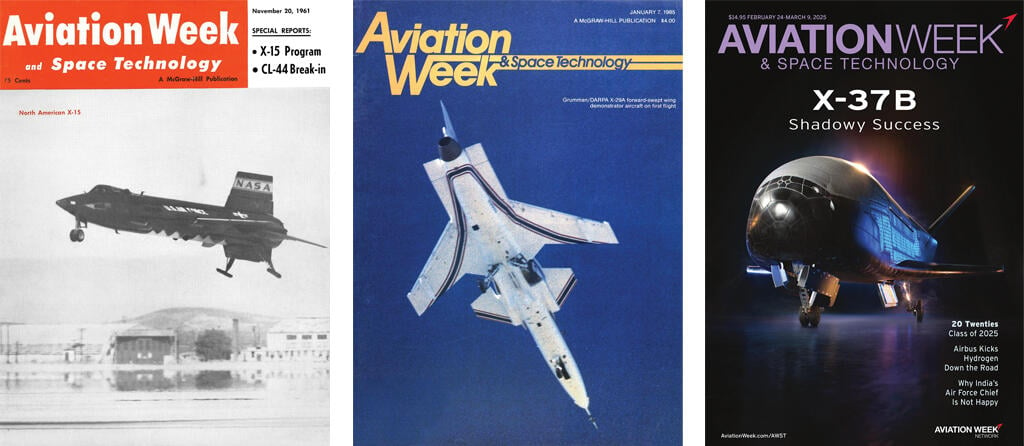
X-Plane Excellence
From Aviation Week’s scoop on Bell’s XS-1 breaking the sound barrier in 1947 to the mysterious orbital activities of Boeing’s X-37B reusable spaceplane, X-planes have been part of the magazine’s lifeblood. They include the North American X-15, which flew 199 times and set the speed record for crewed, powered flight of Mach 6.7 that remains unbroken. Laying the foundation for the space shuttle, the X-15 was the most successful crewed experimental vehicle ever flown by the U.S.—and test pilot Scott Crossfield was synonymous with the rocketplane. “Simply put, the X-15 was Crossfield,” AW&ST stated, awarding him a Laureate for Lifetime Achievement in 1998. Other X-planes that featured on the cover include Grumman’s X-29 with its distinctive forward-swept wing in 1985, and, in 2025, the X-37B, which spent more than 3,774 days in orbit over six completed missions. A seventh mission was about to end after 484 days in space when Military Space Editor Vivienne Machi wrote in February 2025 that the minishuttle was playing a key role in pending decisions on how best to give the U.S. a military edge in a contested domain.
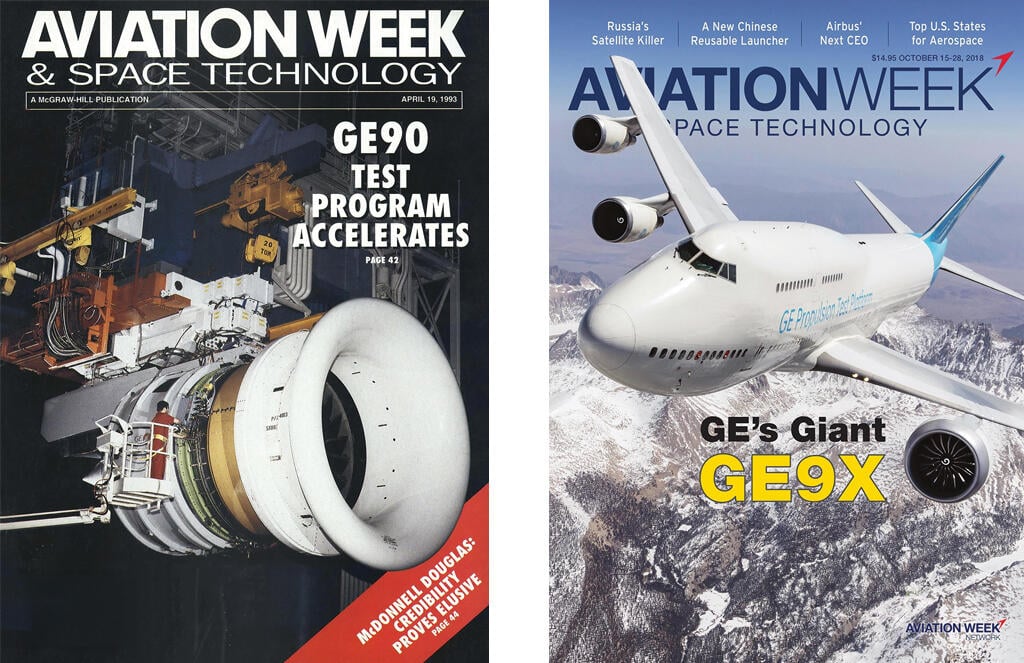
GE’s Giant Engines
When it launched the GE90 in 1990, GE faced competition to power Boeing’s 777 from both Pratt & Whitney and Rolls-Royce. But in 1999, GE struck a deal to power new long-range derivatives of the 777 solely with the 115,000-lb.-thrust GE90-115B—the most powerful commercial engine in service. Reporting on the fast-paced GE90 test program in April 1993, editor Stanley Kandebo said the core of the initial 84,700-lb.-thrust engine was planned as the heart of a family of advanced GE engines. He was proven correct. In addition to being scaled up to the -115B, the GE90 core was scaled down to the GEnx, the dominant engine choice on Boeing’s 787. Reporting on the program in April 2006, editor Michael Mecham wrote that the GEnx was the payoff on GE’s three decades of development work on composites. Exclusivity on the 777-200LR/300ER, meanwhile, proved crucial to the success of the original GE90 and continues on the 777X with the GE9X, which—with a 134-in.-dia. fan—is the largest production engine yet. Reporting in 2018 on GE’s plans to test the GE9X on its 747 flying testbed, editor Guy Norris quoted Chief Test Pilot Jon Ohman: “The sheer size of that engine is absolutely impressive. It’s about the size of a 737 fuselage, and to see that on the airplane is incredible.”
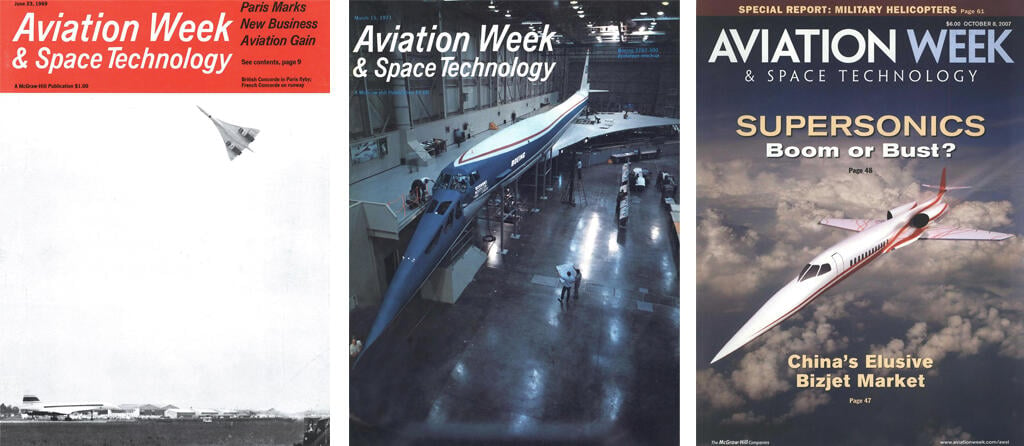
Supersonic Redux
When British and French Concordes debuted at the Paris Air Show in 1969, aviation was on the cusp of supersonic air travel. But by the time a mockup of Boeing’s 2707 featured on AW&ST’s cover in March 1971, the U.S. response to Europe’s lead was headed for cancellation. Such was the interest in supersonic flight that the Concorde appeared on no fewer than three AW&ST covers in 1969, marking the elegant aircraft’s first flight and show debut. But economic failure and a fiery crash would spell the end. “The retirement of the first and only supersonic commercial transport is not a step back for future fast air travel; it instead reveals our failure to take a step forward,” Editor-in-Chief David M. North wrote after the aircraft ceased operations in 2003. The dream did not die with the Concorde, and whether there is a future for supersonic air travel was the subject of several AW&ST cover stories in the years that followed. While Aerion failed to develop its supersonic business jet, featured on an October 2007 cover, startup Boom Technologies still plans a Mach 1.7 airliner for the early 2030s.
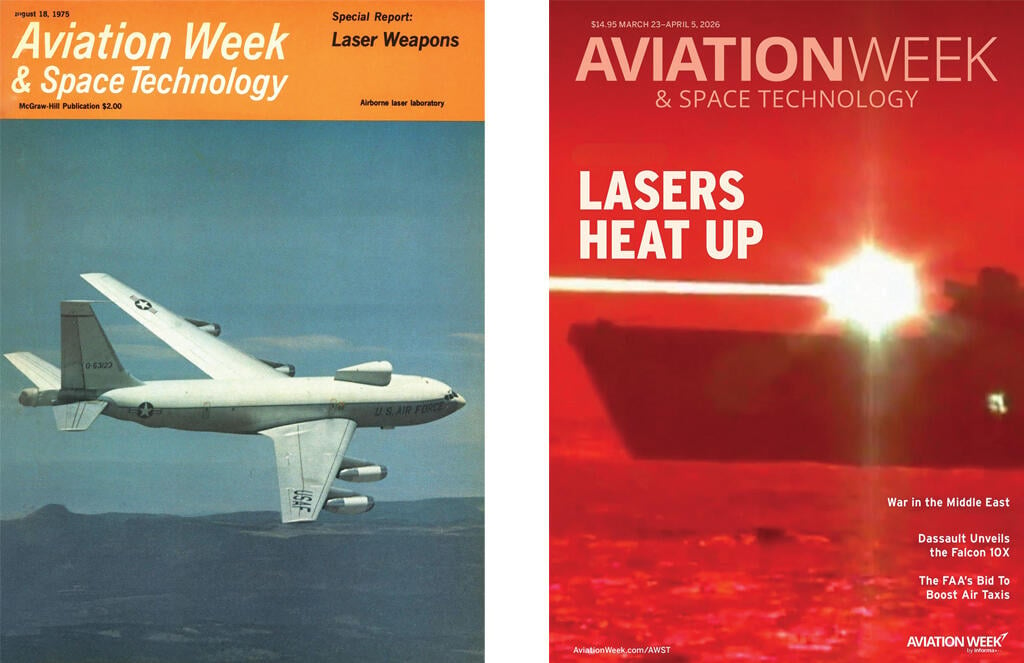
Lasers Light Up
The U.S. Air Force’s Airborne Laser (ABL) program was ready to declare victory in developing a directed energy weapon to shoot down ballistic missiles, editor Robert Wall wrote in 1999. Boeing’s YAL-1, a modified 747-200, would go on to destroy one missile target and damage another with its megawatt-class chemical laser in a February 2010 test. But by 2012, ABL—a follow-on to the NKC-135A Airborne Laser Laboratory featured on AW&ST’s cover in 1975—was canceled. It was not until the 2020s that the technology matured into practical weapons. “High-energy lasers are having a long-overdue moment,” editor Steve Trimble wrote in March of this year. China and Israel have fielded weapons, and, as a result of decades of fundamental research and a steady stream of funding, the U.S. is poised to deploy laser weapons ranging from 20 kW to 120 kW by 2027 to counter drones and missiles.
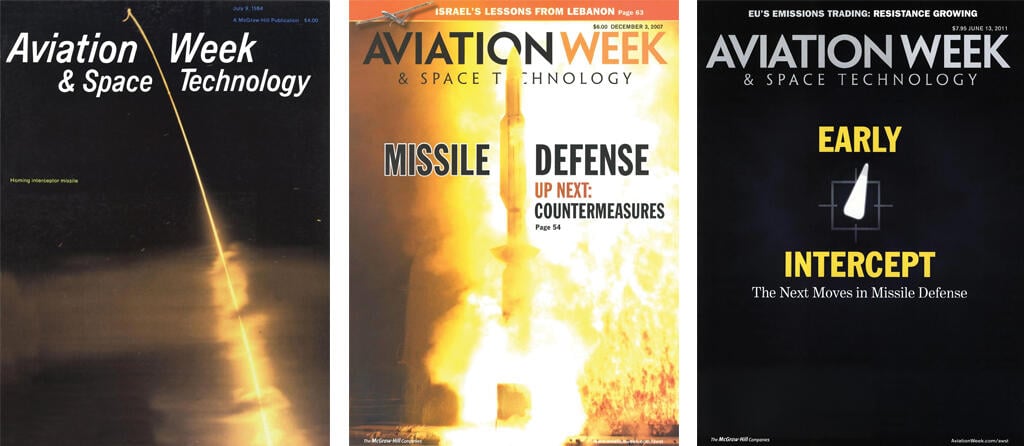
Stars Wars to Golden Dome
The dramatic cover of AW&ST’s July 9, 1984, issue shows the first-ever successful “hit-to-kill” intercept of a ballistic missile, conducted under the U.S. Army’s Homing Overlay Experiment—a milestone in missile defense and a high point in the abortive Strategic Defense Initiative. The Star Wars program petered out in 1993, but ballistic missile defense continued to evolve. After a series of embarrassing failures, the U.S. Missile Defense Agency (MDA) was making progress by the late 2000s. “It is absolutely remarkable how far we’ve come,” Lt. Gen. Trey Obering was quoted as saying by editor Amy Butler in AW&ST’s Dec. 3, 2007, issue. On the cover was Raytheon’s SM-3 missile, the sea-based component of the MDA’s ballistic missile defense system, which in a recent test had destroyed two ballistic missile targets simultaneously. Ballistic missile defense was again the cover story in June 2011, with a dramatic image showing a warhead target in the crosshairs of an SM-3’s infrared seeker. Butler’s story explored questions around the MDA’s plan to deploy an early-intercept capability in Europe to protect against Iranian missiles. That capability is now operational in the shape of land-based, SM-3-armed Aegis Ashore systems in Poland and Romania.
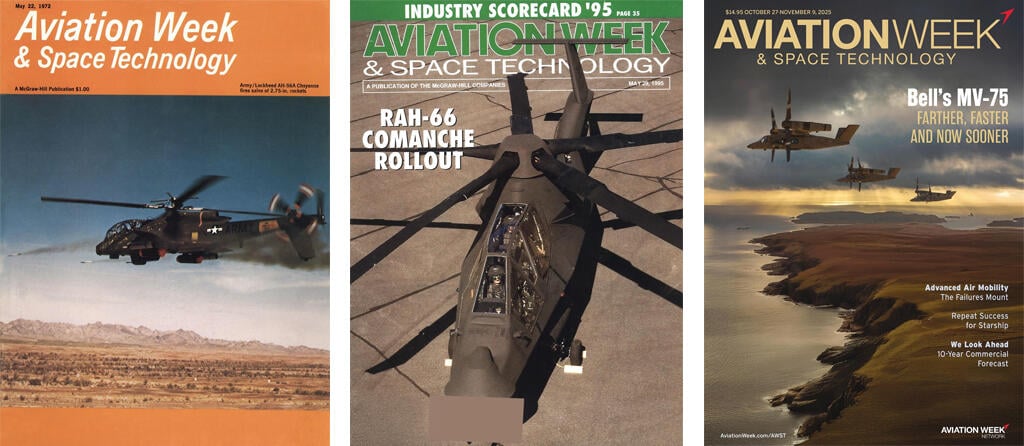
Rotorcraft Roundabout
The U.S. Army’s troubled history with advanced rotorcraft development has played out in the pages of AW&ST over the decades. Lockheed’s rigid-rotor AH-56 Cheyenne was already headed for cancellation when it appeared on the cover in 1972, a victim of post-Vietnam War changes. In his May 12 pilot report, editor Robert Ropelewski praised the AH-56’s exceptional stability and maneuverability. But he also noted “congressional skepticism of the need for a system as complex and expensive as the Cheyenne.” Congress prevailed. The Army canceled the AH-56 and launched a new program that produced the iconic Boeing AH-64 Apache. By the early 1990s, the Army planned to partner the AH-64 with a stealthy scout/attack helicopter, the Boeing-Sikorsky RAH-66 Comanche. “[The Comanche] is projected to be the cornerstone of the U.S. Army’s future warfighting strategy,” editor Stanley Kandebo wrote from the rollout in May 1995. But the program was terminated in 2004, as costs soared. Several more false starts later, the Army is reviving the Cheyenne name and trying again with the Bell MV-75. Reporting in October 2025 on the risks behind aggressive plans to accelerate fielding of the advanced tiltrotor to 2030, editors Brian Everstine and Steve Trimble noted that the move “adds pressure to the Army’s biggest acquisition program, but the service says it is worth the risk.”
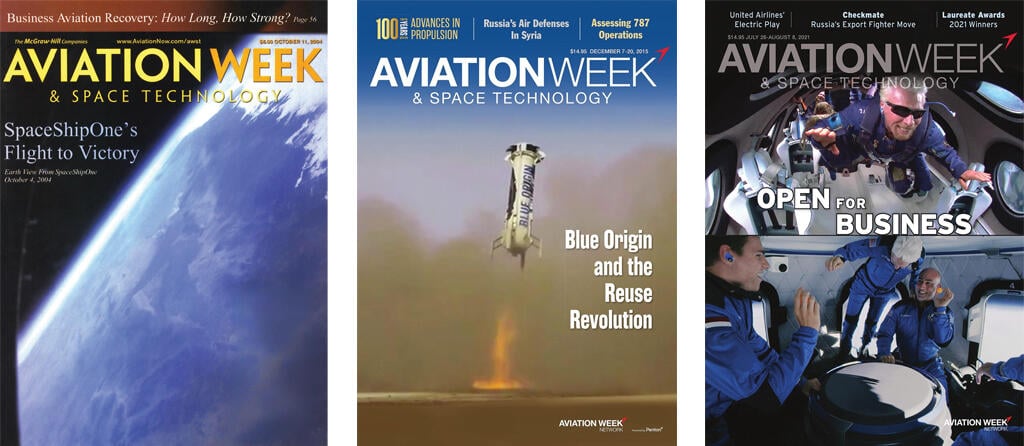
Suborbital Spaceflight
By winning the Ansari X Prize and a place on AW&ST’s cover in 2004, Burt Rutan’s SpaceShipOne opened the way to reusable space tourism. Editor Michael A. Dornheim reported on Scaled Composites’ plans to build suborbital vehicles for space tourism startup Virgin Galactic. But it was Blue Origin’s New Shepard that was the first to carry a paying customer to suborbital space in July 2021, simultaneously creating the world’s oldest and youngest astronauts: Wally Funk at 82 and Oliver Daemen at 18. Funk, who died in July at age 87, had been denied the chance to become a NASA astronaut. “I am so delighted that Wally had that opportunity to reach her dream,” astronaut Eileen Collins wrote in an appreciation published by AW&ST in July. Virgin Galactic flew founder Richard Branson into space and onto the AW&ST cover in July 2021, but did not begin commercial flights until 2023. “After decades of fits and starts, private space travel is on firm footing, with two suborbital spacelines” as well as orbital flights by SpaceX, Space Editor Irene Klotz wrote following the 2021 flights. For now, both programs are on pause: Blue Origin is focusing on development of its New Glenn orbital launch vehicle, and Virgin Galactic is completing development of its improved Delta-class SpaceShip, aiming to resume suborbital flights by year-end.
We look at how stories unfolded on Aviation Week’s covers.

Comments