This article is published in Aviation Daily part of Aviation Week Intelligence Network (AWIN), and is complimentary through Dec 24, 2025. For information on becoming an AWIN Member to access more content like this, click here.
DUBAI—The UAE is working toward making the use of sustainable aviation fuel (SAF) mandatory in the country as a key component of its SAF policy roadmap, says Sharif Al Olama, undersecretary for energy and petroleum affairs at the ministry of energy and infrastructure.
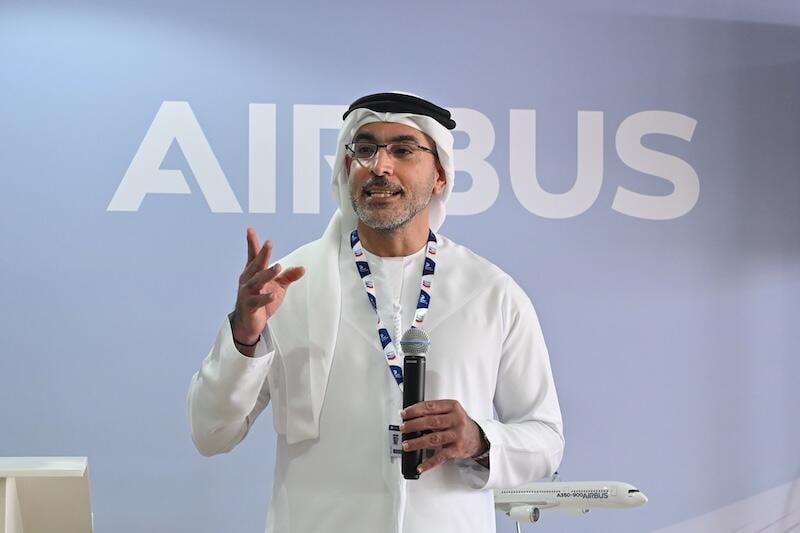
Today, the “soft requirement” is for carriers to uplift 1% SAF on a voluntary basis by 2031, but the government is working with Gulf carriers and other stakeholders to bring in a SAF mandate making it compulsory, Al Olama told Aviation Week prior to a meeting of the UAE government’s SAF & LCAF (Low Carbon Aviation Fuel) Executive Committee hosted by Airbus on Nov. 17 here at the Dubai Airshow.
“When we launched the [voluntary] policy, we wanted to test the water with our national airlines and test the environment to see the acceptance of utilizing SAF,” Al Olama said.
The government is now moving to the next phase of understanding what the impact of a SAF mandate would be on airlines and how additional costs would be passed on to consumers.
“We are very cautious when it comes to getting new policies or new mandatory requirements on board because we are aware that there can be some impact on the operations of our national airlines, so we really need to strike that balance,” Al Olama said.
Although he stressed the UAE’s cautious approach to SAF, the country “really wants to hit the ground running” when it comes to adopting and producing SAF. “Whenever we see there is a global need, the UAE takes the lead. We have the soft power to drive this on a global scale,” Al Olama said.
One initiative the UAE government is pursuing is a bid, alongside UK-based Chinook Hydrogen, to develop a SAF production plant at Hong Kong International Airport, he said.
“We are hoping it's going to be a major success, and if this project does come through, I see it as a blueprint that we can apply immediately in the UAE,” Al Olama said.
The UAE is “very pragmatic” when it comes to sustainability policy and planning, said Gabriel Sémelas, president for Africa and Middle East at Airbus.
“There is a great alignment between the government, the regulators, the local entities, all the technicians doing all the work required and industry,” Sémelas added. “I think this is unique. It doesn't happen in every place in the world,” and can be used as an advantage, not just in the UAE, but globally.