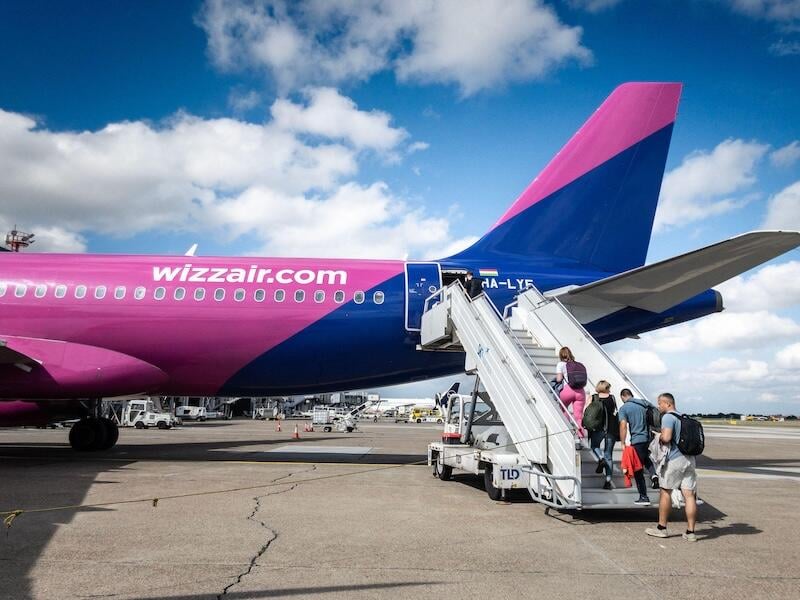
Passengers board a Wizz Air jet at Belgrade Nikola Tesla Airport.
Wizz Air has warned that its Belgrade base could be forced to close from November following regulatory changes introduced by Serbian authorities.
The Hungary-based ULCC has accused Serbia of introducing measures that would effectively prevent it from continuing to operate a base in the capital, arguing that the changes conflict with the European Common Aviation Area Agreement.
“Wizz Air strongly condemns the Serbian authorities’ plan to breach its obligations to Europe as they implement measures aiming to force the airline to cease its base operations in Belgrade from November 2026,” the airline says in a statement.
The dispute centers on amendments adopted by Serbia’s Civil Aviation Directorate (CAD) in March concerning the authorization of foreign carriers operating international services to and from the country. According to the revised regulations, European Union (EU) carriers operating under third- and fourth-freedom rights would be authorized to conduct flights that originate and terminate within the European Union or the carrier’s home state.
Wizz Air argues that the changes threaten its ability to continue operating aircraft based in Belgrade, where it currently maintains a four-aircraft base and serves 23 destinations, including Barcelona, Hamburg, Madrid, Malta and Rome Fiumicino. According to OAG Schedules Analyser data, the airline currently accounts for 20.9% of capacity at Belgrade Nikola Tesla Airport (BEG), making it the airport’s second-largest carrier behind Air Serbia, which holds a 51.9% share.
The carrier says it has invested heavily in Serbia since opening its Belgrade base in 2010, transporting more than 14 million passengers.
“Despite these contributions, Serbian authorities are now pursuing measures clearly designed to push Wizz Air out of Belgrade in an effort to shield the state-backed national carrier from legitimate competition,” the airline claims.
“The Serbian authorities must decide whether they support open markets, connectivity, investment and consumer choice—or whether they intend to restrict the market in order to protect artificially one carrier at the expense of the Serbian economy and against the interests of the Serbian people,” says Owain Jones, Wizz Air’s chief corporate officer.
Serbian regulators have rejected the airline’s characterization of the changes. In a statement, CAD Serbia says, “No air carrier has been denied the right to operate flights between the Republic of Serbia and the Member States of the European Union, nor the right to open new routes in accordance with applicable international agreements.”
The regulator adds that the amendments “do not represent a restriction of traffic rights, but rather a regulation of the regulatory framework that applies equally to all air carriers operating on the market of the Republic of Serbia.”
CAD also says it performs its responsibilities “professionally, impartially and in accordance with domestic and international regulations, with full respect for the principles of equality and fair competition.”
Wizz Air accounts for approximately 19.3% of departure-seat capacity from Serbia, OAG data shows, making it the second-largest airline after Air Serbia, which holds a 37.3% share. In addition to Belgrade, Wizz serves destinations from southern Serbia city Nis and Pristina, Kosovo.
BEG has been approached for comment.

Related Content