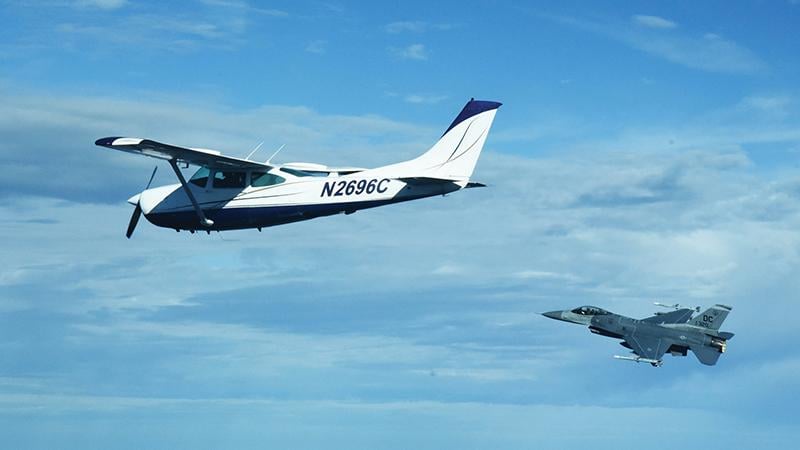
A D.C. Air National Guard F-16C Fighting Falcon escorts a Cessna 182 during a training exercise at McGhee Tyson Air National Guard Base.
An Air Force interceptor wagging its wings or flying in front of your aircraft dropping flares is an unwelcome surprise for any pilot, and it is not unusual for an aircraft intruding into protected airspace to be met on the ground by law enforcement.
The penalties for airspace violations can include fines and/or possibly even jail time, not to mention that the pilot is placing his or her passengers and the aircraft in danger. Ultimately, if an aircraft poses an imminent security threat, deadly force is possible.
Let’s review common mistakes that have resulted in responses by national security and law enforcement agencies and provide some insight to help pilots better understand how to avoid these inadvertent airspace incursions. We also will review a common misunderstanding by business aircraft pilots operating close to Washington, D.C.’s special airspace.
The security and defense of the nation’s airspace is assigned to the North American Aerospace Defense Command (NORAD). Its resources include supersonic interceptors positioned around the country with pilots on alert for immediate scramble upon detection of a possible threat.
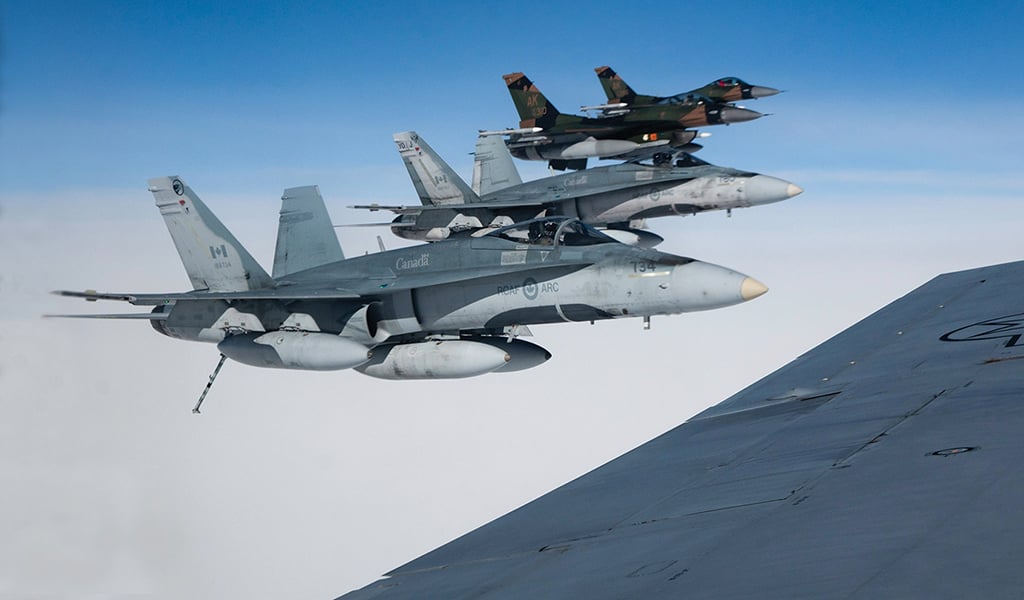
On average, the command responds to a “tactical situation” every 6 hr. due to an aircraft penetrating a security temporary flight restriction (TFR) area. VIP movements and special events such as include the Super Bowl require extensive coordination among security and military organizations to ensure the security of the airspace above these events.
Fixed- and rotary-wing aircraft from other security agencies are also used for these responses. U.S. Coast Guard helicopters in key locations have been equipped with lighted marquees on the right side that will advise the intruding pilots to switch to a specific radio frequency.
When may NORAD intercept an aircraft? Situations include unauthorized intrusions of a national security or VIP TFR, Washington D.C. Special Flight Rules Area or Air Defense Identification Zone. NORAD will also respond when the FAA or an airline has a concern about a potential threat, an inflight disturbance or an emergency squawk code.
Aircraft deviating from a flight plan can result in launching NORAD interceptors. Business aviation experienced this in October 1999 during the tragic loss of the Learjet 35 carrying professional golfer Payne Stewart as NORAD interceptors pulled up alongside the ill-fated jet trying to ascertain the status of the pilots. NORAD is similarly authorized to conduct an intercept when requested by a federal agency such as U.S. Customs and Border Protection (CBP), the FBI or the Transportation Security Administration (TSA).
Protecting Airspace Over the President
Protecting the airspace over the president is a top priority for NORAD. Each time the president travels outside of the White House, a multitude of agencies coordinate to protect the airspace above those events. The president’s duties require frequent travel, such as speaking to the UN Assembly in New York, addressing graduating cadets at a U.S. military academy or surveying the scene of a natural disaster from the air. The airspace above will be protected by TFRs that pilots must obey.
NORAD’s resources along the southeast coast of Florida have been especially busy since Jan. 20, 2025, due to President Donald Trump’s visit to his residence at Mar-a-Lago in Palm Beach. That airspace—which is usually congested with a mix of scheduled airline, business and general aviation traffic using tightly spaced airports—has recently included pairs of Air Force interceptors streaking through the skies and dropping flares in response to violations of the flight restrictions over Trump’s home.
The airspace above Mar-a-Lago is currently protected by a combination of permanent and temporary flight restrictions. There is a permanent flight restriction over Mar-a-Lago due to its designation as a presidential residence. A TFR extending out to a 30-nm (34-mi.) radius is enacted when the president is present.
D.C. Special Flight Rules Area
The airspace over Washington, D.C. was given additional protections in the aftermath of the Sept. 11, 2001, terrorist attacks. It is now formally protected by the D.C. Special Flight Rules Area (SFRA). Under 14 CFR 91.161, pilots flying under VFR within a 60 nm radius of the Washington, D.C. VOR/DME require Special Awareness Training.
There is a 2,000-mi.2 Air Defense Identification Zone (ADIZ) surrounding Washington’s three major airports. Aircraft operating in the ADIZ are required to file a flight plan, be in continuous communication with air traffic control (ATC) and have a functioning transponder that transmits a uniquely identifiable code.
There is a Flight-Restricted Zone (FRZ) extending approximately 15 mi. around the U.S. capital that has additional operating requirements for general aviation aircraft. This includes applying for and receiving a TSA and FAA waiver. Numerous organizations representing pilots have assembled training materials to help pilots understand and comply with the rules of this airspace.
The National Capital Region Coordination Center (NCRCC), a working group consisting of agencies including NORAD, the Coast Guard and CBP, coordinate a response whenever an unidentified aircraft appears headed toward the airspace.
An example of the security of this airspace occurred on May 11, 2005, at 11:28 a.m. The FAA and NCRCC began tracking an unidentified aircraft entering the ADIZ from the northeast that had not filed a flight plan and was transmitting the generic VFR transponder code.
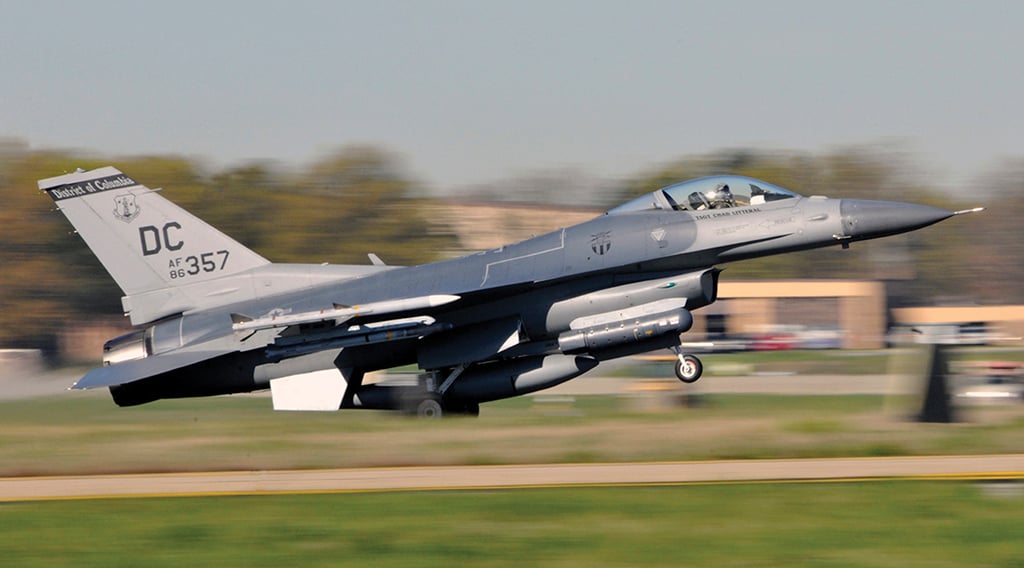
The FAA’s watch officer contacted the Potomac Terminal Radar Approach Control (Tracon) to confirm the aircraft was not communicating with ATC. When the aircraft turned southbound toward the FRZ, CBP launched a Blackhawk helicopter and Citation jet from Reagan Washington National Airport (DCA), and two F-16s were scrambled from Andrews AFB (now Joint Base Andrews). The F-16s were assigned to the District of Columbia Air National Guard’s 121st Fighter Sqdn., which is one of the units responsible for airspace security over the nation’s capital.
The CBP Blackhawk intercepted the single-engine Cessna about 10 mi. north of the Capitol building. The helicopter signaled the occupants of the Cessna to communicate on an emergency frequency but were unsuccessful. The Defense Department authorized the F-16 pilots to use flares. The F-16s fired four warning flares to get the Cessna pilot’s attention.
At this point, the intruding Cessna was 6.7 mi. from DCA. The Secret Service and U.S. Capitol Police made the decision to evacuate the White House and the Capitol. This resulted in the evacuation of thousands of people, causing significant alarm. Ultimately, the Cessna’s pilot was able to make contact with the CBP Citation on an emergency frequency and turned west. The F-16s and the Blackhawk escorted the Cessna out of the ADIZ.
The pilot of the Cessna contacted Potomac Tracon at 12:22 p.m. and was instructed to proceed to Frederick Municipal Airport (FDK) in Maryland. Upon landing, the Cessna’s occupants were taken into custody by the FBI, the Secret Service and Maryland state authorities for questioning.
The Cessna pilot had committed a long list of mistakes that included penetrating the Class B airspace around Baltimore-Washington International Airport (BWI), both the ADIZ and FRZ, and the prohibited airspace of the U.S. Naval Observatory without authorization. The FAA concluded the pilot lacked the qualifications to hold an airman pilot’s certificate and issued an emergency revocation order.
One of the “gotchas” for business aviation when flying into satellite airports in the vicinity of Washington, D.C. is assuming that an IFR flight plan will keep them in compliance with the special rules. NASA’s Aviation Safety Reporting System files indicate past misunderstanding when IFR pilots switched their transponder to squawk the standard 1200 code for VFR upon being instructed by the Tracon to change to the CTAF for entering the pattern.
Be advised that it is necessary to remain on the assigned discrete transponder code until after landing inside the D.C. Special Flight Rules Area (SFRA). Never squawk 1200 while flying in the SFRA.
Fighter Pilot’s Perspective
BCA sought answers to help pilots better understand how to avoid being the subject of an intercept and how to properly react if an interceptor shows up unannounced off your wing. This author has the privilege of long-term friendships with former Air Force colleagues who flew interceptor duties for NORAD.
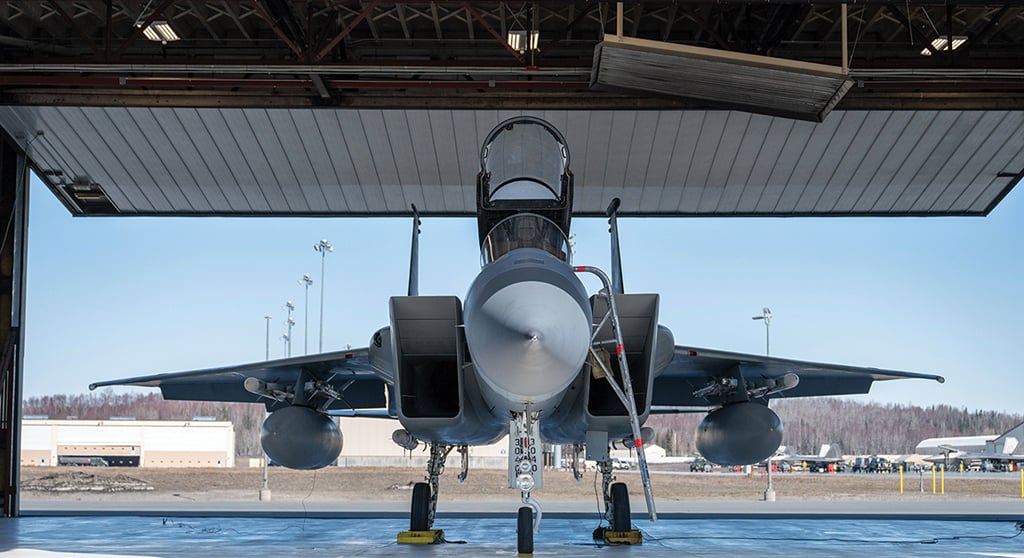
A vast array of sensors to include radar are used to maintain constant vigilance over our national airspace. These are staffed 24/7 by a wide spectrum of servicemen and women. Some of them are staffing remote radar sites in Northern Alaska. National security and military authorities begin to intensely monitor an unidentified aircraft’s trajectory long before it hits the boundary of protected airspace. Air traffic control will attempt to contact the unidentified aircraft on the VHF frequencies for that region.
Pilots on alert are ready to scramble when the claxon sounds. Friends of this author sat long hours in the alert facilities or on “cockpit alert,” ready at a moment’s notice to start the engines and get airborne. One of the author’s friends, while attached the Air National Guard, would spend his cockpit alert rotations with his medical books to keep his alertness during those often boring periods while attending medical school.
When an unidentified target is determined to pose a possible threat, a pair of interceptors will be launched to do a visual identification. The first thing the interceptors try to establish is whether the unidentified aircraft is a threat. One of the interceptors will do a pass rocking its wings, assured to get the pilot’s attention while simultaneously trying to establish radio contact.
The wing rocking basically means: “We see you; do you see us?” The hope is to see the intruder rock its wings in acknowledgement. The second interceptor follows slightly behind, keeping a keen eye on the unknown aircraft’s motion, and each interceptor is armed with an assortment of air-to-air weaponry.
Several former interceptor pilots had learned to fly in general aviation (GA) and are still active in GA. They understand that inadvertent mistakes can happen. These elite pilots want to see an uneventful ending to an intercept and provide solutions to make that happen. They understand how an intruding pilot can get lost above a cloud layer, or that navigation instruments can fail. They emphasize that they want to be a facilitator to help find a safe solution.
If you detect an interceptor off your wing, your reactions can quickly de-escalate the concern of these air defense fighters. First, stay predictable in your altitude, heading and airspeed. Acknowledge the interceptors with a wing rock. Attempt to contact the interceptor on the Guard frequency (121.5 MHz), or if not, talk to ATC.
Do not do anything that will jeopardize your safety or the safety of the interceptor pilots like turning into their aircraft or diving for the ground. Also, do not think you can slow down to your stall speed to evade the fast movers. They have plenty of training in maneuvers to respond.
If the interceptor makes a gradual turn, follow it. If your current heading will place you on a course of heightened concern, the interceptor is likely to do a “head butt” in which the lead intercept will do an aggressive turn in front of the nose of the intruder aircraft. It is recommended that you turn immediately and follow the aircraft in front of you.
If an interceptor has pulled up beside you and lowered its landing gear, that is the international signal to land immediately. Follow that aircraft to be lined up on final approach.
An additional recommendation from these sources is to monitor the Guard frequency with your secondary communication set. During their own recreational flying, former interceptor pilots steadfastly keep the secondary radio set tuned to 121.5 MHz as a backup.
Check The Notams
Air Force Gen. Gregory Guillot, commander of NORAD and the U.S. Northern Command, issued the following statement after recent airspace intrusions:
“Adherence to TFR procedures is essential to ensure flight safety, national security and the security of the president. The procedures are not optional, and the excessive number of recent TFR violations indicates many civil aviators are not reading Notice of Airmen [Notams], before each flight as required by the FAA, and has resulted in multiple responses by NORAD fighter aircraft to guide offending aircraft out of the TFR.”
The FAA recommends that all aviators check Notams frequently for possible changes to TFRs prior to operations within a region. An official source for TFR information is contained on the FAA’s Graphic TFR webpage, which provides a description of the TFR’s location from the nearest VOR as well as the specific latitude and longitude coordinates. The webpage also contains a graphic illustration of the location of the VIP TFR by including an illustration from the respective sectional.
Earlier this year, NORAD sent a letter to general aviation pilots titled “Check Your Notams.” The letter provides other helpful suggestions, to include ensuring “TFR” is selected on ForeFlight if you have it, and reviewing free resources such as skyvector.com to help find out where TFRs are located.
TFRs can pop up and change with barely any notice. A recommendation is to use your cell phone just before launching and calling 1-800-WX-BRIEF to ask if there are any last-minute TFRs along your route.
The complexity of TFR Notams can be difficult to understand. NBAA provides a service to its members with notification of VIP and special event TFRs as well as plain-language descriptions of the impact. Air traffic management specialists with the association provide information on the dimensions of the TFR, the times the TFR is in effect, which airports are impacted and additional guidance. These notifications are available on the NBAA’s VIP TFR Impact Statement webpage and in the association’s Airspace Alerts mailing list.
Members of the Aircraft Owners and Pilots Association can opt in to receiving email alerts for new TFRs within 250 nm by enabling Airspace Alerts (via checkbox) in their online account preferences.
More than 4 million Notams are issued annually. The need to modernize the Notam system was highlighted by a major system outage in January 2023. U.S. Transportation Secretary Sean Duffy has directed the FAA to accelerate development and deployment of a new Notam service. Contractor CGI Federal is working on an accelerated schedule to introduce the new Notam Modernization Service this year. (See aviationweek.com/business-aviation/safety-ops-regulation/faa-plans-notam-test-system-launch-july).
One final thought on airspace intrusions. Unfriendly foreign powers are constantly probing the edges of our airspace to determine areas of lesser radar coverage or to ascertain the time required for response. In recent years the number of drone intrusions along the southern border has incurred additional attention and concern from national security authorities.
Each inadvertent airspace intrusion by a stray aviator requires attention and the commitment of costly resources. Each of these incidents is a distraction from the vital mission of our national security teams who are devoted to the safety and security of our airspace.

Related Content