
Air India 787 Crash Being Investigated As ‘Criminal Act,’ Says Safety Expert
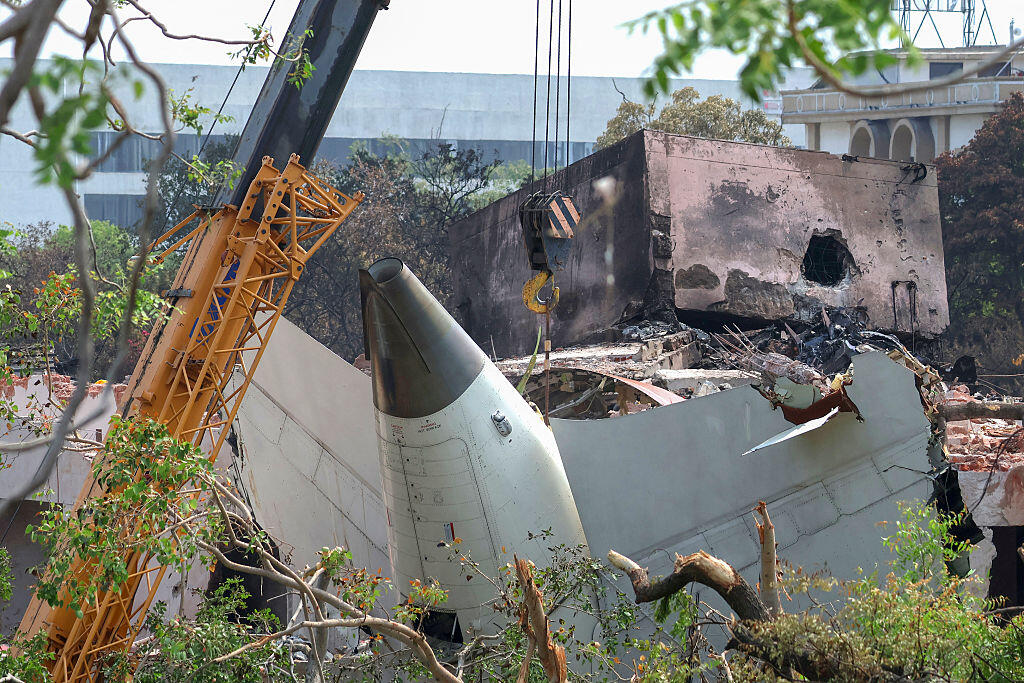
LAS VEGAS—India’s Aircraft Accident Investigation Bureau (AAIB) is now looking into the June 12 crash of an Air India Boeing 787-8 as an intentional act, says veteran safety consultant and former NTSB investigator Greg Feith.
The AAIB’s preliminary report on July 12 revealed that fuel cutoff switches for the 787’s two GE Aerospace GEnx-1B engines were transitioned from “run” to “cutoff” around three seconds after takeoff from Ahmedabad Airport. Although both fuel switches were turned back on within a further 14 sec., the aircraft was too low to recover and impacted trees and buildings, killing 241 of 242 occupants on the 787 and 19 on the ground.
The AAIB has criticized subsequent western media reports as “irresponsible” for indicating the fuel cutoff switches were likely deliberately moved by one of the pilots. However, Feith says: “It has become very apparent, especially now with information I know and what's come out about the cockpit voice recorder—where the question is heard ‘why did you cut off the fuel?’—[that] somebody had to have seen that action to make that statement. You just wouldn’t have a dual-engine failure.”
Speaking at the American Institute of Aeronautics and Astronautics Aviation forum here in Las Vegas, Feith says: “Something had to prompt that type of comment. Now we get into the psychology part of it, and that's really where this investigation is going to go.
“And oh, by the way, it's no longer an accident. It's investigated as a criminal event, just like EgyptAir, just like Germanwings, just like SilkAir. These are criminal events—intentional acts,” he adds, referring to three fatal crashes deemed to have been deliberately caused which occurred in 1999, 2015 and 1997 respectively.
Feith, who participated in the investigation into the SilkAir crash—where a Boeing 737-300 traveling from Jakarta to Singapore was downed—says other theories continue to persist in the face of contradictory evidence provided by the AAIB. “To this day, people are still talking about this as a dual-engine failure, despite the fact that the AAIB came out with a preliminary report which gave some initial findings. They said at this stage of the investigation, there are no recommended actions for the 787-8 or the engines. They just exonerated the airplane. They just exonerated the engines.”
“The junior investigators and the trolls are still making a big deal about engine failure, software issues, FADEC problems. They're not part of the process,” Feith continues. The AAIB “had a team of subject matter experts dissecting all of this in that 30-day period. You think they didn't look at that? It makes no logical sense,” he adds.
“The fact is that now we have people all spooled up looking at the wrong thing instead of looking at, 'is this an isolated problem or a systemic event?' It's the first major accident for a brand-new airplane [type]. This is the kind of controversy that gets stirred up and distracts us from really looking at where we need to be and what we need to be doing to enhance aviation safety,” Feith says.
Referencing the SilkAir accident, he says: “I've been down this road. I spent two years working on SilkAir in Palembang, Sumatra. I took a team of investigators over with me from Boeing and the engine manufacturer, the FAA and a variety of others, and we determined in concert with their National Transportation Safety Committee, that this was an intentional act.”

Related Content



Comments