This article is published in Aviation Daily part of Aviation Week Intelligence Network (AWIN), and is complimentary through Sep 16, 2026. For information on becoming an AWIN Member to access more content like this, click here.

21 Air Crew Attempted Go‑Around Before Overrun, NTSB Details Show

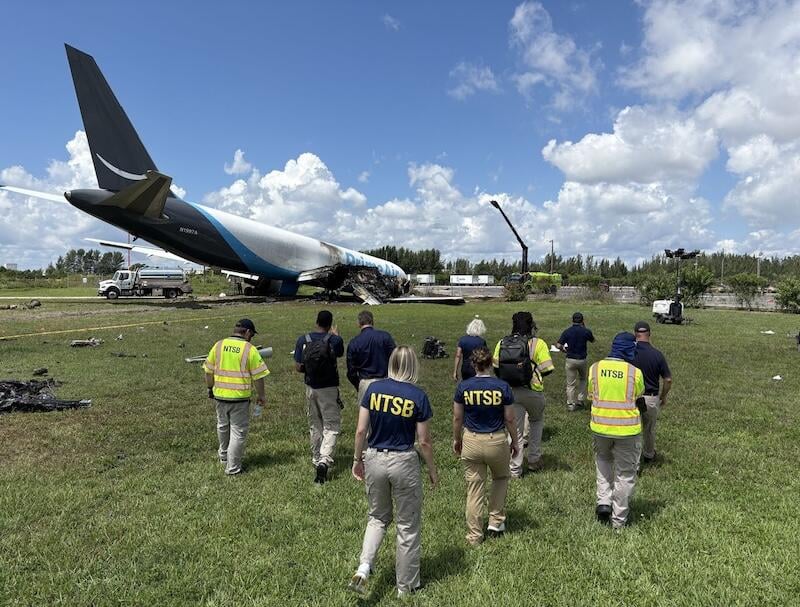
NTSB investigators approach a crashed 767F
Credit: NTSB

Pilots flying the 21 Air Boeing 767-300 freighter that overran its runway at Miami on Sept. 6 attempted a go-around following a problematic landing that may have prevented automatic speed-reduction devices from activating, data released by the NTSB suggests.

The aircraft's nose and right main landing gear touched down on Miami International Airport's (MIA) Runway 30 at a ground speed of 158 kt., investigator-in-charge Chihoon Shin said during a media briefing late Sept. 8.

Seven seconds later, with the left landing gear bogie still off the runway, brakes were applied. The left gear then touched down 11 sec. after the main and right bogies. The aircraft was moving at 134 kt.

Four seconds later, the brakes were released and “throttles increased to values consistent with go-around thrust,” Chin said.

Four seconds after the apparent go-around attempt, “throttles were reduced to idle power, brakes were reapplied and the ground speed was 117 kt.,” Chin continued.

“The throttles remained at idle, and brakes continued to be applied until the end of the recording,” or 11 sec. after the second throttle reduction, he added.

The aircraft ran off the runway, crossed a public road and came to rest in parking lot about 1,500 ft. past the runway end. It hit a van and an SUV, killing five of the vehicle passengers and injuring five others. Neither pilot was seriously injured.

Data pulled from the flight data recorder (FDR) showed “no indication ... that speed brakes or thrust reversers were deployed,” Chin said.

The final recorded ground speed was 65 kt.

Investigators are working to verify additional accident sequence data and aircraft performance characteristics.

On the 767, both main gear bogies must be down to activate armed speed brakes or deploy thrust reversers. Speed brakes and manual wheel braking can be applied manually.

Another critical factor is where the aircraft touched down on the 9,360-ft. runway. ADS-B data and unverified videos shared online show the freighter touched down at least 4,000 ft. down the runway—beyond the standard touchdown zone of 3,000 ft. maximum. Missing the touchdown zone is one of several factors that usually prompts an immediate go-around.

Landing reference speeds vary based on several factors, including aircraft weight, configuration and weather conditions. A typical 767 landing target speed ranges from 130-145 kt., well below Flight 7598's reported touchdown speed.

The 21 Air aircraft, operating as Flight 7598 for Amazon Air and en route from San Juan, Puerto Rico, had a planned landing weight of 231,236 lb., Shin said, including 32,000 lb. of cargo. The type's maximum landing weight is around 325,000 lb. A lighter weight usually reduces a flight's landing reference speed.

Weather at the time of the accident included a thunderstorm over the airport, shifting winds from 190 deg. at 17-26 kt. and shifting, broken clouds, and visibility of 10 statute miles.

NTSB Chair Jennifer Homendy said the captain, age 55, has 7,145 total flight hours. He received his 767 type rating in May. The 37-year-old first officer has 2,655 hr. He received his 767 rating in April 2025. Flight time on the 767 was not given.

“We're interviewing the pilots [Sept. 9], and we want to hear their account of the accident before we release a readout of the cockpit voice recorder (CVR),” Homendy said. Both the Acron Aviation FA2100 CVR and Ontic solid-state FDR have high-quality data from the accident flight, she added.

Addressing reporters on the day of the accident, Homendy emphasized investigators will—as always—look at myriad factors that may have contributed to the accident. Among them this time is the absence of engineered material arresting system (EMAS) on the runway end. “We will look at that,” Homendy said.

The road that the 767 crossed its about 1,300 ft. from the end of Runway 30. The space is flat and obstacle-free except for a few small trees, which are noted in MIA's official FAA master record. Beyond the usable runway end within the 1,300-ft. gap to the road is a 400-ft. blast pad.

The configuration dates to 1986, when the runway was moved 160 ft. southeast as part of a major airfield revamp. It is within the FAA's acceptable runway safety area (RSA) standards, which the agency established based in large part on related NTSB recommendations.

Current RSA criteria of level, obstacle-free space extending 1,000 ft. beyond the runway end and out 500 ft. wide—250 ft. on either side of the runway centerline—were first published in a 1983 advisory circular. The FAA subsequently mandated the minimums for all new and reconstructed runways.

The RSA standards were part of a series of FAA initiatives to mitigate the risks of runway overruns. The effort included developing EMAS in the 1990s with several industry stakeholders.

Made of crushable blocks and placed at runway ends, an EMAS helps aircraft safely decelerate if it runs past the usable runway end. Specific EMAS configurations vary based on airfield geometry, but FAA guidance calls for them to handle the airport's largest expected aircraft type exiting at up to 70 kt.

The FAA's RSA and EMAS criteria were based in part on an agency study of 33 overruns involving Part 121, 129, and 135 aircraft from 1975 to 1987. Among its findings: 30 of the overruns occurred at 70 kt. or slower, and two aircraft came to rest farther than 1,000 ft. beyond the runway end.

An EMAS is typically used in an RSA that cannot be modified to meet the 1,000 ft. x 500 ft. standard, such as by removing obstacles or grading terrain. Several airports use them to mitigate natural risks, such as bodies of water, beyond runways.

New York-Kennedy received the first EMAS, in 1996. Other major commercial airports with at least one EMAS include Boston Logan, Chicago-O'Hare, Charlotte-Douglas, Philadelphia and Newark Liberty. FAA data shows 70 airports have a total of 120 systems installed.

“Should EMAS be everywhere at every airport? That will be a key part of our investigation,” Homendy said.

The 767-300ER involved in the accident—reg. N1997A—was ordered by Australian lessor Ansett World in 1988 and delivered to its first operator, the now-defunct Belgian charter operator Sobelair, in 1994, Aviation Week's Fleet Discovery database shows. The aircraft was later leased out to Vietnam Airlines, Air Europa, Kenya Airways and then Nordwind Airlines.

In 2015 the aircraft was sold to a subsidiary of Atlas Air and it reemerged in 2016 as a converted freighter. In January 2025 the 767F was subleased to 21 Air, which is one of the carriers contracted by Amazon for cargo services. The aircraft had completed more than 107,000 flight hours over its service life across 23,204 cycles.

“We’ll fully cooperate with [the NTSB] and support any other investigating authorities and we’ll also continue to coordinate with 21 Air, which operated the flight,” an Amazon spokesperson said.

Additional reporting by Guy Ferneyhough in London.

Sean Broderick

Senior Air Transport & Safety Editor Sean Broderick covers aviation safety, MRO, and the airline business from Aviation Week Network's Washington, D.C. office.