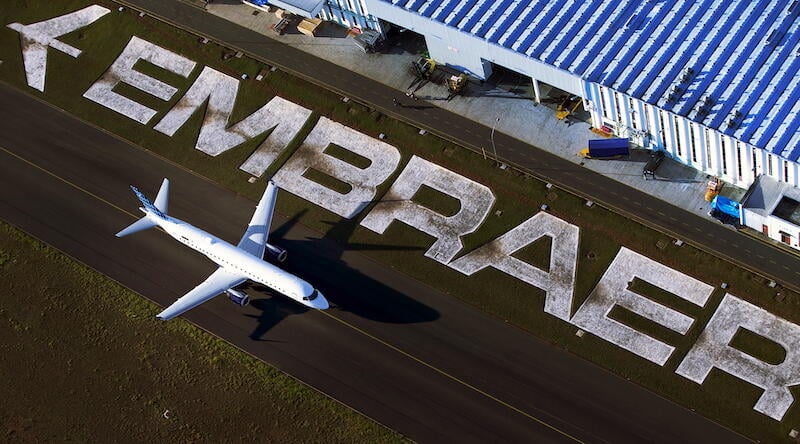
Embraer president and CEO Francisco Gomes Neto said a plan to spread production more evenly across the year, which was first launched in 2023, is beginning to deliver “material results.”
“This year, we have already seen the first results of the project, and from 2026 onwards, we can expect more stable production,” Gomes Neto said.
For the past two years, Embraer has been working on a Production Leveling Plan to maximize output and stabilize its supply chain. This is already leading to higher aircraft production rates and shorter assembly cycles.
Previously aircraft fasteners had been causing issues, but this has now shifted to fuselage and engine parts.
“In general, we have seen improvements, but the bottlenecks are moving from one product to another,” Gomes Neto said. “We are progressing in bringing the parts we need to level our production, which is our main target.”
However, production is running “as planned,” and Embraer is maintaining its guidance of 77-85 commercial jet deliveries this year.
Embraer has been working very closely with Pratt & Whitney, and Gomes Neto is seeing improvements in engine deliveries and performance. “We are happy with the development,” he said. “We have seen progress.”
Meanwhile, Neto said that Embraer did not feel the effects of US tariffs in Q1. He added that Embraer aircraft have a substantial amount of US content, which partly mitigates the Brazilian airframer’s exposure.
“Our initial analysis points towards limited impact, so we remain confident and reiterate our 2025 guidance,” Gomes Neto said. “We are working on initiatives to minimize the impact of US tariffs on our business.”
Embraer EVP & CFO Antonio Carlos Garcia said this could include additional cost reduction measures. He estimated that tariffs could negatively impact the group’s EBIT margin by 90 basis points for 2025, with executive aviation and support services feeling the greatest impact.
Garcia was quizzed on whether US airlines might delay commercial aircraft deliveries until the tariff situation stabilizes. “We still don't know everything,” Garcia replied. “We do not have, at least today, a setback on commercial but it's too early to confirm.”
Embraer is still hoping to place E2s in Poland, Turkey and other markets. “We are working on several campaigns,” Gomes Neto said. “We expect to bring some good news during the year.”
Gomes Neto hinted that Embraer could locate some product and services work in Poland, if it secures orders from LOT Polish Airlines and a military campaign. “If we succeed in both, we can bring a lot of initiatives to be done in Poland,” he said.
However, he would not be drawn on new aircraft developments. Gomes Neto said customers have asked about Embraer’s plans for larger jets, but for the time being the company is investing in new technologies for future products across its entire portfolio. These technologies include more autonomous flight, along with new fuselage, wing and cockpit designs.
“That can be a bigger executive jet, or a bigger commercial jet, or even in defense. So, we are making studies in all parts. We don't have a decision, but what we're doing, in a concrete way, is investing in new technologies.”
Gomes Neto declined to comment on other manufacturers’ decisions to push back their development of hydrogen-powered aircraft.