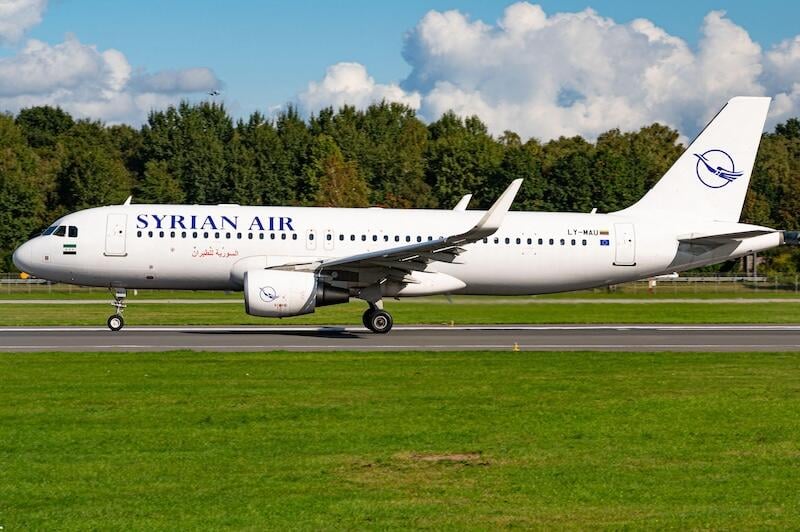
Syrian Airlines opend a route between Damascus and Munich on Nov. 12, adding its second German destination in three days as the flag carrier grows its European network.
The service to Munich Airport follows the launch of twice-weekly flights to Berlin Brandenburg Airport on Nov. 10. OAG schedules show the Munich route also operating twice a week using Airbus A320 equipment.
The German additions extend a European expansion that began in September, when Syrian Airlines introduced service from Damascus International Airport to Copenhagen and Vienna. The Copenhagen route operates weekly, while Vienna receives two flights per week. A weekly route between Aleppo and Moscow Sheremetyevo Airport is scheduled to begin on Nov. 18.
Germany and Syria signed a new air transport agreement in July, providing the regulatory basis for the resumption of direct services.
Syrian Airlines’ expansion comes during a broader recovery in Syria’s international aviation market. Airlines scheduled approximately 1.8 million departing seats from Syrian airports between January and November 2026, up 68.5% from about 1.07 million during the same period in 2025. The number of nonstop airport pairs increased to 55 from 31.
Passenger data indicates strong demand for European service. Sabre Market Intelligence estimates that approximately 549,300 two-way passengers traveled between Syria and Europe in the 12 months through June 2026, more than nine times the total during the previous 12-month period.
Germany was the second-largest country market after Turkey, accounting for about 113,500 passengers. Dusseldorf was the largest German city market with approximately 29,400 passengers, followed by Frankfurt at 27,700 and Berlin at 22,900. Munich was smaller, generating about 5,900 passengers to and from Syria during the period, including nearly 4,500 traveling to or from Damascus.
Vienna accounted for approximately 4,400 passengers, Copenhagen for nearly 10,000 and Moscow for about 11,900.
The German routes are particularly important given the size of the Syrian population in the country. Germany’s 2025 microcensus found that about 732,000 people living there had come from Syria after fleeing conflict or persecution, or to seek asylum or other international protection.
However, Germany’s large Syrian population may not translate directly into an equivalent visiting-friends-and-relatives (VFR) market. The government said in August that short visits to Syria could trigger a review of a traveler’s protection status, unless there is a compelling reason for the journey.
Any withdrawal is not automatic and would not necessarily remove the person’s right to remain in Germany, which may be based on other grounds. That uncertainty could limit demand for short visits, although the routes should still attract permanent returnees, travelers with secure residence rights and passengers originating in Syria.
The network recovery follows the December 2024 fall of former Syrian president Bashar al-Assad’s regime and the subsequent easing of international sanctions. The European Union lifted most of its remaining economic sanctions on Syria in May 2025, except for measures maintained on security grounds.
The easing has removed some barriers to fleet and network expansion, although Syrian Airlines General Manager Capt. Anwar Akkad said financial institutions have been slow to adjust their compliance procedures.
“This is one of the main things we are trying to drive with our finance minister and our central bank,” Akkad told Aviation Week. “We are asking the financial sector in Syria to talk to their foreign counterparts, as well as to agencies and banks where we’ve had money frozen for a while.”
CAPA – Centre for Aviation fleet data shows Syrian Airlines has five A320-200s and one wet-leased Boeing 737-500 in service. Another A320 and two A340-300s are inactive. The airline aims to expand to 10 operational aircraft during the first quarter of 2027.
With additional reporting by Alan Dron.

Related Content