With the FAA’s environmental review of a second Las Vegas airport underway, officials in Clark County, Nevada, believe the long-discussed project is realistically on track for potential completion in the mid-2030s.
Rosemary Vassiliadis, who retired as director of Las Vegas Harry Reid International Airport (LAS) on Sept. 12 after 12 years in the role, has long been an advocate for a second Las Vegas airport and believes the process is now meaningfully moving forward. In May, the FAA issued a notice of its intent to prepare a required environmental impact study on the future airport, which has been under discussion for more than 25 years.
A second airport, now known as the Southern Nevada Supplemental Airport, “is something that we always had in the works … because at the end of the day, we have very limited airspace here at LAS,” Vassiliadis told Aviation Week’s Window Seat Podcast just before her retirement. “We're in a valley. We have mountains. We butt up against Department of Defense airspace with Nellis AFB and the missions that they have going on there.”
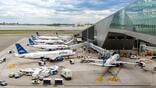
LAS handled a record 58.4 million annual passengers in 2024 and expects growth to stretch past the airport's capacity in the next decade.
Clark County, for which Vassiliadis served as aviation director, selected the site for the second airport in southern Nevada 25 years ago. Clark County owns and manages LAS, the host of Routes World 2022.
More News And Analysis From Routes World 2025
Under an act of the U.S. Congress, Clark County will take possession of 17,000 acres of land where the airport will be located once the FAA and the U.S. Bureau of Land Management give final approval for the project.
The second airport site is located on part of a dry lakebed known as Roach Lake in southern Nevada near the California border. Around 30 mi. south of LAS, the second airport would be bordered by the Interstate 15 highway on the west and Union Pacific Railroad tracks on the east.
“The federal notice of intent for the environmental review was filed in mid-May, and the environmental impact statement process has officially begun,” Vassiliadis said. “It's about a two to three-year process for [the FAA to reach a final] decision.”
The second airport would be a part of the Clark County aviation system, complementing LAS. “So, very much like Washington Dulles and National or Chicago Midway and O'Hare,” Vassiliadis explained. “It will be part of our system. It won't operate independently. [The new airport and LAS] would work together.”
In addition to the 17,000 acres set aside for the airport, Clark County will control a 1-mi. barrier around the site. Vassiliadis said long-haul international flights are likely to be a priority at the second airport, but the mix of flights is “very hard to predict” given changing airline strategies.
She added that LAS and the new airport will be connected via road and rail. “There will be direct connectivity to LAS,” Vassiliadis said. “It may sound like [the second airport] is far out, but in real time, it won't be.”
Vassiliadis was succeeded in the top role at LAS by James Chrisley, who was promoted from deputy director.
For the entire interview with Rosemary Vassiliadis, listen to Aviation Week's Window Seat Podcast: How To Run A Major O&D Airport.

Related Content