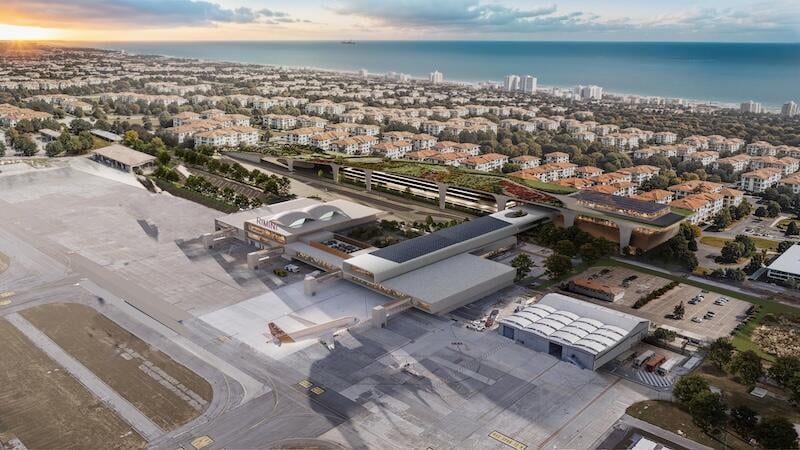
A rendering of the Rimini Airport redevelopment plan.
Rimini Airport (RMI) is targeting the establishment of an LCC base and a domestic hub connection to Rome as part of its next phase of network development, with discussions already under way with multiple airlines.
Speaking ahead of Routes Europe 2026, AIRiminum CEO Leonardo Corbucci says the airport’s immediate priority is to expand its existing airline portfolio and capture traffic already generated within its catchment area but currently using other airports.
“We already see strong demand, but passengers are flying from elsewhere,” Corbucci tells Routes. “The first step is to grow with the airlines we already have and develop those flows.”
Rimini is working closely with Ryanair, Wizz Air and easyJet to expand route networks in the short term, with particular focus on increasing frequencies and destinations across core European markets.
Corbucci says the airport is aiming to secure a based aircraft from an LCC between 2027 and 2028, describing it as a “key milestone” in its medium-term strategy. However, he acknowledges that capacity constraints and performance monitoring mean timelines remain fluid.
Alongside the LCC base, Rimini is pursuing a domestic connection to Rome to strengthen hub access and improve connectivity across Italy.
More News And Analysis From Routes Europe 2026
Beyond this, the airport’s longer-term ambition is to secure links to major European hubs including Paris, Madrid, Frankfurt and Istanbul, enabling global connectivity via indirect services.
Corbucci says the strategy is structured in phases: first building volume through low-cost and leisure traffic, then layering in hub connectivity and higher-value markets.
The arrival of Routes Europe 2026 in Rimini comes weeks after RMI unveiled plans for an initial €80 million ($94 million) investment as part of a wider €200 million redevelopment program aimed at transforming the Italian gateway into a more integrated hub for the Emilia-Romagna region.
The plan includes terminal redevelopment, expanded parking, new commercial areas, improved surface access and a broader “airport district” designed to connect the airport more closely with the city and surrounding region.

Related Content