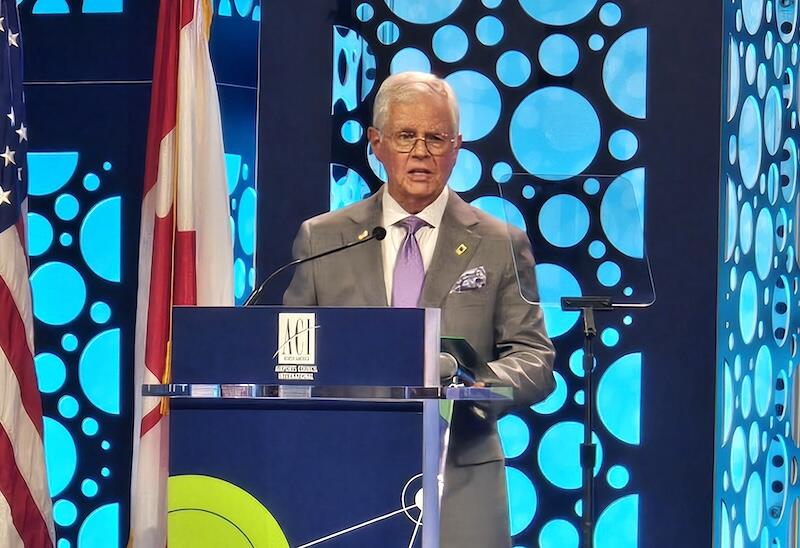
Airports Council International-North America CEO Kevin Burke, set to retire in October, delivers his final state-of-the-industry address at the association's annual conference in Philadelphia.
PHILADELPHIA—U.S. airports face a myriad of challenges developing and maintaining infrastructure and preparing for a technologically advanced future, Airports Council International-North America (ACI-NA) CEO Kevin Burke said.
“I believe the period ahead may be one of the most consequential our industry has ever faced,” Burke told the ACI-NA annual conference in Philadelphia. “Passenger and cargo demand will continue to grow while airports undertake billions of dollars in capital projects, manage rising construction costs and navigate increasingly complex regulatory processes.”
ACI-NA estimates U.S. airports need around $175 billion in infrastructure investment through 2029.
Burke delivered his final state-of-the-industry address as ACI-NA CEO on Sept. 15 ahead of his planned retirement on Oct. 4 after 13 years leading the organization. He will be replaced by Chris Rocheleau, the former acting FAA administrator.
Burke emphasized airports must adapt to a rapidly evolving technology landscape. “Cybersecurity risks will become more sophisticated,” he said. “Artificial intelligence will change how airports operate, plan and make decisions. New technology requires us to think differently about our infrastructure, our operations and the passenger experience.”
A newly released survey of North American airport executives conducted by AirportNEXT Solutions in partnership with ACI-NA found that “cybersecurity threats to operational technology systems” is the top area of concern for airport leaders.
Burke said decisions made by U.S. policymakers will be critical in shaping airports’ futures.
“That’s important because tomorrow’s infrastructure cannot be built with yesterday’s policies,” he explained. “In the U.S., airports need modern infrastructure financing tools, sustained investment in air traffic control modernization, predictable federal funding and regulatory processes that allow long-overdue projects to move forward efficiently.
“We must continue to make the case for eliminating the outdated federal cap on the passenger facility charge, while protecting tools like tax-exempt municipal bonds, which are essential for our industry.”
U.S. airports have been the beneficiary of $20 billion in grants from the federal government as part of the 2021 infrastructure bill passed by Congress. But the legislation’s authority expires on Sept. 30, and airport executives attending the conference expressed concern that money available to make infrastructure investments will become more scarce.
Private Financing
The grants were particularly valuable because airports in the U.S. are nearly all owned and operated by municipalities. But there may be other avenues to financing expansion.
Recent widely praised terminal construction projects completed or underway at New York LaGuardia (LGA) and John F. Kennedy (JFK) airports were largely funded via public-private partnerships (PPP) in which private consortiums finance and build facilities.
For example, global airport developer and operator Ferrovial leads a private consortium called New Terminal One (NTO) that is financing and managing the development of JFK’s new $9 billion international terminal scheduled to open later this year. It is the most expensive element of JFK’s sweeping $19 billion overhaul and will be the airport’s largest terminal.
Whether the PPP model, prevalent throughout much of the world, could take hold in the U.S. has long been a topic of discussion at ACI-NA’s annual gatherings.
Danielle Rinsler, Ferrovial’s director of corporate development and strategy in the U.S., said private investment can help narrow the infrastructure funding gap in the U.S. She noted that around 80% of European passengers travel through privately financed airport facilities, while only about 7% of U.S. passengers do.
Regarding the success of PPPs at LGA and JFK—in which the Port Authority of New York and New Jersey has offered decades-long leases to private consortiums to build and manage terminals—Rinsler said, “A lot of folks say, well that’s New York.”
But she said there are “opportunities for airports to engage” in private financing on a smaller scale than the New York airports.
“I’ve heard a lot of alarmist comments around [cities and municipalities] losing control of airports,” Rinsler told Aviation Week. “I think the Port Authority has proven that you don’t lose control ... There are lots of ways for airports to push off the development of these projects to the private sector and reap a lot of the upside—whether that’s revenue sharing or just the improved passenger experience or bringing economic development to your communities.”
Moving Forward
Beyond major infrastructure projects, maintaining and upgrading current facilities is critical, said Philadelphia International Airport (PHL) Chief Development Officer Api Appulingam. PHL’s current largest capital development program is spending $100 million to refurbish the airport’s 48 restrooms at a pace of eight per year.
“Everybody wants a big, sexy project from airports, and I think there’s such an underestimation of the basics [such as restrooms] and storm water drainage,” she said. “All these basic things people are underestimating because they want to just move through right away to building the brand-new, flashy, shiny thing. We need to make sure there is a focus on the importance of the basics at an airport. We have to get that right before we can move on to new things.”
Burke said airports must simultaneously manage the present and plan for the future. “Airports are operational organizations, and there will always be something immediate that is demanding attention,” he said. “So that’s why it’s important that we continue to look beyond the horizon. For example, advanced air mobility is moving from concept toward reality. New [aircraft] propulsion technology may change airport energy requirements and infrastructure. Biometrics will continue to reshape the passenger journey. Cyber threats will evolve, and climate resilience will increasingly influence capital planning.”
Burke added: “We all know how challenging capital planning can be. We don’t know exactly what the airport of 2040 will look like. None of us do. [Airports need to] make sure they are asking the right questions early enough to help shape those decisions.”

Related Content