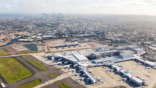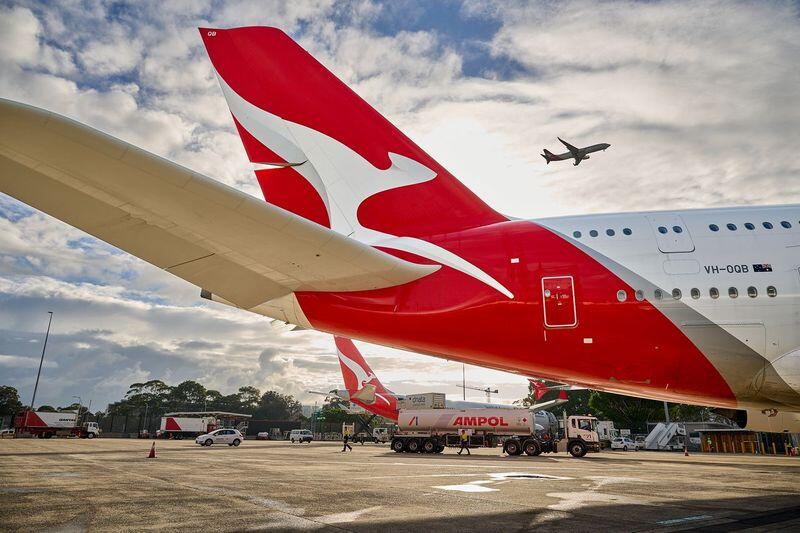
HONG KONG—Sydney Airport (SYD) is targeting growth across Asia and the Middle East while preparing for the effects of Qantas’ Project Sunrise, which will see the launch of ultra-long-haul services from 2027.
CEO Scott Charlton says nonstop flights to cities such as New York, London and Paris will complement one-stop hub flows and reinforce the airport’s role as Australia’s international gateway.
“The strongest business cases for ultra-long-haul flights are to the big financial and cultural centers that already have deep business and VFR demand,” Charlton tells Routes. “Those are the routes where the nonstop option saves the most time and creates real value for premium travelers.”
He adds that while nonstop services will attract corporate passengers, hubs in Doha, Singapore and Dubai will remain critical for competitive pricing and connectivity to secondary markets. “[Ultra-long-haul routes] will complement the hub flows rather than replace them, giving passengers more choice and freeing up some capacity on the traditional one-stop routes to serve different market segments,” Charlton says.
More News And Analysis From Routes World 2025
That expected shift in long-haul travel patterns comes against a backdrop of robust demand already flowing through SYD. Charlton says the airport is seeing momentum across both outbound and inbound markets, with expanded bilateral agreements helping to keep fares competitive and stimulate growth.
“In [the second quarter] we saw strong demand right across the board—Australians are still keen to travel overseas, and inbound numbers from markets like China, the UK, the Philippines and New Zealand were all solid,” Charlton says. “Cheaper international fares also helped, thanks to expanded air rights with some key markets.”
Japan has become Sydney’s fourth-largest outbound market, with growth “outpacing expectations,” he explains. But realizing additional capacity will depend on aircraft availability and airline fleet mix.
China also remains central, boosted by policy shifts such as 30-day visa-free entry for Australians. However, Charlton cautioned that further expansion would require additional bilateral rights.
In Southeast Asia, affordability is fueling outbound growth, with the expanded Australia-Philippines air services agreement cited as a model for unlocking more flights. The Middle East is also a key focus, Charlton says, supported by partnerships such as Virgin Australia’s tie-up with Qatar Airways and capacity growth from Etihad.
“Sydney leads all Australian airports in seat capacity to the Middle East, but further growth will rely on maintaining those strong airline partnerships and ensuring alignment with broader alliance strategies,” Charlton adds.
New opportunities are also emerging in Turkey and Malaysia. Turkish Airlines is set to take to its Istanbul–Kuala Lumpur–Sydney route to daily by early 2026, while Malaysia Airlines is already adding services following bilateral expansions.
Charlton says that SYD is working closely with government and carriers to “create the right environment for airlines to commit, by demonstrating the demand, building strong partnerships and working closely with both government and airlines to turn interest into new services.”
Looking ahead, Charlton expects SYD to account for the majority of the region’s passenger traffic even after Western Sydney International (WSI) opens in 2026.
“WSI is being built to cater for 10 million passengers every year, and in the T2 domestic terminal alone, we are already doing almost double that annually,” he says. He adds that SYD forecasts it will carry about 80% of passengers in the Sydney basin through 2045.
SYD’s draft 2045 master plan, published in September, projects annual traffic to reach 72 million passengers—a 75% increase on current levels—with international travelers making up about half the total.
To accommodate the growth, the airport intends to press ahead with major infrastructure projects. These include a A$200 million ($130 million) upgrade of T2 aimed at cutting kerb-to-gate times to 15 minutes, as well as plans to link and expand the T2 and T3 terminals into a single integrated precinct.
Up to 12 new international gates will be added through the T2/T3 project, and two more international gates will be added as part of extensions to the T1 international terminal.
“This will be a first for Sydney Airport and will make it easier for passengers to move between regional, domestic, and international flights, while improving comfort, efficiency, and flexibility,” Charlton says.
Cargo is also central to the expansion. Annual airfreight capacity is forecast to more than double from 600,000 tonnes to 1.4 million tonnes by 2045, supported by new taxiways, parking stands and upgraded freight facilities.
WSI, meanwhile, has a draft master plan that outlines growth to 19 million passengers annually by 2045 and 500,000 tonnes of air freight.
SYD released its draft Master Plan 2045 on Sept. 15, with public consultation open until Dec. 12. The plan may be revised based on feedback before being submitted to the government by the end of March, with the final version scheduled for publication in June.