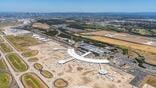
Luxembourg Airport (LUX) has broken ground on construction of a new fuel farm aimed at significantly expanding onsite aviation fuel capacity and making the airport more resilient in the event of a supply disruption.
LUX expects the fuel farm to be completed in 2028. Total cost of building the facility is anticipated to come to €106.5 million ($125 million). The farm will have up to six tanks, each with the capacity to store 5,000 m³ (1.3 million gal.) of aviation fuel. The facility has been designed to incorporate sustainable aviation fuel (SAF).
The farm will increase the airport’s fuel storage capacity by 275%, according to LUX.
“With the main storage tanks positioned landside and directly connected to the highway, and a dedicated supply system extending airside, the design combines efficiency with resilience,” LUX said. “In the unlikely event of a disruption, fuel deliveries can also be secured by truck.”
Luxembourg’s Ministry of Mobility and Public Works is the contracting authority for the fuel farm project, while airport operator lux-Airport serves as the project manager.
“By significantly expanding storage capacity, the facility will ensure an uninterrupted fuel supply for airlines and partners, providing several days of operational autonomy and reinforcing supply security,” the airport said.
LUX CEO Alexander Flassak said the new fuel farm will allow the airport to use space now dedicated to fuel storage “for future expansion of the cargo area.”
Cargolux is based at the airport, which is also served by cargo carriers Atlas Air, China Airlines Cargo, Emirates SkyCargo, Qatar Airways Cargo and Silkway West Airlines. LUX is served by 16 passenger airlines connecting LUX to 120 destinations nonstop.
“By modernizing and expanding the capacity of the fuel depot, we are achieving greater security of supply and reserve capacity for increasing air traffic,” Flassak said.
The airport said the fuel farm will be “fully aligned with modern environmental standards” and “equipped with optimized heating and cooling systems that enhance both energy efficiency and safety.”

Related Content