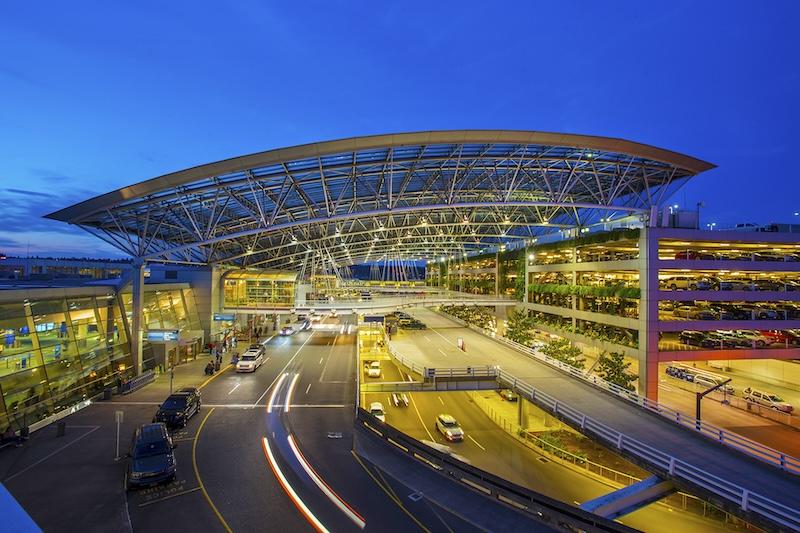
Portland International Airport.
The latest news on airports globally, with updates on financing, infrastructure expansion and sustainability initiatives.
Delta Air Lines took delivery of more than 400,000 gal. of blended sustainable aviation fuel (SAF) at Portland International Airport (PDX) in Oregon. Shell supplied the SAF, made from waste-derived feedstock. The SAF was blended with traditional jet fuel and delivered to PDX “via barge, truck and pipeline,” Delta said. “Earlier this month, the blended SAF entered the airport’s privately owned fuel supply system.” The delivery marked the first commercial-scale SAF uplift at PDX. The SAF “can help improve local air quality and cut down on greenhouse gas emissions, which is great news for our communities,” PDX Director Dan Pippenger said. “We're looking forward to working with our partners to make sure state and local policies support development of the infrastructure and market needed to bring SAF here on a larger scale.” While heralding the use of SAF at PDX, Delta warned the alternative fuel is in short supply globally. “The technology to produce it remains nascent, so it is expensive and not widely available,” the airline said. “In fact, there is not enough SAF in production today to fuel the world's airlines for a single week. This is why the work to scale SAF and bring it to new markets, like Portland, is so important.”
Fiji’s Nadi International Airport (NAN) is investing $26 million to upgrade its baggage handling system. “The project will deliver a modern, more efficient and resilient baggage system, including upgrading the check-in counter conveyor with dual conveyors to improve throughput during peak travel times,” said Fiji Airports, which runs NAN. “It also includes a new outbound screening line with [advanced, high-tech] machines for enhanced security and efficiency, a large new ... carousel that boosts capacity and operational flexibility, and automatic bag drops, delivered in partnership with Collins Aerospace, providing greater passenger convenience.” The airport has awarded an $8.1 million contract to France-based Alstef Group to provide and install conveyor belts for the system.
The U.S. Transportation Security Administration (TSA) said it is on pace to screen more passengers at U.S. airports in 2025 than in any year since its establishment in November 2001. TSA screened nearly 10.4 million passengers from Aug. 29-Sept. 1, the Labor Day holiday weekend in the U.S. That was up 3.3% over the four-day Labor Day period in 2024. TSA screened 2.97 million passengers on Aug. 29, “the highest volume ever for the Friday before Labor Day and the 15th-busiest single day in the agency’s nearly 24-year history,” TSA said. “Of the top 10 busiest travel days [in TSA’s history], eight have been reported since May 23.”
Paris Charles de Gaulle Airport (CDG) and Air France introduced a system aimed at expediting transit through the airport for passengers with a short amount of time to make a connection. Nearly half of the 140,000 Air France passengers handled daily at CDG are connecting. “Unforeseen circumstances can sometimes reduce the available time for passengers to transfer between flights,” Air France noted. Under the new system, when a connection time falls below a certain threshold—for example, 45 min. for a connection between a flight arriving from Toulouse–Blagnac Airport and a flight headed to New York John F. Kennedy International Airport—a “short connection pass” is automatically provided to passengers via their smartphones. “No later than upon arrival of the inbound flight at [CDG], passengers receive a text message and an email informing them that, due to the short time available to reach the boarding gate for their next flight, they are eligible for priority access at security and border control,” Air France explained. “Soon, this message will also be delivered via a notification in the Air France mobile app and through WhatsApp. When passengers arrive at the security and border control checkpoints, their boarding passes are scanned and … priority access is then offered to them.” Air France said the system “relies on real-time information sharing” between the airline and CDG. The data shared includes estimated walking time for passengers and the expected time needed to complete security screening and border patrol clearance based on current wait times. CDG Director Régis Lacote said the system is “simple for passengers and operationally effective—a real step forward in improving the travel experience.”
Boston Logan International Airport (BOS) closed Runway 9-27 on Sept. 2 for 75 days for safety work. Runway 9-27 is one of six total runways at BOS and one of three runways used for airline flights. BOS will be installing an engineered material arresting system (EMAS) at the end of the runway. “This project requires two 75-day closures of the runway over the next year,” BOS said. The second will begin on July 1, 2026. “While this runway is closed, there will be an impact on the number of planes that can land and take off at Boston Logan,” the airport said. “This could cause delays, especially if there are other impacts due to the weather or diversions, among other situations.” The EMAS is made of lightweight collapsible material designed to stop an aircraft overshooting the runway, critical at BOS because the airport abuts Boston Harbor. BOS already has an EMAS at the end of two other runways. “Due to the geography around the airport, this system is extremely important,” the airport said. BOS can handle 120 operations per hour in ideal weather conditions when all three of its long runways are available.

Related Content