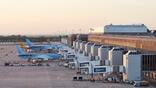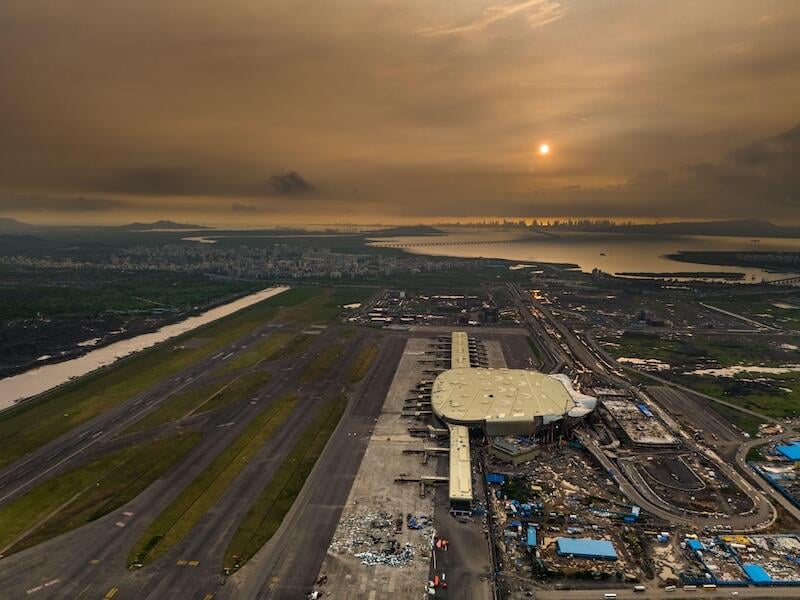
Navi Mumbai International Airport as seen in September 2025.
The latest news on airports globally, with updates on financing, infrastructure expansion and sustainability initiatives.
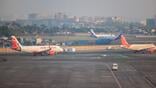
Navi Mumbai International Airport (NMI) will begin handling commercial flights on Dec. 25. Mumbai’s second airport, which cost $2 billion to build, is expected to ease capacity pressure at congested Chhatrapati Shivaji Maharaj International Airport (BOM). NMI will have capacity to handle 20 million annual passengers. The airport will begin by handling 23 scheduled daily departures, rising to 34 daily departures in February 2026. The first arrival on Dec. 25 will be an IndiGo flight from Bengaluru. The first departure will be an IndiGo flight to Hyderabad. During the airport’s initial period of operations, Air India Express and Akasa Air will join IndiGo in connecting NMI to 16 domestic destinations. During the first month of service, NMI will operate for 12 hr. daily between 8 a.m. and 8 p.m. Starting in February 2026, the airport will operate 24 hr. daily. Adani Airports Holdings, which runs BOM, will also oversee NMI. The two airports will be operated “in synergy in a twin airport system,” Adani has said. NMI opens with a single runway and one terminal. “Over time, the airport will scale to four runways and multiple terminals, with a dedicated cargo terminal and state-of-the-art facilities for perishables and express cargo, boosting India’s trade and logistics ecosystem,” according to Adani. The Indian government and Adani expect the airport to eventually be able to handle 90 million passengers annually. NMI sits on 2,866 acres of land, allowing for ample space to expand.
Emirates Airline and easyJet moved operations at Manchester Airport (MAN) in the UK to the airport’s Terminal 2, meaning all airlines except Ryanair have made the switch to the £1.3 billion ($1.7 billion) terminal. Terminal 2 opened in 2021, and airlines have steadily relocated as the airport worked to complete the facility. “Now that the final airlines have moved across, work will continue to complete the final elements of Terminal 2, like the last sections of the departure lounge,” MAN said. Ryanair uses Terminal 1 and Terminal 3, which are connected. The airport said it is now focused on making improvements to Terminal 3. Much of Terminal 1 has been shut down. “Emirates' move marked a significant milestone of its own, signaling the full opening of a new pier, one of the major pieces of infrastructure delivered through the second phase of the Terminal 2 transformation,” MAN said. “Until now, the airline's Airbus A380 … could only operate from a gate in Terminal 1. New gates on Terminal 2's second pier were used for the first time, allowing the A380 to operate from the new facility thanks to double air bridges.”
The U.S. Transportation Security Administration (TSA) expects to screen more than 17.8 million passengers at airports across the country between Nov. 25 and Dec. 2, the U.S. Thanksgiving holiday period. Thanksgiving day is Thursday Nov. 27. The agency anticipates screening greater than 3 million passengers on Sunday Nov. 30, the day on which the highest number of passengers will be traveling. “We are projecting that the Sunday after Thanksgiving will be one of the busiest travel days in TSA history,” the agency said. TSA noted it has screened an average of 2.48 million passengers daily throughout 2025, slightly up from 2.47 million daily passengers in 2024.
Duluth International Airport (DLH) in Minnesota was awarded $20 million by the U.S. Transportation Department (DOT) to be put toward a new air traffic control (ATC) tower. Both Delta Air Lines and United Airlines operate regional flights from DLH. The DOT funds follow the FAA awarding the airport $16.8 million for the project. The new ATC tower is expected to cost $66 million to build, so the federal money will cover just over half of the cost. According to the FAA, DLH has the third-oldest ATC tower in the U.S. The tower was built in the 1950s. “The new tower will be double the height of the existing one and give controllers improved sight lines to the airfield,” the agency said.
Seattle-Tacoma International Airport (SEA) reopened a security checkpoint located on the north end of SEA's check-in area after nearly a year of overhauling the TSA screening station. “The redesign has doubled the queuing space and tripled the recompose area after screening,” SEA said. “It provides six efficient security lanes and features dramatic high ceilings, public art and expanded restrooms.”

Related Content