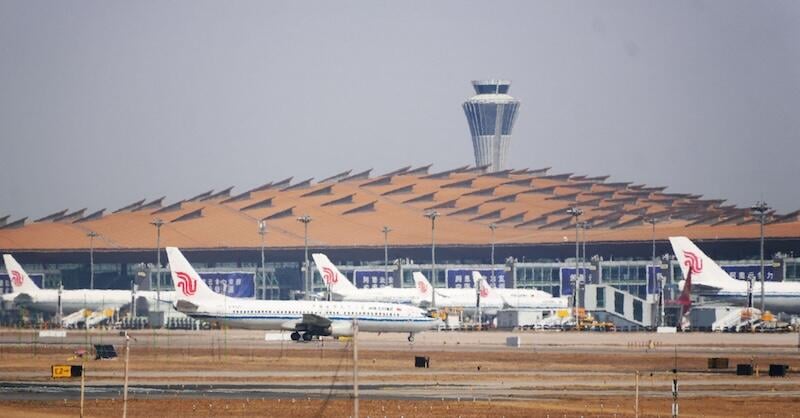
Beijing Capital International Airport.
XI'AN, China—Beijing Capital International Airport (PEK) is expanding international capacity in 2026, as traffic growth continues despite geopolitical pressures on key markets.
The airport handled 70.7 million passengers in 2025, up 5% year on year, including 17.3 million international and regional travelers, a 16.3% increase, according to data provided by the airport operator.
Growth has continued into 2026, with 12.1 million passengers recorded in January and February, up 8.6% year on year, supported by strong Chinese New Year travel demand. Traffic momentum also remained robust in March, when the airport processed 6.2 million passengers, a 10.9% increase, with international traffic rising 19.4%.
Wang Xiao, manager of the Aviation Business Department, says that the airport has focused on rebuilding and expanding its international network, adding destinations such as Oslo, Tel Aviv, Male and Tbilisi in 2025, followed by Abu Dhabi in early 2026. Additionally, Air China plans to resume operations to New Delhi on April 21 after a six-year hiatus.
Frequencies have also increased on routes including Cairo, Toronto, Tashkent, Almaty and Vladivostok, alongside planned additions to Brussels and Bangkok. Wang adds that the airport plans to “further enhance our global connectivity by developing routes to other growing markets in Asia, Africa and South America.”
More News And Analysis From Routes Asia 2026
To support airline growth, the airport has introduced incentive schemes, including exemptions on landing charges for new international routes or increased frequencies. “We believe that market demand is the fundamental driver for airlines to serve a destination,” Wang says.
Airline capacity is also expanding. Air China accounts for about 61% of departure seats from Beijing Capital in summer 2026, OAG Schedules Analyser data shows, followed by Hainan Airlines (15.8%) and China Eastern Airlines (4.5%), with 44 airlines serving the airport. Capacity is growing in markets such as Russia (+67%), Singapore (+26%) and South Korea (+12%), with additional increases to Turkey and Belgium.
However, capacity to Japan has declined sharply amid rising geopolitical tensions, as Chinese carriers cut frequencies and suspend routes.
Looking ahead, Beijing Capital expects additional slot availability as infrastructure expands, helping to alleviate longstanding constraints. Combined with China’s projected economic growth, this is expected to sustain demand. However, Wang stresses that geopolitics remains the biggest challenge in the short term.

Related Content