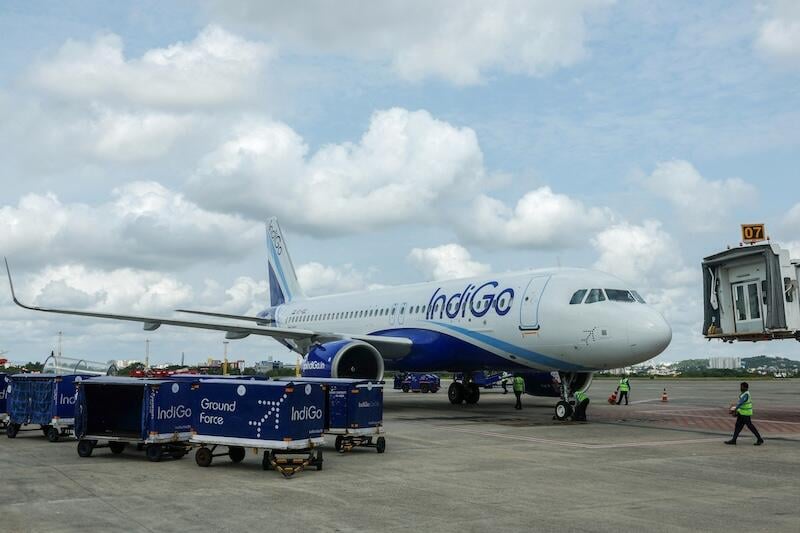
An IndiGo Airlines aircraft rolls back from a gate on May 8, 2026, at Biju Patnaik International Airport in Bhubaneswar, India.
Willie Walsh has reaffirmed IndiGo’s aircraft commitments in his first results as CEO, saying the carrier will adjust capacity and aircraft utilization to manage near-term cost pressures.
The Indian LCC expects capacity growth in the low single digits for the financial year ending March 2027, with the termination of its Norse Atlantic Airways Boeing 787 wet-lease operation from Nov. 1 contributing to the slowdown. However, it is retaining its mid-teens growth forecast for the 2028 financial year and plans to introduce Airbus A350s in 2028 remain unchanged.
“We’re still committed to the fleet orders that we have,” Walsh said during the Oct. 29 earnings call. He also retained the airline’s 2028 capacity forecast: “Right now, we’re not changing the financial year 2028 growth guidance of mid-teens, but clearly we’ll keep that under review.”
IndiGo reported a net loss of 18.79 billion rupees ($198 million) for the three months ended Sept. 30, compared with a loss of 25.82 billion rupees a year earlier. Revenue from operations rose 25.9% to 233.64 billion rupees, helped by higher yields as the airline reduced flying during the seasonally weaker fiscal second quarter.
Walsh said capacity decisions would be made flight by flight, weighing demand against the cost of operating each service. “It’s really on a flight-by-flight basis that we’re looking at capacity,” he said. “I think the measures we took in Q2 have proven to be absolutely right. And we’ll continue to apply that discipline as we go forward.”
IndiGo ended September with 442 aircraft, up from 432 at the end of June. Its fleet included 186 A321neos, 174 A320neos, 26 A320ceos, four A321XLRs, 44 ATR turboprops, three A321 freighters and five damp-leased 787s due to be returned.
Despite the fleet increase, quarterly available seat kilometers (ASK) fell 1% year over year to 40.8 billion. Domestic capacity was broadly flat, while international ASKs declined about 2.9%. Passenger numbers fell 4.7% to 27.5 million, and load factor dropped 2.2 percentage points to 80.3%.
Going forward, capacity cuts will fall mainly on international routes in the December quarter as the Norse operation ends. However, Walsh said the withdrawal of the widebody would not affect IndiGo’s longer-term plans, with the A321XLR maintaining service to Amsterdam to retain its slot.
“We’ve learned a lot from the operation, which will stand us in good stead when we introduce the A350s in 2028,” he said.
Quarterly fuel expenses increased 67.2% to 99.67 billion rupees, with fuel cost per ASK up 68.9%. Walsh said substantial fuel cost increases would inevitably feed through to fares, although he questioned whether airlines could maintain current ticket prices if fuel became cheaper.
“As fuel prices go up, ticket prices go up. As fuel prices come down, ticket prices come down,” he said. “Not exactly in line, but there is a correlation there, and I would expect to see that continue.”
IndiGo expects passenger revenue per ASK to increase more than 25% year over year in the December quarter. Walsh said forward bookings pointed to broadly flat year-over-year load factors during the stronger festive travel period. “We do see much stronger demand in the [fiscal] third quarter [compared with] the seasonally soft second quarter that we’ve just come out of,” he added.
IndiGo has about 67.27 million seats scheduled across its network for winter 2026-27, up 2.9% from the previous winter, according to OAG data.

Related Content