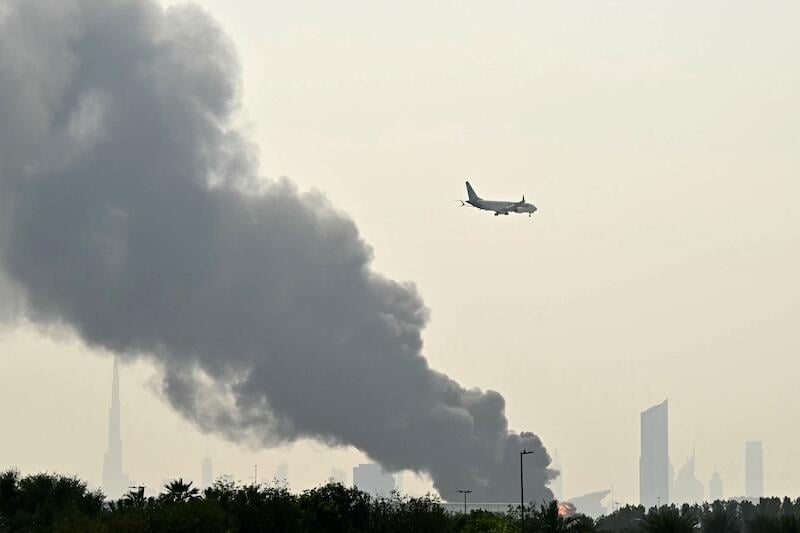
An Emirates aircraft flies near Dubai International Airport.
Airlines are continuing to implement short-term suspensions and capacity cuts in the Middle East as escalating conflict disrupts one of the industry’s most critical aviation corridors—although the impact is not yet reflected in published schedules.
For now, most carriers in the region are retaining planned capacity and operating flights where feasible, rather than making structural network adjustments. However, forward planning has slowed, with few new route announcements to the Middle East in recent weeks as airlines adopt a wait-and-see approach amid uncertainty over the duration of the disruption.
The effects have been most pronounced among Gulf carriers, whose hub-and-spoke models rely on stable regional operations and uninterrupted transfer flows. “We’re dealing with an immediate challenge where we’re talking about maybe half a million people a day going through these Gulf hubs, a large percentage of which are transferring,” said John Strickland, director at JLS Consulting, speaking on Aviation Week’s Window Seat podcast.
Qatar Airways says it will operate a more limited network between March 18 and March 28, maintaining service to a reduced list of destinations across Europe, Asia-Pacific and Africa, including London Heathrow, Paris, Bangkok and Tokyo Narita.
Emirates and Etihad Airways continue to operate reduced operations—although each is flying about 90% of its previously planned network as of March 18. Other regional airlines have faced even greater operational constraints. Bahrain’s airspace closure has forced Gulf Air to suspend normal operations at its home base, with the carrier temporarily operating a limited schedule from Dammam in Saudi Arabia.
Kuwait International Airport has also experienced operational disruptions, prompting Jazeera Airways to relocate services to Al Qaisumah in Saudi Arabia, with passengers transported by ground across the border. Kuwait Airways has also all but suspended operations.
Iran’s Mahan Air operated a Tehran-Shanghai Pudong service on March 18, Flightradar24 data shows, and has filed an adjusted interim schedule for March 20-28, including routes from Tehran Imam Khomeini to destinations such as Dubai, Istanbul and Shanghai, even as airspace restrictions remain in place.
European airlines are also responding with suspensions across key Middle Eastern markets. British Airways has extended the suspension of services to and from Amman, Bahrain, Dubai and Tel Aviv up to and including May 31. The carrier has also extended its suspension of service to Doha until April 30, and Abu Dhabi until the start of the winter season.
Lufthansa Group has similarly suspended multiple destinations, including Dubai, Abu Dhabi, Amman, Erbil and Beirut until March 28; Tel Aviv until April 2; and Tehran until April 30. KLM has extended the suspension of Riyadh, Dammam and Dubai until March 28.
Israeli flag carrier El Al has canceled a broad range of services between March 21 and March 27, including flights to major European gateways such as London, Paris, Frankfurt and Zurich, as well as several U.S. destinations, citing operational restrictions at Tel Aviv Ben Gurion Airport.
Elsewhere, Cathay Pacific has suspended Hong Kong-Riyadh service through the end of March, while Virgin Atlantic has withdrawn its London Heathrow-Dubai route for the remainder of the winter 2025-26 season.
At the same time, carriers are redeploying capacity to markets unaffected by the conflict, seeking to offset lost Middle East revenues while capturing displaced long-haul demand. Lufthansa Group says it will add frequencies in the “coming weeks,” including four additional Munich-Singapore rotations and increased Frankfurt-Cape Town service, while Austrian Airlines is boosting Vienna-Bangkok operations. Air France has also moved quickly to up-gauge and add frequencies from Paris Charles de Gaulle, scheduling additional flights to Bangkok, Singapore, Delhi, Mumbai and Nairobi across March.
Elsewhere, Air India says it will add 36 additional frequencies to Europe and North America between March 19 and March 28, representing more than 10,000 incremental seats across routes linking New Delhi and Mumbai with destinations including London Heathrow, Frankfurt, Zurich and Toronto Pearson.
The disruption highlights the extent to which global traffic flows have become dependent on Gulf hubs for east-west connectivity. “People have become used, particularly on east-west routings from Europe … to go via Gulf. It’s not a thought to consider maybe other ways,” Strickland said.
Despite the scale of disruption, longer-term structural changes remain uncertain. Airlines face significant operational and commercial constraints in redeploying aircraft, limiting how quickly networks can be reshaped. “You can’t easily redeploy them in terms of long-term planning,” Strickland said.
For now, the response remains short term, with airlines prioritizing flexibility over long-term network redesign. While demand is beginning to shift toward nonstop and alternative routings, the Gulf hub model is expected to remain resilient. “I would not believe that somehow these Gulf hubs are going to melt away,” Strickland said. However, much will depend on the duration of the conflict.

Related Content