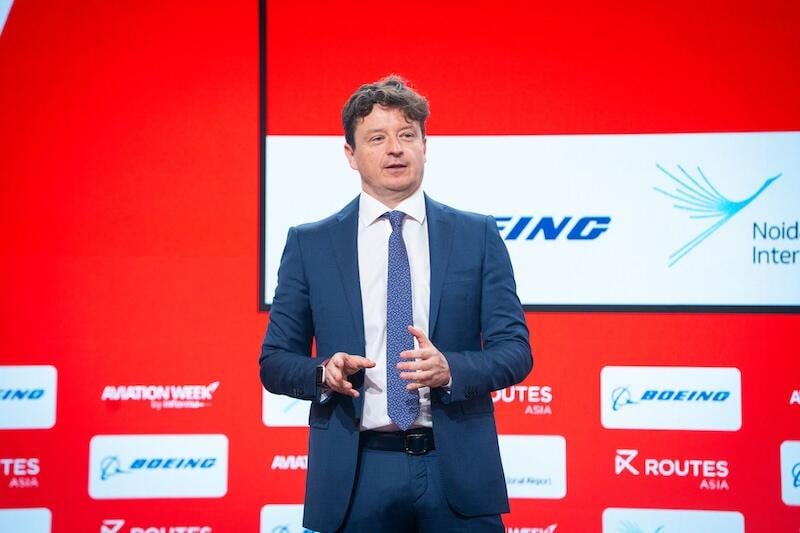
Stefano Baronci on stage at Routes Asia 2026.
XI'AN, China—Airports across Asia-Pacific and the Middle East are maintaining a cautious stance on potential fuel supply disruptions, according to ACI Asia-Pacific & Middle East Director General Stefano Baronci.
Speaking at Routes Asia 2026 in Xi’an, China, following recent warnings from ACI Europe about possible jet fuel shortages in Europe linked to the Middle East crisis, he said the situation across Asia-Pacific and the Middle East remains highly fragmented and does not yet warrant a unified policy response.
“We are monitoring the situation as we speak … but it doesn’t seem to be the case [that it is a problem],” Baronci told Routes, emphasizing that resilience differs significantly between markets.
“There are countries such as Korea, China and Japan that have a stronger resilience, because they have a bigger stockpile of fuel,” he said, while others like Vietnam may face constraints more quickly depending on the duration of disruption.
Unlike Europe, where airport and airline groups have called for coordinated intervention, Baronci said Asia-Pacific and Middle East stakeholders are not yet aligned on a single approach. “We cannot find the common denominator in our region to say we have one unique position, one message to address,” he said.
Despite the near-term uncertainty, Baronci stressed that the region’s long-term fundamentals remain intact, with Asia-Pacific continuing to dominate global aviation demand. “Asia-Pacific will continue to be the epicenter of global aviation,” he said.
More News And Analysis From Routes Asia 2026
The region already accounts for 37% of global passengers—around 3.6 billion travelers—and is projected to handle about 10 billion passengers annually by 2054, according to ACI data.
“Our industry has always gone through different kinds of challenges, and it has always emerged stronger, more resilient and more innovative,” Baronci said.
To accommodate long-term demand, airports across Asia-Pacific and the Middle East are ramping up infrastructure investment. ACI estimates that $240 billion will be invested over the next decade, including $136 billion in brownfield projects and $104 billion in greenfield developments.
At the same time, he highlighted structural challenges, including increasing congestion and outdated slot allocation systems. The number of coordinated, capacity-constrained airports globally has risen from 170 in 2015 to 215 in 2025, with Asia-Pacific now second only to Europe in terms of slot-controlled airports.
Baronci argued that reform is needed to ensure slot allocation evolves. While current rules provide stability, they risk limiting competition and efficiency if not updated to reflect changing demand patterns. “We have to think strategically … what is the best system for aviation in 20 years' time?” Baronci said.

Related Content