
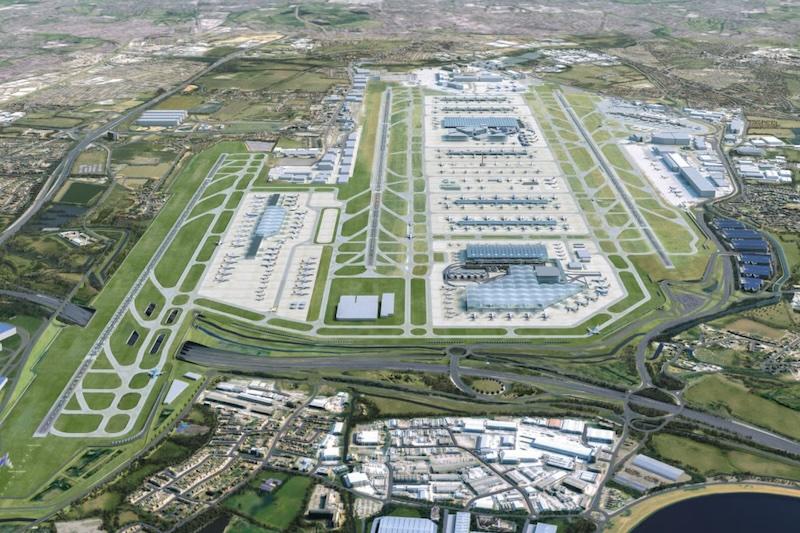
Heathrow plans to tunnel the M25 motorway so the new runway can be constructed above it.
The UK government has picked London Heathrow Airport’s in-house proposal as the scheme to steer long-stalled plans for a third runway, edging out the rival concept put forward by the Arora Group after months of technical scrutiny.
Transport Secretary Heidi Alexander says Heathrow’s 3,500-m (11,480-ft.) northwest runway design—requiring the relocation and tunneling of the M25 and costed at around £33 billion ($43 billion)—offers “the most credible and deliverable option” compared with hotelier Surinder Arora’s cheaper Heathrow West bid, which centered on a shorter runway that avoided building across the motorway.
The move marks the most substantive progress on Heathrow’s expansion since the UK’s Airports National Policy Statement (ANPS) was first approved in 2018, before legal challenges, evolving climate policy, political upheaval and the pandemic pushed the project into years of inactivity.
By designating Heathrow’s scheme as the basis for completing the refreshed ANPS, ministers have restarted a process they expect to complete by July 2026, paving the way for a development consent decision before the end of the current parliament. If consent is granted on that timeline, it is hoped the runway could be operational by 2035.
“Heathrow is our only hub airport which supports trade, tourism and hundreds of thousands of jobs, underpinning prosperity not only in the southeast [of England] but across the UK,” Alexander says. “We’re acting swiftly and decisively to get this project off the ground so we can realize its transformational potential for passengers, businesses and our economy sooner.”
In a written statement to the UK Parliament, Alexander says that after seeking further information from both finalists—Heathrow and Arora—the Transport Department judged Heathrow’s proposal to show greater operational and engineering maturity, particularly in its surface-access plans and long-term resilience.
Heathrow’s 3,500-m runway was assessed as offering better “future-proofing for next-generation aircraft” compared with Arora’s shorter 2,800-m concept. While both proposals would affect the M25, the government determined that Arora’s alternative would also create “considerable” impact on the motorway network, despite avoiding tunneling. Additionally, Heathrow’s scheme requires more land overall but fewer compulsory residential acquisitions.
Crucially, ministers judged Heathrow’s scheme more likely to meet the government’s ambition for a planning decision within the current parliament, which will run until July 2029 unless a general election is called before that date.
Overall, Heathrow says the new runway will increase capacity to 756,000 flights and 150 million passengers a year, up from about 84 million currently. The airport also intends to build a new terminal called T5X, alongside extending Terminal 2 and closing Terminal 3. The total cost of the work will be about £49 billion.
However, selecting Heathrow’s scheme as the basis for the ANPS review does not give the airport construction rights. Instead, it establishes the reference design for completing the policy framework. Once the revised ANPS is in place, any promoter, including Arora, will be entitled to submit its own development consent order (DCO) for a third runway.
With the policy work now restarting, attention is shifting to the regulatory environment, which will be central to determining whether expansion is financially viable. The UK Civil Aviation Authority (CAA) is developing a new regulatory approach for early cost recovery and assessing how expansion-related expenditure would be incorporated into Heathrow’s regulated asset base—decisions expected to have a significant bearing on airport charges and the scheme’s economic attractiveness. The Transport Department says it is working with the regulator to protect passengers’ interests and to ensure the framework “supports the timely and efficient financing of expansion.”
At the same time, ministers continue to stress that any scheme must satisfy the government’s four tests: economic growth, air quality, noise impact and full compliance with legally binding climate obligations. Alexander says she has written to the Climate Change Committee seeking advice on aviation’s contribution to future carbon budgets and on how the ANPS should be updated to reflect the UK’s current net zero legislation.
While designating Heathrow’s scheme offers long-awaited clarity, major hurdles remain. The refreshed ANPS must still clear consultation and parliamentary scrutiny, and any subsequent DCO will face its own evidential tests and potential legal challenges before construction can begin.

Related Content





Comments