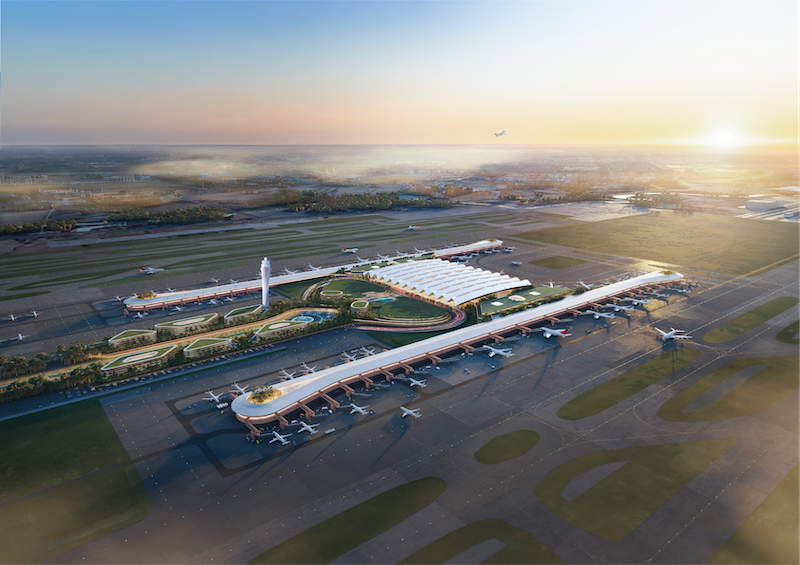
Gia Binh International Airport plans to build its cargo strategy around northern Vietnam’s expanding manufacturing base and a proposed 5,000-hectare (12,355-acre) free-trade zone near Hanoi.
The airport’s first phase is designed to handle 1.6 million metric tons of freight annually by 2030, rising to 2.5 million metric tons by 2050, according to official planning documents.
Rather than operate primarily as a passenger gateway, Gia Binh intends to combine cargo terminals, logistics facilities, industrial development and surface transport links within a wider airport economic zone.
“Air cargo is a pillar of [Gia Binh's] development model, not a supporting function,” Denis Bugrov, Masterise Aviation Infrastructure's deputy CEO, told Routes.
Gia Binh is located in the Bac Ninh-Bac Giang-Hai Phong manufacturing corridor, one of Vietnam’s largest centers for electronics, semiconductor components and high-value exports. Masterise estimates that industries in the corridor generated about $150 billion in electronics exports during 2025.
The developer argues that logistics infrastructure has not kept pace. Manufacturers in northern Vietnam currently rely on Hanoi Noi Bai International Airport, road transport to other domestic gateways or cross-border links into southern China.
More News And Analysis From Routes World 2026
“The current bottleneck is therefore infrastructure capacity, not market demand,” Bugrov said.
Plans for Gia Binh include an automated cargo terminal, consolidation and distribution facilities, an inland container depot, and road and rail links with Hanoi, Hai Phong’s seaport and northern border crossings.
The airport would form the aviation component of the proposed free-trade zone in Bac Ninh. The provincial People’s Council approved changes to its development plan in June, covering an area intended to combine manufacturing, logistics, commerce, services, innovation and digital industries. Further central-government approvals are required before the project can proceed fully.
Locating manufacturers, freight forwarders and logistics companies close to the airport could reduce handling stages and ground-transport times for high-value and time-sensitive goods. A further 1,000 hectares of high-tech industrial development is also envisaged around the site.
Masterise expects the wider zone to generate electronics, semiconductor, pharmaceutical, e-commerce and cold-chain traffic. It is seeking dedicated freighter operators, express logistics groups and passenger airlines able to provide bellyhold capacity.
Bugrov said the development team has held discussions with more than 30 airlines and about 40 express and logistics companies. Masterise has also signed memoranda of understanding with an international cargo-terminal operator and an integrated logistics company, although neither has been identified.
The cargo and passenger strategies are intended to support one another. High-yield freight carried in the bellyholds of long-haul passenger aircraft could improve route economics, while dedicated freighters could provide frequencies and destinations that passenger demand alone would not support.
That could be particularly important during Gia Binh’s early years, when local passenger traffic may not be sufficient to sustain an extensive intercontinental network. Electronics and other high-value exports could help underpin widebody routes linking northern Vietnam with major production, distribution and consumer markets.
The airport also wants to attract a global express or integrated logistics operator to establish a regional transfer facility. Masterise argues that Vietnam has yet to secure a dedicated hub from one of the largest international logistics groups despite rapid growth in manufacturing and e-commerce.
“The ultimate objective is to turn northern Vietnam’s manufacturing advantage into a global connectivity advantage—shortening the journey from factory to international market, strengthening the region’s logistics capability and positioning [Gia Binh] as an important link in Vietnam’s and the region’s aviation supply chain,” Bugrov said.

Related Content