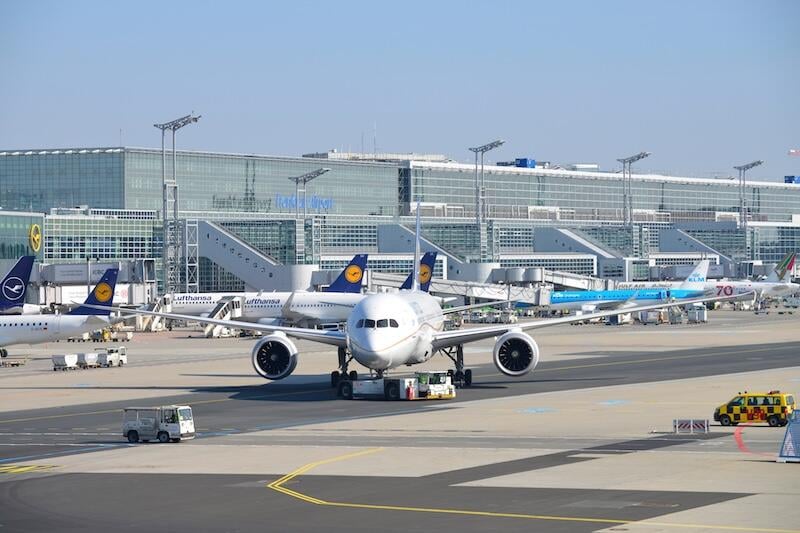
Frankfurt Airport (FRA) is targeting further long-haul growth across North America, Asia, Africa and Latin America as Fraport seeks to strengthen the airport’s role as a global connecting hub.
Fraport Chief Operating Officer Dietmar Focke said the airport will prioritize markets that combine local passenger demand, connecting traffic and cargo flows. Asia—including India—remains a particular focus, alongside North America and selected destinations in Africa and Latin America.
“Our priority is to develop routes where three factors reinforce one another: growing local demand, a strong fit with Frankfurt’s European feeder network, and meaningful cargo potential,” Focke told Routes.
Frankfurt’s route development proposition lies in its ability to combine several traffic segments. Approximately 49% of passengers transferred at the airport during 2025, while about half of Germany’s population lives within 200 km (124 mi.). Its high-speed rail connections extend that catchment farther into Germany and neighboring markets.
The airport also handled about 2.1 million metric tons of cargo during 2025, providing belly-freight demand that can strengthen the economics of long-haul passenger routes.
However, Frankfurt’s headline capacity has recently remained subdued. OAG Schedules Analyser data shows airlines offered approximately 25.54 million departure seats during summer 2026, broadly unchanged from the previous year, while departures declined 3.2% to about 130,500.
More News And Analysis From Routes World 2026
Lufthansa mainline capacity fell 3.9% to approximately 13 million seats, while Condor expanded 28.7% to 2.93 million. Lufthansa City Airlines provided about 500,900 seats after opening an operating base at FRA in February.
“Frankfurt will remain the central platform in Lufthansa Group’s network because it combines a large local market with extensive European feed, intercontinental connectivity, premium demand and cargo,” Focke said.
Fraport and Lufthansa are pursuing what Focke described as a shared “superconnector” ambition, focused on ground reliability, shorter connecting times and a more seamless transfer experience.
Frankfurt is also creating additional room for other network operators. Condor, its second-largest airline, is scheduled to move to Terminal 3 in summer 2027.
The €4 billion ($4.5 billion) terminal began operating April 23 and initially provides capacity for as many as 19 million passengers annually. A future expansion could raise that to 25 million. Its infrastructure includes 24 aircraft parking positions adjacent to the terminal, 14 bus gates and a Sky Line transit system connecting all three terminals and the airport’s rail links.
“The result is not simply more space, but scalable capacity, stronger connectivity and a more resilient operating platform,” Focke said.
Recent growth on routes to Bangkok, Johannesburg and Almaty illustrates the range of opportunities. Condor increased Frankfurt-Bangkok capacity by about 38.7% during summer 2026 and expanded Johannesburg seats by approximately 30.6%, while Air Astana added around 30.2% more capacity from Almaty.
“We do not work from a generic wish list,” Focke said. “For each opportunity, we assess the addressable local market, connection quality, seasonality, premium demand, cargo flows, aircraft economics and the airline’s network strategy.”

Related Content