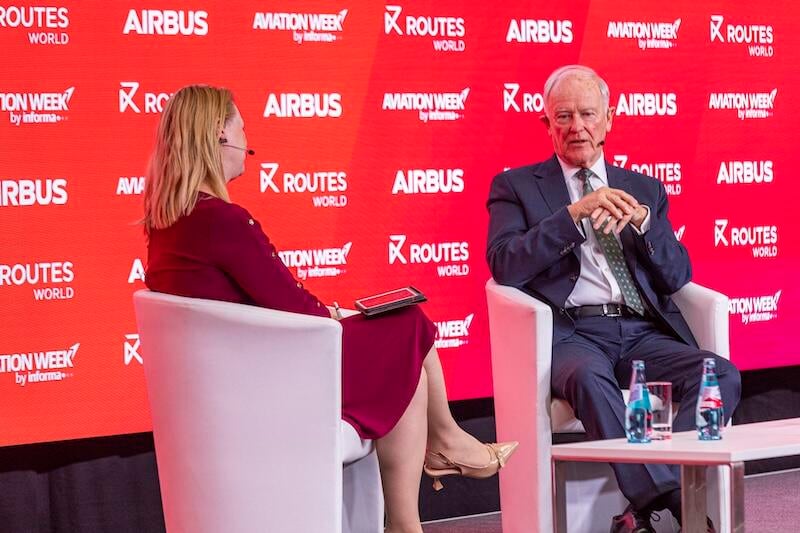
Emirates Airline President Tim Clark speaks onstage at Routes World 2026 in Frankfurt.
“If you imagine entering that airport curbside, there is no check-in, there is no central search, there is no immigration. You just keep walking.”
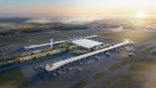
That is how Emirates Airline President Tim Clark envisions the passenger experience at Dubai’s planned Al Maktoum International Airport. Also known as Dubai World Central (DWC), the $35 billion development is ultimately expected to have five runways, 400 gates and capacity for 260 million passengers annually by the 2050s.
Speaking at Routes World 2026 in Frankfurt, Clark offered a glimpse of the project’s scale and ambition. He expects the new airport to open in 2031 or 2032, with capacity approaching 165 million passengers annually.
That would exceed the current traffic of any airport in the world, including Atlanta, which handled about 106.3 million passengers in 2025, and Dubai International Airport (DXB), which processed a record 95.2 million.
DWC will cover about 27 mi.2, five times the footprint of DXB, providing expansion space that is increasingly difficult to find at Dubai’s constrained existing hub. It will also be considerably larger than Istanbul Airport, which began operations in 2018 and is designed eventually to accommodate 200 million passengers annually.
Operating DXB near saturation has shaped the thinking behind its successor, Clark said.
“What has happened in Dubai over the last 20 years, the compression that has forced into the airport,” he said, describing the challenge of handling growing numbers of passengers, aircraft and bags within a tightly constrained site. “It’s become a Herculean task to deal with the footfall above wing and the baggage below the cargo in that compressed bit of real estate.”
DXB’s two runways and limited room for further terminal expansion have forced Emirates and its airport partners to find increasingly sophisticated ways of accommodating rising traffic within the available space.
Dubai has had DWC on its drawing board for two decades. Construction began in 2006, cargo operations started in 2010 and limited passenger flights followed in 2013.
The project’s development was subsequently delayed and remained relatively modest while Dubai concentrated on expanding DXB. However, a major plan approved in 2024 revived the vision of a vast new aviation complex.
The completed airport is expected to include five parallel runways, four satellite concourses and extensive automated transport and baggage systems. Emirates and FlyDubai will eventually transfer their operations, while DXB is expected to close.
More News And Analysis From Routes World 2026
The challenge, Clark said, is making an airport of such extraordinary size feel manageable for passengers. Emirates is planning 193 “contact gates” in the initial major configuration, with the potential for all of them to be occupied during peak connecting periods.
“If you imagine the footfall, people crossing the hub at that point in time,” he said, the scale of the movement between aircraft, terminals and baggage facilities becomes apparent.
“We’ve had to map the footfall of a passenger who has to traverse that particular vast part using the various mobility platforms. That could be rail, it could be cars, whatever it may be. And that has been modeled to the nth degree to make sure we get that absolutely right.”
Emirates nevertheless intends to preserve a minimum connecting time of approximately 1 hr. 15 min., despite the distances passengers and bags will need to cover.
“Which is tight for that scale. But everything is designed to do that,” Clark said.
The airport’s transport and baggage systems are being planned around the intense arrival and departure banks that characterize Emirates’ operations, rather than expecting passengers to navigate vast distances unaided. The challenge is particularly significant given the airline’s reliance on large widebody aircraft, which can generate substantial passenger flows within a short period.
The most radical element of Clark’s vision is the possibility of dispensing with many of the formalities that define airport travel today. He said biometric identification, automated screening and other technologies could eventually make conventional check-in counters, immigration queues and centralized security checkpoints largely unnecessary.
“I don’t see central search being an inhibitor because it’ll look at you, it’ll know you and you’ll just keep walking,” he said.
Dubai already uses smart gates and biometric passenger processing, but Clark envisions a more integrated system that would allow travelers to move through the airport with minimal interruption.
He suggested the benefits would extend beyond convenience to airport concessionaires. Removing queues and other bottlenecks could give passengers more time to spend in shops and restaurants, potentially increasing commercial revenue.
“And what does that do? For all the shopkeepers and fast food [restaurants], the dwell time increases. The pockets are emptied because everybody’s hungry when they travel,” Clark said. The aim, he said, is to make traveling through DWC “something to look forward to.”

Related Content