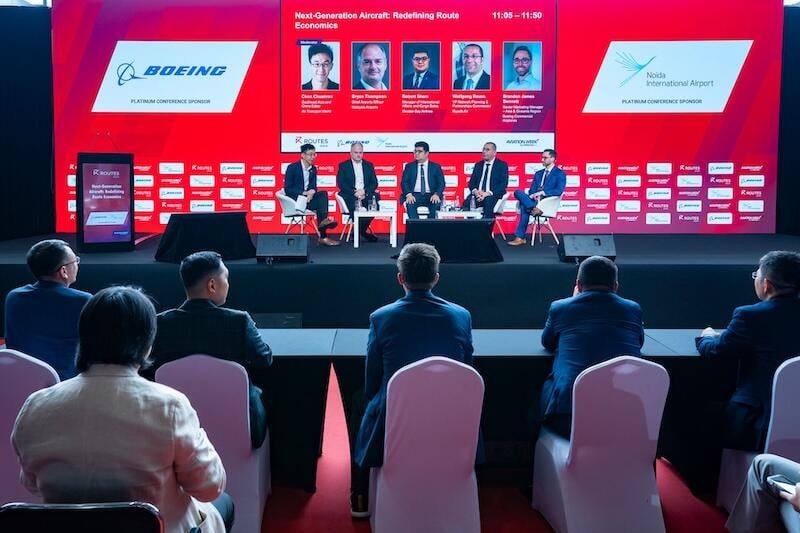
Panelists on stage at Routes Asia 2026 in Xi'An, China.
XI’AN, China—Airlines are increasingly relying on new-generation aircraft to sustain marginal routes as costs and operational constraints intensify, delegates have been told at Routes Asia 2026.
Panelists said that while demand across Asia-Pacific remains strong, rising fuel costs and challenging operating environments are forcing airlines to be more selective in how they deploy capacity. As such, aircraft capability is becoming central to determining which routes can be maintained or expanded.
Brandon Bennett, senior marketing manager for Asia and Oceania at Boeing, said recent developments are focused on extending range and improving economics to support more flexible network planning. “We just had the 787 … achieve certification on improved capability, which adds 400 nm more range, helping airlines take more passengers and cargo or open new, longer, thinner routes,” he said.
Boeing in March secured approval for an increased maximum takeoff weight upgrade for the 787, allowing the -9 and -10 variants to carry additional payload or extend range. Similar gains in capability are also being seen in the narrowbody segment.
More News And Analysis From Routes Asia 2026
At Hong Kong-based Greater Bay Airlines, the introduction of the 737-9, compared with the 737-800, has improved both revenue potential and operational resilience, particularly on routes affected by strong seasonal winds. “The first thing … is the additional seats,” said Robert Sham, manager of international affairs and cargo sales, noting that it has enabled the carrier to add a premium economy cabin. “That goes up in terms of revenue … and the second part is basically the reduction of cost.”
He said fuel savings have been critical on Japan routes, where winter jet streams can significantly extend flight times. “Operating flights to Japan … especially in winter, is very harsh because of the jet stream … sometimes the wind speed can go up to 200 kt.,” Sham said. “That poses an extra 1 to 2 hr. of flight time. With the MAX 9 introduction, that literally extended our lifeline and helped us to be able to launch routes to destinations like Sapporo.”
For startup carriers, aircraft selection is closely tied to network viability from the outset. Wolfgang Reuss, vice president of network planning and partnerships at Riyadh Air, said the airline modeled its network before selecting aircraft capable of delivering it under demanding conditions.
“We have some very hot temperatures in peak summer … and that combined with air pressure [creates] quite challenging takeoff conditions,” he said. Those constraints mean aircraft performance is critical not only for efficiency, but for ensuring routes can be operated reliably.

Related Content