This article is published in Aviation Week & Space Technology and is free to read until Nov 25, 2026. If you want to read more articles from this publication, please click the link to subscribe.
Scale Advantages Beckon As Korean Air-Asiana Merger Nears Completion
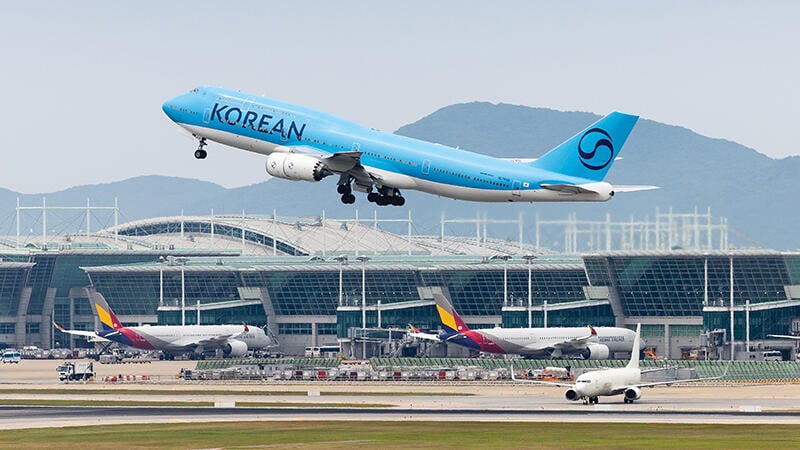
The main hubs of both Korean Air and Asiana Airlines are situated at Seoul Incheon International Airport.
Six years after it was first proposed, Korean Air’s merger with former rival Asiana Airlines is finally approaching the finish line.
The two carriers are due to combine under the same air operator certificate (AOC) on Dec. 17. The deal’s wide-reaching ramifications will not only reshape the South Korean aviation market but also transform Korean Air into a far stronger competitor on the global stage.
The South Korean government helped initiate the merger process in November 2020, viewing it as the best way to preserve jobs and services following the financial collapse of Asiana.
- CEO Cho aims to streamline the combined fleet
- Competition regulations have boosted growth of other airlines
Despite this state involvement, Korean Air still had to navigate multiple regulatory processes in South Korea and in several other countries served by both carriers. Gaining approvals from overseas competition authorities turned into a marathon as regulators proposed considerable concessions before signing off on the deal.
Walter Cho, chairman and CEO of Korean Air and parent Hanjin Group, said he initially thought it would take six months to gain the necessary approvals. But Korean and Asiana had such strong positions in many important passenger and cargo markets that concerns arose about reduced competition.
The process took so long that Cho began to question if the merger was worth it. “At one point, I almost gave up and [thought] maybe it’s not going to work, . . . maybe I should just concentrate on growing Korean Air by itself,” he said during an onstage interview with Aviation Week at the CAPA Airline Leader Summit – Asia event in Chitose, Japan, on Oct. 2.
However, after three years of work on the project, Cho decided that he and the Korean Air team “had spent too much time and effort to just throw it away. . . . So I said, ‘OK, last push, [let’s] try it again.’ ”
Korean Air needed to gain clearance from aviation regulators in 14 jurisdictions, including the U.S. and European Union. The final overseas approvals were granted in December 2024, and since then, the carriers have been working on the more technical aspects of the merger.
“Some [competition approvals] came very easily, but there were a few that were very challenging, and we didn’t get the sense that we’d get it done until the last minute,” Cho said. “We had many negotiations . . . many discussions with [regulators], but we got it done. And it was very satisfying in the end.”

Among the most major competition concessions were the surrender of slots to other airlines on certain routes where Korean Air and Asiana were particularly dominant. Korean even had to lease aircraft to some smaller players so they could operate the international routes.
But the most notable requirement was for Asiana to split off and sell its freighter operation—including staff and aircraft. Air Incheon was selected as the purchaser, and the deal was completed in August 2025 with the transfer of 11 freighters. Air Incheon has since changed its name to AirZeta.
“At that time, it was painful” to cede the routes and particularly the Asiana freighter business, Cho said. However, “it was worthwhile because with that small sacrifice, we’re gaining a lot more,” he added.
One of the main benefits will be scale. Korean Air was the 20th-largest full-service carrier in 2025 based on annual international seats, and Asiana was 34th, according to data from CAPA – Centre for Aviation and OAG. Combined, they would be the 10th-largest globally and the largest in the Asia-Pacific region, just ahead of Cathay Pacific.
“Larger scale in the operation will bring more efficiency to the company and also for customers,” Cho said. “We will grow our network by over 50% with the merger, and we’ll provide better customer service and better frequency and schedule.”
The broader international network will increase connecting options, in turn strengthening the standing of Seoul Incheon International Airport as a connecting hub.
Korean Air finalized the financial acquisition of Asiana in December 2024, but Asiana has remained a separate operation under its own AOC as a subsidiary. While considerable merger preparation has been possible, some of the necessary realignment will occur after the airlines are under the same AOC.
Cho noted that Korean Air and Asiana have been competing in South Korea and in many of the same overseas markets for decades. This has resulted in very similar schedules in certain markets, with flights to the same destinations sometimes departing within 10 min. of each other, Cho said. The merger will allow Korean to optimize the combined schedule.
Korean’s fleet and orderbook also is expected to grow dramatically. The carrier has a fleet of 169 aircraft and 212 more on order, while Asiana has 67 aircraft and orders for 27.
Merging these two large fleets brings its own challenges, however. Cho said the combined fleet is “way too complex,” so the airline is looking to restructure and simplify.
One of the first priorities will be phasing out the 11 Airbus A380s operated by Korean Air and Asiana and the remaining four passenger Boeing 747-8s operated by Korean. These will be retired “over the next two years or so,” Cho said. The Airbus A350-1000s that Korean has on order are the likely replacements for the A380s.
The 30 Airbus A330s operated by Korean and Asiana as well as the 11 A320ceo-family aircraft in the Asiana fleet also will be phased out over the next 3-4 years, Cho said. The A330s are to be replaced by Boeing 787s.
Korean Air will be introducing newer aircraft types that will improve its efficiency and cabin product, which will boost its competitiveness, Cho said.
The carrier’s post-merger fleet plans took a step forward with a new order for 103 Boeing aircraft that was confirmed in September. This added to existing orders for Boeing and Airbus aircraft. The order comprised 20 Boeing 777-9s, 25 787-10s, 50 737-10s and eight 777-8F freighters.
Korean Air tells Aviation Week that deliveries from the latest order are scheduled to begin in the early 2030s. The aircraft “will support long-term growth following the integration [with Asiana] while replacing aging passenger and freighter airframes,” a spokesperson says.
The carrier already had orders for all of these types except the 777-8Fs, which will be new to the airline and will help Korean Air make up for the loss of the Asiana freighter fleet. “I wish I could get those [777-8Fs] right now because we’re short of freighters, and the cargo market is extremely strong,” Cho said.
Korean also has seven A350Fs on order to help grow its freighter fleet. These were converted from passenger A350 orders in October 2025 following Korean’s deal for 33 A350s signed in 2024.
Establishing formulas to combine pilot seniority lists and frequent-flyer mileage programs are always challenging in large airline mergers, and this has proven true for the Korean Air-Asiana linkup.
Korean submitted an initial plan for combining the mileage programs to the Korea Fair Trade Commission in June 2025, but it had to make revisions to protect the rights of Asiana program members better. The airline resubmitted the plan in September 2025, and the commission granted final approval in September 2026. The plan includes mechanisms for converting Asiana miles into Korean Air’s loyalty program, commitments to maintain award seats at certain levels and a new elite loyalty tier to match the Asiana program.
The pilot seniority list merger has been more contentious. There are notable differences in the systems used by Korean Air and Asiana, and the Korean Air pilots’ union and the airline disagree over whether this should be settled through collective bargaining or by the company.
Merging the two airlines’ safety management systems has been a massive undertaking, affecting several different departments within the carriers (AW&ST July 13-26, p. 88). This is not just about bringing Asiana’s operations under the Korean Air system—in some cases, the combined carrier will adopt Asiana’s practices. Oversight teams, reviews and audits will help to ensure safety functions are aligned and no gaps occur as a result of the merger.
Korean Air has launched a revamp of its brand and corporate image in preparation for its expansion on the world stage. One component of this is a new livery for its aircraft. Korean has begun repainting its own fleet and intends to repaint the Asiana fleet after the merger is completed.
Combining with Asiana Airlines will increase Korean Air’s dominance in the South Korean market. Korean Air has a 20.5% share of the country’s system seat capacity, and Asiana has 12.4%, according to data from CAPA and OAG for the week of Oct. 12. Together, they account for about a third of system capacity—and nearly half when including their low-cost carrier (LCC) subsidiaries.
In terms of South Korea’s international capacity—including overseas and local carriers—Korean Air and Asiana combined would have a share of 31% of weekly seats and 42.5% with their subsidiaries. They would have a 37% share of domestic capacity, increasing to 63% when including their LCCs.
Jin Air is Korean Air’s LCC subsidiary. The parent plans to absorb the two Asiana LCCs—Air Busan and Air Seoul—into Jin Air; the process is due to be finalized in March. This would make Jin Air the largest South Korean LCC, overtaking current leader Jeju Air.
The LCC fleets differ more than those of the parent airlines. Jin Air has an all-Boeing fleet comprising 22 737NGs, seven 737-8s and three 777-200ER widebodies. In contrast, the Asiana LCCs are all-Airbus: Air Busan operates five A320s, eight A321s and eight A321neos, and Air Seoul has six A321s.
The Korean Air-Asiana merger also has created major ramifications for carriers outside the two groups. The competition remedies stipulated by regulators resulted in routes being opened to smaller South Korean airlines, presenting them with rare opportunities to expand into new international markets. Instead of facing opposition from the two major carriers, the new entrants received support to establish these routes.
This has resulted in the rise of new international competitors for Korean Air as Asiana disappears. Cho noted that some smaller airlines gained slots and routes to Europe and North America from Korean Air, and he said he hopes they do well with these. “I think they’ll make us a better carrier. . . . Competition doesn’t diminish us; it makes us stronger.”
Major beneficiaries of this process were T’Way Air, which started operations to Europe, and Air Premia, which expanded its U.S. operations.
One of the requirements for European Commission approval was that Korean support the market entry of another airline on key routes between South Korea and Barcelona, Spain; Frankfurt; Paris; and Rome. Korean Air designated T’Way Air as the remedy carrier and provided operational support including aircraft, crew and maintenance services for T’Way on these routes.
This boosted T’Way from being primarily a narrowbody LCC on short-haul routes to a carrier offering European service on widebodies. Korean Air leased five A330s to T’Way in 2024, lifting its total fleet to 11 A330s, two 777-300ERs and 38 Boeing narrowbodies. T’Way changed its name to Trinity Airways in September.
Air Premia was named as the remedy carrier on U.S. routes. As part of the competition concessions, Korean Air leased four 787-9s to the airline to allow it to boost U.S. capacity and agreed to interline with Air Premia to help feed its long-haul routes.
The additional 787s helped Air Premia ramp up its capacity in the second and fourth quarters of 2025. It is now operating 72% more capacity than it was at the start of 2025.
Air Premia’s capacity share on key U.S. routes has been rising steadily, and it now accounts for 21% of weekly capacity between Seoul and Los Angeles. The carrier also flies to Honolulu, San Francisco and New York in the U.S. and launched flights to Washington in April.
Despite the initial support, the fuel-cost crisis is making it difficult for the two smaller airlines to reap the benefits of the new routes. For example, Trinity has trimmed capacity in some markets and plans to suspend its Frankfurt route in October.
On the domestic front, Korean and Asiana had to transfer slots to local carriers on the key Seoul-Jeju route, which is the world’s busiest in terms of capacity. However, some of these airlines have not yet taken up the slots due to higher fuel costs, leading to an overall capacity decline.
While the full effects of the Korean Air-Asiana combination are still emerging, it is already evident that the consolidation has enabled overall growth for other players in the South Korean market. But it is Korean Air’s trajectory change that is the most significant.
“I believe it’s a new chapter for the airline, . . . and we have so many things to achieve from now,” Cho said. “There’s many challenges in front of us, but I’m very excited to see what comes next.”

Related Content